
5.2 Roadmap (Summarized Short Version)
Our starting point
The DUAL.AI.TEACHer project aims to develop a clear and adaptable roadmap of seven to ten stages that helps teacher education institutions embed AI into both initial teacher education and continuing professional development. The roadmap focuses on institutional change rather than individual initiatives and was developed together with teacher educators.
Two existing models provided particularly relevant foundations.
The first is a six-stage higher education model, summarized as “learning to learn again”. It moves from reframing institutional conversations about AI through trust and governance, staff fluency, curriculum change and the redesign of teaching and assessment, towards institution-wide amplification (Black, 2025). Its main strength is that it treats AI as a driver of institutional transformation rather than simply a tooling question.
The second is a four-phase GenAI implementation roadmap for schools and districts: establish a foundation, develop staff, update what is taught, and assess and progress. Its strength is its operational focus and emphasis on concrete implementation.
Neither model, however, fully addresses teacher education institutions. These institutions must transform their own teaching while simultaneously preparing future teachers for contexts beyond their direct control. Focusing only on internal transformation risks producing AI-related curricula delivered by staff with limited practical experience. Focusing only on future classroom practice risks modernizing teacher education without changing the institution itself. The DUAL.AI.TEACHer roadmap therefore connects both dimensions.
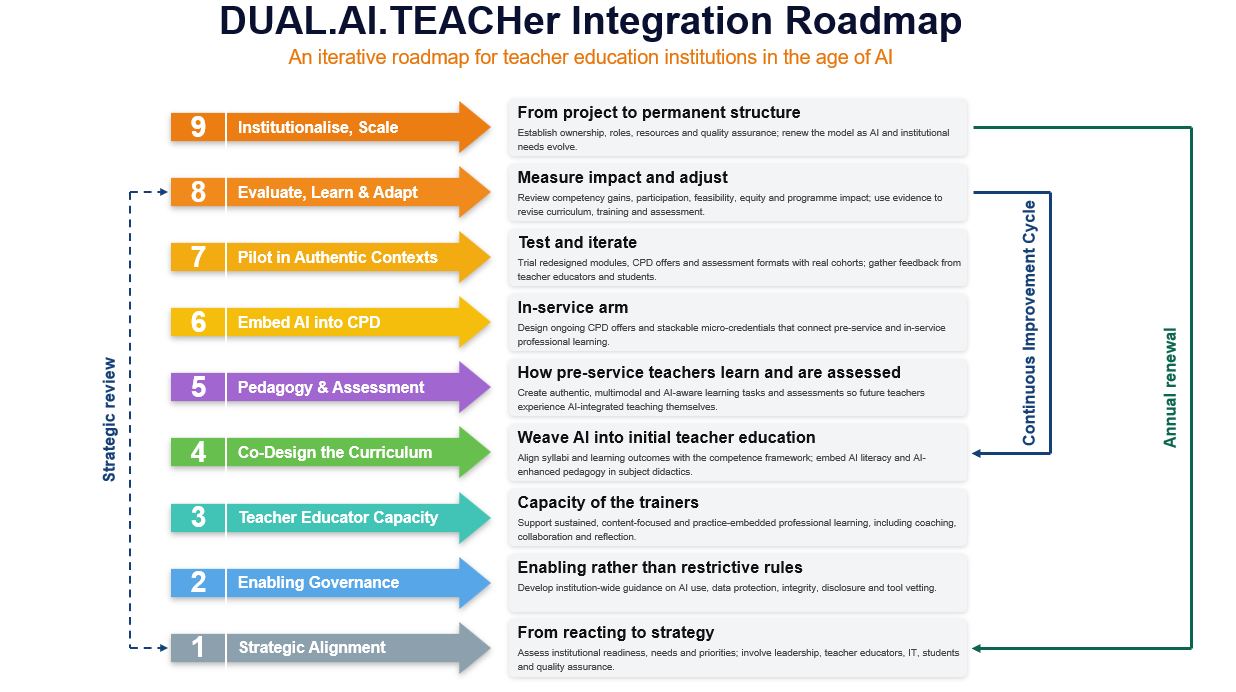
Figure 1. DUAL.AI.TEACHer Integration Roadmap: Nine stages for the institutional integration of AI in teacher education.
Two axes beneath the stages
Rather than combining the two reference models step by step, the roadmap is built around two parallel axes.
The first is institutional transformation: structures, governance, curriculum and the formal conditions that enable or constrain AI use. This axis follows the reframe-to-amplify logic of the higher education model and is informed by established research. Diffusion of Innovations identifies trialability and observability as characteristics that facilitate innovation adoption, informing the emphasis in Stage 7 on visible pilot implementation (Neal et al., 2018).
The second is human capacity, which serves as the quality axis of the roadmap. Training cannot be reduced to isolated workshops. Research on effective teacher professional development highlights sustained duration, content focus, practice, reflection, feedback and coaching (Lipowsky & Rzejak, 2021). These principles therefore inform the design of training activities throughout the roadmap, from teacher educators in Stage 3 to in-service teachers in Stage 6. A one-off workshop alone does not constitute completion of a stage.
AI for Education. (n.d.). AI adoption roadmap for education institutions.
Black, A. (2025, December 3). Learning to learn again: A roadmap for higher education institutions in the age of AI. enablinginsights.
Lipowsky, F., & Rzejak, D. (2021). Fortbildungen für Lehrpersonen wirksam gestalten: Ein praxisorientierter und forschungsgestützter Leitfaden. Bertelsmann Stiftung.
Neal, J. W., Neal, Z. P., Lawlor, J. A., Mills, K. J., & McAlindon, K. (2018). What makes research useful for public school educators? Administration and Policy in Mental Health and Mental Health Services Research, 45(3), 432–446.