
5.2 Roadmap (Summarized Short Version)
Our starting point
The DUAL.AI.TEACHer project aims to develop a clear and adaptable roadmap of seven to ten stages that helps teacher education institutions embed AI into both initial teacher education and continuing professional development. The roadmap focuses on institutional change rather than individual initiatives and was developed together with teacher educators.
Two existing models provided particularly relevant foundations.
The first is a six-stage higher education model, summarized as “learning to learn again”. It moves from reframing institutional conversations about AI through trust and governance, staff fluency, curriculum change and the redesign of teaching and assessment, towards institution-wide amplification (Black, 2025). Its main strength is that it treats AI as a driver of institutional transformation rather than simply a tooling question.
The second is a four-phase GenAI implementation roadmap for schools and districts: establish a foundation, develop staff, update what is taught, and assess and progress. Its strength is its operational focus and emphasis on concrete implementation.
Both models do what they set out to do: one addresses universities as a whole, the other schools and districts. Teacher education institutions sit across both settings, and this is where we saw room to extend the existing work. These institutions transform their own teaching while simultaneously preparing future teachers for contexts beyond their direct control. Attending to internal transformation alone would leave AI-related curricula to be delivered by staff with limited practical experience, while attending to future classroom practice alone would modernize the programme without changing the institution that delivers it. The DUAL.AI.TEACHer roadmap builds on both models and connects the two dimensions.
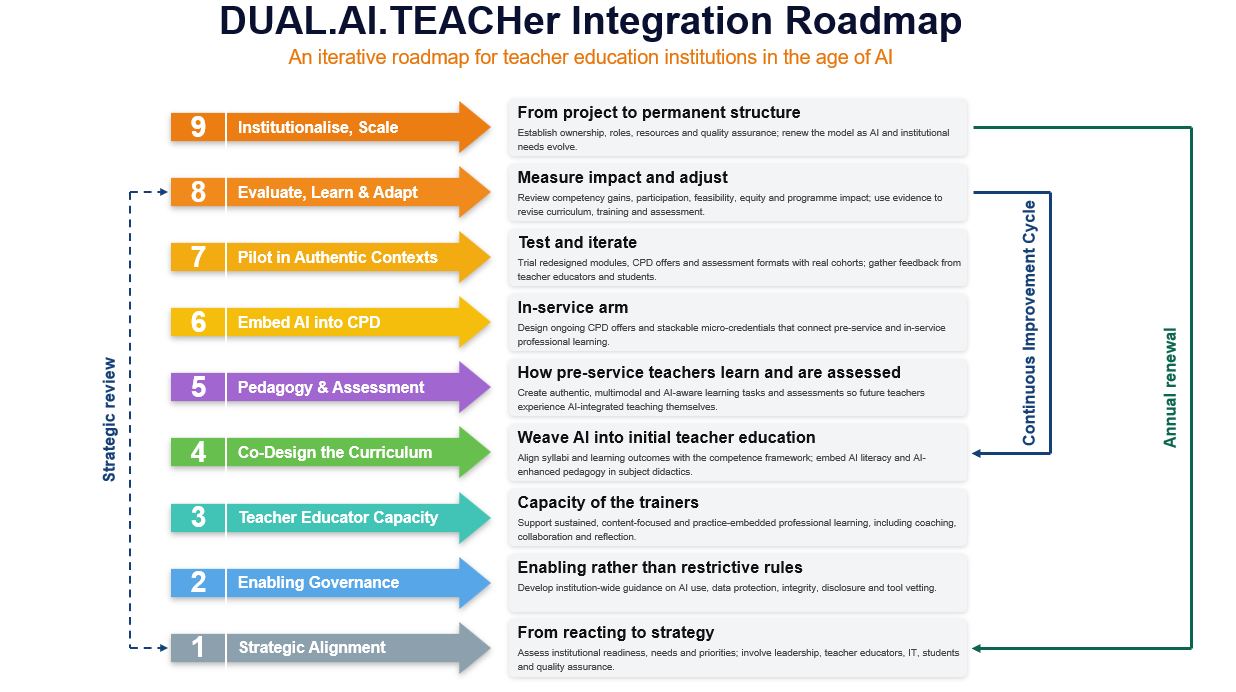
Figure 1. DUAL.AI.TEACHer Integration Roadmap: Nine stages for the institutional integration of AI in teacher education.
Two axes beneath the stages
Rather than combining the two reference models step by step, the roadmap is built around two parallel axes.
The first is institutional transformation: structures, governance, curriculum and the formal conditions that enable or constrain AI use. This axis follows the reframe-to-amplify logic of the higher education model and is informed by established research. Diffusion of Innovations identifies trialability and observability as characteristics that facilitate innovation adoption, informing the emphasis in Stage 7 on visible pilot implementation (Neal et al., 2018).
The second is human capacity, which serves as the quality axis of the roadmap. Training cannot be reduced to isolated workshops. Research on effective teacher professional development highlights sustained duration, content focus, practice, reflection, feedback and coaching (Lipowsky & Rzejak, 2021). These principles therefore inform the design of training activities throughout the roadmap, from teacher educators in Stage 3 to in-service teachers in Stage 6. A one-off workshop alone does not constitute completion of a stage.
The Roadmap Cheatsheet
| Stage | Task | Done when |
| Strategic Alignment | Assess where the institution actually stands and agree what it wants to achieve, with leadership involved and a cross-functional team in place. | The starting position and the goal exist in writing. |
| Enabling Governance | Put institution-wide guidance in place on AI use, data protection, integrity, disclosure and tool vetting, framed around what is possible rather than what is banned. | Staff can answer "am I allowed to do this?" without asking anyone. |
| Teacher Educator Capacity | Build the capacity of those who teach, through sustained, content-focused, practice-embedded professional learning with coaching and reflection. | Development is ongoing, not only a single workshop. |
| Co-Design the Curriculum | Move AI into the formal programme by revising syllabi and learning outcomes, anchored in subject didactics rather than in a standalone module. | AI-related outcomes appear in the regular module documentation of several subjects. |
| Pedagogy & Assessment | Redesign learning tasks and assessment to be authentic and AI-aware, and model AI-integrated teaching so students experience it as learners. | Assessment formats have been revised, not just supplemented by a declaration of AI use. |
| Embed AI into CPD | Turn continuing professional development into a structured offer with stackable micro-credentials, securing the in-service arm. | Provision has a published structure and a recognised credential. |
| Pilot in Authentic Contexts | Trial the redesigned modules, CPD and assessments with real cohorts and gather feedback systematically. | Documented feedback exists and has led to identifiable revisions. |
| Evaluate, Learn & Adapt | Review competency gains, participation, feasibility, equity and impact, and use the evidence to revise. | Evidence has changed something, not just filled a report. |
|
Institutionalise, Scale |
Convert the initiative into permanent structure: ownership, roles, resources, quality assurance, renewal. | The work continues after the people who started it have moved on. |
AI for Education. (n.d.). AI adoption roadmap for education institutions.
Black, A. (2025, December 3). Learning to learn again: A roadmap for higher education institutions in the age of AI. enablinginsights.
Lipowsky, F., & Rzejak, D. (2021). Fortbildungen für Lehrpersonen wirksam gestalten: Ein praxisorientierter und forschungsgestützter Leitfaden. Bertelsmann Stiftung.
Neal, J. W., Neal, Z. P., Lawlor, J. A., Mills, K. J., & McAlindon, K. (2018). What makes research useful for public school educators? Administration and Policy in Mental Health and Mental Health Services Research, 45(3), 432–446.
No comments to display
No comments to display