
5.4 Roadmap (Extended Full Version)
Who this section is for
SchoolDeans, leaders,programme deputydirectors, headsteacher educators and those responsible for professionalquality developmentassurance in ainstitutions school.that prepare teachers. YouThis doroadmap notwas needwritten toprimarily havefor readyou, theand precedingthis sectionssection in full. Ifassumes you have read the nine stages in 5.2,1. thisUnlike sectionschool tells you how they apply to a school; if you have not, you can start here.
Where schools enter the roadmap. This roadmap was developed for teacher education institutions, but its change logic is not specific to them, and one stage concerns schools directly. Stage 6, Embed AI into CPD, is the in-service arm: it is wherereaders, teacher education institutions organiseneed to consider the continuingroadmap professionalas developmenta whole, because the stages address different parts of institutional change that your staff attend. That is your entry point. What your institution offers as Stage 6 arrives in your school as professional development, and whether it changes anything in your classrooms dependsdepend on conditionsone within that school. another.
Why you cannot start there and stop. Sending staff to a one-off course is the most common approach and at the same time unlikely to change practice on its own. What works is sustained engagement with a content focus, opportunity to practise, and follow-up in the form of coaching or collaboration (Lipowsky & Rzejak, 2021). This has a direct consequence for a school leader. The scarce resource is not the course; it is the protected time afterwards in which teachers try something, discuss it with colleagues and adjust.
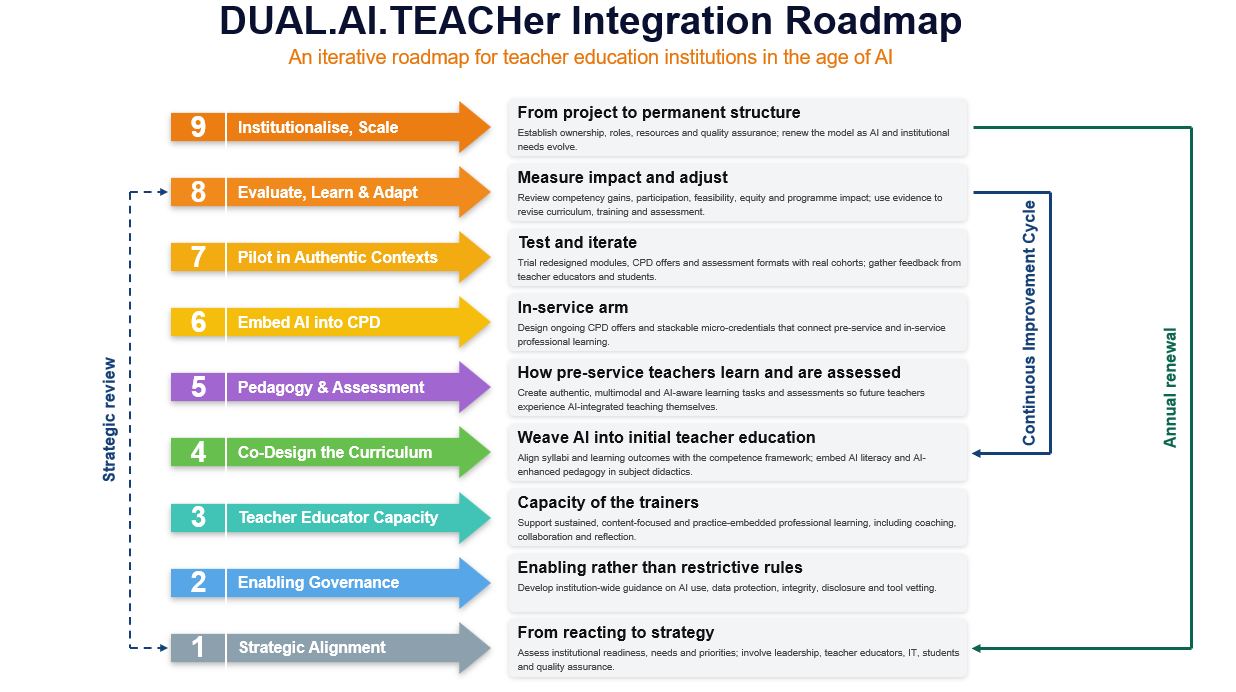
Figure 1. DUAL.AI.TEACHer Integration Roadmap: Nine stages for the institutional integration of AI in teacher education.
Your specific position
Teacher
educationinstitutions carry two mandates at once. You transform your own teaching, and you prepare future teachers for classrooms you do not control, under conditions you cannot fully predict, using technology that may have changed by the time your graduates arrive there. The threetwo stagesmandates are closely connected. Focusing only on internal transformation risks producing AI-related curricula without sufficient connection to prioritisefuture atclassroom schoolpractice. level
Focusing only on future classroom practice risks modernising the programme without changing the institution that delivers it. The roadmap therefore treats both dimensions together.
Stage 3 enables what follows. Much of the later work depends on the capacity of teacher educators. Their expertise lies in their disciplines and subject didactics, so integrating AI is not simply a matter of adding another tool. Professional development needs to connect AI use to subject-specific teaching, learning and assessment rather than treating it as a generic technical competence. For this reason, Stage 3 deserves particular focus when resources are limited.
Where Stage 4 becomes difficult. The principle that AI literacy should be embedded within subject didactics rather than treated only in a standalone module is easy to state but a lot harder to implement. A standalone module can be assigned to one person, while distributed integration requires many colleagues to reconsider parts of their own teaching. Where a standalone module is useful as a transitional step, it should ideally be connected to a longer-term plan for integration across the programme.
Your distinctive lever. Stage 5 highlights a particular feature of teacher education: your students are learners now and teachers later. How you teach them therefore becomes part of what they learn about teaching. If pre-service teachers experience thoughtful, AI-integrated teaching as learners, they encounter concrete models they can later reflect on and adapt in their own practice. Teaching about AI without modelling its pedagogical use provides a very different experience. This is why Stage 5 goes beyond assessment reform alone.
Stage 6 is your connectioninterface point,with schools. Your continuing professional development provision is the entry point. It extends your institution's reach beyond future teachers to those who are already working in classrooms. At the same time, collaboration with in-service teachers can bring current classroom experience back into teacher education. CPD can therefore function not only as a service provided to schools, but also as a channel for reciprocal learning between schools and teacher education institutions.
What you can do that schools cannot
Teacher education institutions often have greater scope to revise programmes and assessment, access to research capacity, and a mandate to work across multiple schools. This gives Stages 1-37 createand 8 particular value: what is learned through pilots and evaluation can inform not only your own institution but also partner schools and the wider system. Making those experiences visible can also support the uptake of new practices elsewhere.
Where to begin if everything is urgent. Start with Stage 2 and Stage 3. Governance reduces uncertainty, while staff capacity creates the conditions that make it work.
Stage 1, Strategic Alignment. Establish where your school actually stands. Some of your staff are already using AI, some are avoiding it, and schools may not have a clear picture of current practice. A short, honest stocktake is worth more than a strategy paper. Name what you want to achieve, and be prepared for themeaningful answer that AI is not currently your school's most pressing problem; that is a legitimate result of this stage.
Stage 2, Enabling Governance. This is particulary important at school level and easy to overlook. Staff and students need to know what is permitted, how AI use is to be disclosed, which tools have been checked for data protection, and what counts as academic dishonesty. Where this is unclear, two things happen at once: cautious teachers avoid AI entirely, and confident ones use it without any agreed limits. Clear, enabling guidance helps addressing both. It does not need to be long.
Stage 3, Staff Capacity. In the original roadmap this stage concerns teacher educators;work in your school it concerns your teaching staff. The same quality conditions apply. Consider starting with a small group of willing colleagues in one or two subjects rather than a whole-staff rollout, and make their results visible to the rest of the staff. Innovations spread when colleagues can see them working in their own setting (Neal et al., 2018).
What is different in a school
Three constraints distinguish your situation from that of a teacher education institution, and the roadmap should be read with them in mind.
You have less curricular autonomy. Stages 4 andto 56. assumeBeginning an institution that can revise its own course content. Much of yourwith curriculum mayrevision be set within national or statutory frameworks and your room for manoeuvre lies in how subjects are taught and how learning is assessed, not in what is prescribed. Read those stages as being about task design and assessment practice.
Yourbefore staff have lessthe discretionary time. A teacher education institution can assign development workcapacity to academicimplement staffit asrisks partproducing ofchanges theiron role.paper In a school, every hour of development competes directly with teaching. This makes Stage 2 disproportionately valuable: guidance costs little time and removes a great deal of friction.
Youthat are closerdifficult to therealise consequences.in Schools experience the the practical consequences of questions around equity, student data and access particulary directly. Stage 8 asks explicitly about equity for this reason.practice.
Lipowsky, F., & Rzejak, D. (2021). Fortbildungen für Lehrpersonen wirksam gestalten: Ein praxisorientierter und forschungsgestützter Leitfaden. Bertelsmann Stiftung.Neal, J. W., Neal, Z. P., Lawlor, J. A., Mills, K. J., & McAlindon, K. (2018). What makes research useful for public school educators? Administration and Policy in Mental Health and Mental Health Services Research, 45(3), 432–446.