
5.4 Roadmap (Extended Full Version)
Who this section is for
Deans, programme directors, teacher educators and those responsible for quality assurance in institutions that prepare teachers. This roadmap was written primarily for you, and this section assumes you have read the nine stages in 5.1. Unlike school readers, teacher education institutions need to consider the roadmap as a whole, because the stages address different parts of institutional change that depend on one another.
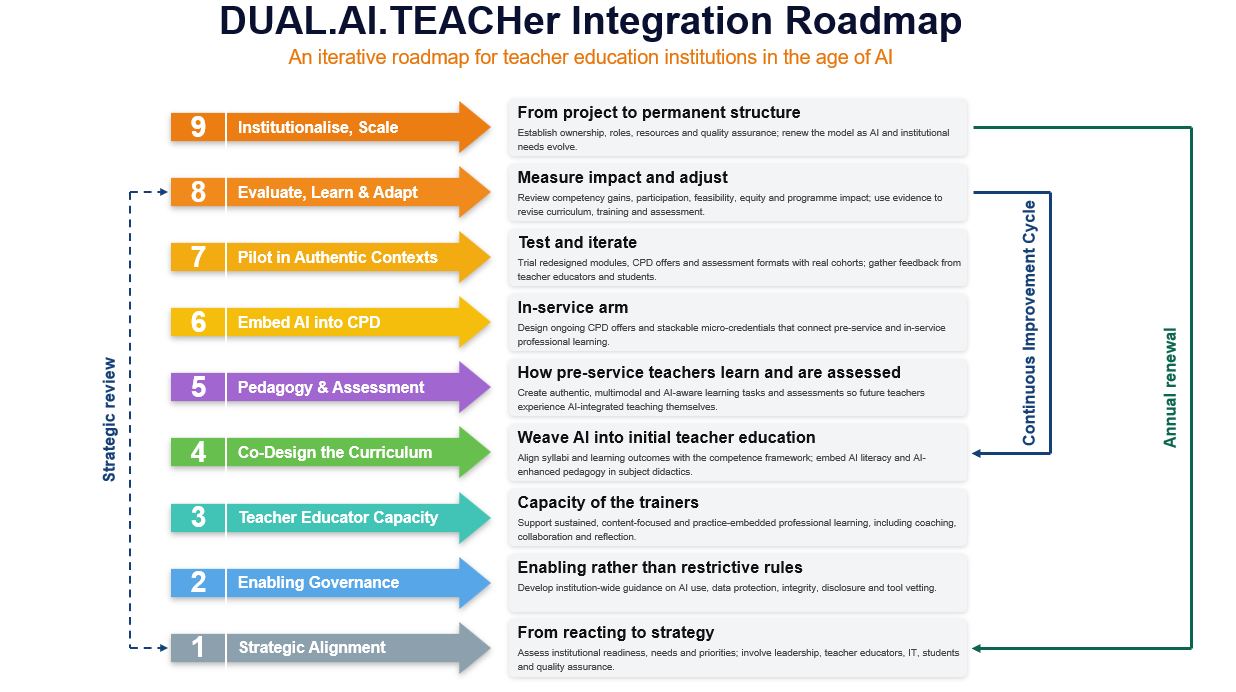
Figure 1. DUAL.AI.TEACHer Integration Roadmap: Nine stages for the institutional integration of AI in teacher education.
Your specific position
Teacher education institutions carry two mandates at once. You transform your own teaching, and you prepare future teachers for classrooms you do not control, under conditions you cannot fully predict, using technology that may have changed by the time your graduates arrive there. The two mandates are closely connected. Focusing only on internal transformation risks producing AI-related curricula without sufficient connection to future classroom practice. Focusing only on future classroom practice risks modernising the programme without changing the institution that delivers it. The roadmap therefore treats both dimensions together.
Stage 3 enables what follows. Much of the later work depends on the capacity of teacher educators. Their expertise lies in their disciplines and subject didactics, so integrating AI is not simply a matter of adding another tool. Professional development needs to connect AI use to subject-specific teaching, learning and assessment rather than treating it as a generic technical competence. For this reason, Stage 3 deserves particular focus when resources are limited.
Where Stage 4 becomes difficult. The principle that AI literacy should be embedded within subject didactics rather than treated only in a standalone module is easy to state but a lot harder to implement. A standalone module can be assigned to one person, while distributed integration requires many colleagues to reconsider parts of their own teaching. Where a standalone module is useful as a transitional step, it should ideally be connected to a longer-term plan for integration across the programme.
Your distinctive lever. Stage 5 highlights a particular feature of teacher education: your students are learners now and teachers later. How you teach them therefore becomes part of what they learn about teaching. If pre-service teachers experience thoughtful, AI-integrated teaching as learners, they encounter concrete models they can later reflect on and adapt in their own practice. Teaching about AI without modelling its pedagogical use provides a very different experience. This is why Stage 5 goes beyond assessment reform alone.
Stage 6 is your interface with schools. Your continuing professional development provision is the entry point. It extends your institution's reach beyond future teachers to those who are already working in classrooms. At the same time, collaboration with in-service teachers can bring current classroom experience back into teacher education. CPD can therefore function not only as a service provided to schools, but also as a channel for reciprocal learning between schools and teacher education institutions.
What you can do that schools cannot
Teacher education institutions often have greater scope to revise programmes and assessment, access to research capacity, and a mandate to work across multiple schools. This gives Stages 7 and 8 particular value: what is learned through pilots and evaluation can inform not only your own institution but also partner schools and the wider system. Making those experiences visible can also support the uptake of new practices elsewhere.
Where to begin if everything is urgent. Start with Stage 2 and Stage 3. Governance reduces uncertainty, while staff capacity creates the conditions for meaningful work in Stages 4 to 6. Beginning with curriculum revision before staff have the capacity to implement it risks producing changes on paper that are difficult to realise in practice.