
5.3 Roadmap for Schools
OurWho startingthis pointsection is for
TheSchool DUAL.AI.TEACHerleaders, projectdeputy aimsheads and those responsible for professional development in a school. You do not need to develophave read the preceding sections in full. If you have read the nine stages in 5.2, this section tells you how they apply to a clearschool; if you have not, you can start here.
Where schools enter the roadmap. This roadmap was developed for teacher education institutions, but its change logic is not specific to them, and adaptableone roadmapstage ofconcerns sevenschools todirectly. tenStage stages6, thatEmbed helpsAI into CPD, is the in-service arm: it is where teacher education institutions embedorganise AI into both initial teacher education andthe continuing professional development.development that your staff attend. That is your entry point. What your institution offers as Stage 6 arrives in your school as professional development, and whether it changes anything in your classrooms depends on conditions within that school.
Why you cannot start there and stop. Sending staff to a one-off course is the most common approach and at the same time unlikely to change practice on its own. What works is sustained engagement with a content focus, opportunity to practise, and follow-up in the form of coaching or collaboration (Lipowsky & Rzejak, 2021). This has a direct consequence for a school leader. The roadmapscarce focusesresource onis institutionalnot changethe rathercourse; thanit individualis initiativesthe protected time afterwards in which teachers try something, discuss it with colleagues and wasadjust. developed together with teacher educators.
Two existing models provided particularly relevant foundations.
The first is a six-stage higher education model, summarized as “learning to learn again”. It moves from reframing institutional conversations about AI through trust and governance, staff fluency, curriculum change and the redesign of teaching and assessment, towards institution-wide amplification (Black, 2025). Its main strength is that it treats AI as a driver of institutional transformation rather than simply a tooling question.
The second is a four-phase GenAI implementation roadmap for schools and districts: establish a foundation, develop staff, update what is taught, and assess and progress. Its strength is its operational focus and emphasis on concrete implementation.
Both models do what they set out to do: one addresses universities as a whole, the other schools and districts. Teacher education institutions sit across both settings, and this is where we saw room to extend the existing work. These institutions transform their own teaching while simultaneously preparing future teachers for contexts beyond their direct control. Attending to internal transformation alone would leave AI-related curricula to be delivered by staff with limited practical experience, while attending to future classroom practice alone would modernize the programme without changing the institution that delivers it. The DUAL.AI.TEACHer roadmap builds on both models and connects the two dimensions.
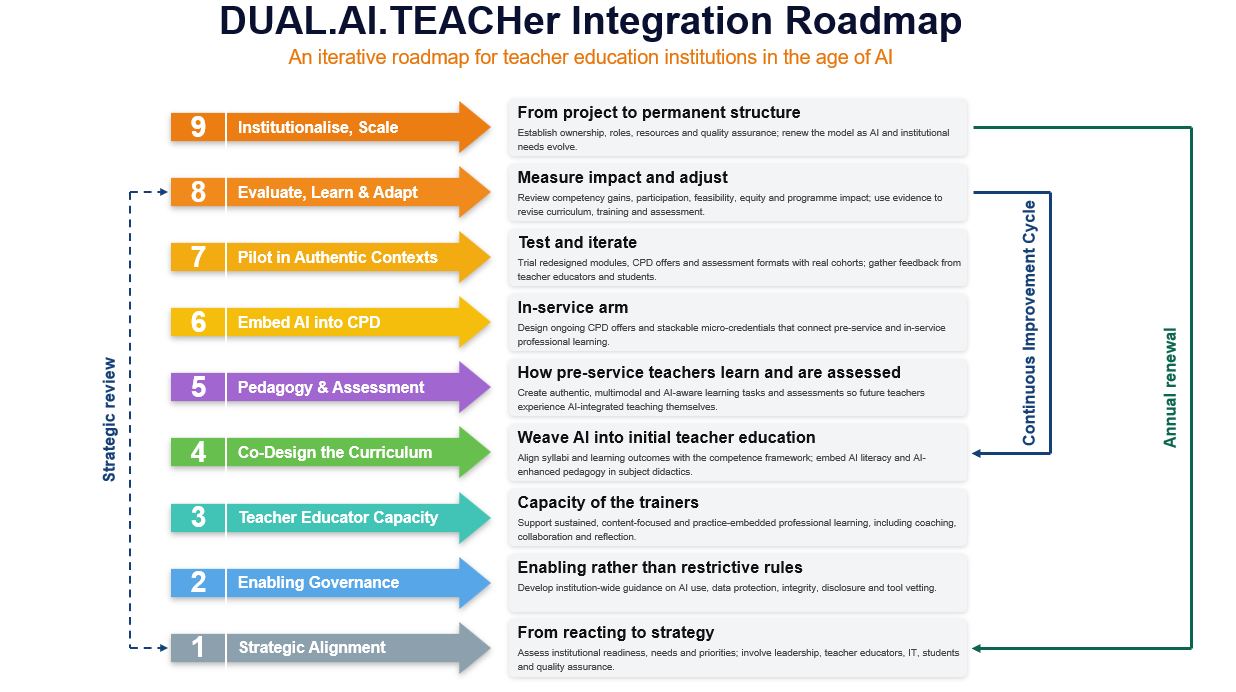
Figure 1. DUAL.AI.TEACHer Integration Roadmap: Nine stages for the institutional integration of AI in teacher education.
TwoThe axes beneath thethree stages to prioritise at school level
RatherStage than combining the two reference models step by step, the roadmap6 is builtyour aroundconnection twopoint, parallelbut axes.
The1-3 first is institutional transformation: structures, governance, curriculum andcreate the formal conditions that enablemake it work.
Stage 1, Strategic Alignment. Establish where your school actually stands. Some of your staff are already using AI, some are avoiding it, and schools may not have a clear picture of current practice. A short, honest stocktake is worth more than a strategy paper. Name what you want to achieve, and be prepared for the answer that AI is not currently your school's most pressing problem; that is a legitimate result of this stage.
Stage 2, Enabling Governance. This is particulary important at school level and easy to overlook. Staff and students need to know what is permitted, how AI use is to be disclosed, which tools have been checked for data protection, and what counts as academic dishonesty. Where this is unclear, two things happen at once: cautious teachers avoid AI entirely, and confident ones use it without any agreed limits. Clear, enabling guidance helps addressing both. It does not need to be long.
Stage 3, Staff Capacity. In the original roadmap this stage concerns teacher educators; in your school it concerns your teaching staff. The same quality conditions apply. Consider starting with a small group of willing colleagues in one or constraintwo AIsubjects use.rather Thisthan axisa followswhole-staff rollout, and make their results visible to the reframe-to-amplify logicrest of the higher education model and is informed by established research. Diffusion ofstaff. Innovations identifiesspread trialabilitywhen andcolleagues observabilitycan assee characteristicsthem that facilitate innovation adoption, informing the emphasisworking in Stagetheir 7own on visible pilot implementationsetting (Neal et al., 2018).
The
What is humandifferent capacity,in whicha servesschool
Three theconstraints qualitydistinguish axisyour of the roadmap. Training cannot be reduced to isolated workshops. Research on effective teacher professional development highlights sustained duration, content focus, practice, reflection, feedback and coaching (Lipowsky & Rzejak, 2021). These principles therefore inform the design of training activities throughout the roadmap,situation from teacher educators in Stage 3 to in-service teachers in Stage 6. A one-off workshop alone does not constitute completionthat of a stage.
Theeducation Roadmap Cheatsheet
You have Enablingless Governancecurricular Putautonomy. institution-wideStages guidance4 and 5 assume an institution that can revise its own course content. Much of your curriculum may be set within national or statutory frameworks and your room for manoeuvre lies in placehow onsubjects AIare use, data protection, integrity, disclosuretaught and toolhow vetting,learning framedis aroundassessed, not in what is possibleprescribed. rather than what is banned.
Staff can answer "am I allowed to do this?" without asking anyone.
Teacher Educator Capacity
Build the capacity ofRead those whostages teach,as throughbeing sustained,about content-focused,task practice-embedded professional learning with coaching and reflection.
Development is ongoing, not only a single workshop.
Co-Design the Curriculum
Move AI into the formal programme by revising syllabi and learning outcomes, anchored in subject didactics rather than in a standalone module.
AI-related outcomes appear in the regular module documentation of several subjects.
Pedagogy & Assessment
Redesign learning tasksdesign and assessment practice.
Your staff have less discretionary time. A teacher education institution can assign development work to beacademic authenticstaff as part of their role. In a school, every hour of development competes directly with teaching. This makes Stage 2 disproportionately valuable: guidance costs little time and AI-aware,removes a great deal of friction.
You are closer to the consequences. Schools experience the the practical consequences of questions around equity, student data and modelaccess AI-integratedparticulary teachingdirectly. soStage students8 experienceasks itexplicitly as learners.
Institutionalise, Scalereason.
AI for Education. (n.d.). AI adoption roadmap for education institutions.Black, A. (2025, December 3). Learning to learn again: A roadmap for higher education institutions in the age of AI. enablinginsights.
Lipowsky, F., & Rzejak, D. (2021). Fortbildungen für Lehrpersonen wirksam gestalten: Ein praxisorientierter und forschungsgestützter Leitfaden. Bertelsmann Stiftung.
Neal, J. W., Neal, Z. P., Lawlor, J. A., Mills, K. J., & McAlindon, K. (2018). What makes research useful for public school educators? Administration and Policy in Mental Health and Mental Health Services Research, 45(3), 432–446.