
1.4 Compliant Use of AI
Take Home message
-
There is no legal vacuum. Data protection law has always applied.
- The timetable moved. The high-risk duties for education AI start on 2 December 2027, not August 2026. Check your school's handouts (see also 1.6).
-
Already binding since February 2025.
EmotionSystemsrecognitionthatinreadschoolspupils'isemotions from their face or voice are prohibited, and schoolsdeployingthat use AI mustensuretakestaffmeasurescompetence.toLabelingbuildoftheirAI-generatedstaff'scontentAIstartsliteracy.inFrom August2026.2026, chatbots must say that they are AI and deepfakes must be labelled. - The hardest layer is data protection. No personal data about pupils without a contract that excludes training on your inputs; consent usually does not carry; deleting names is not anonymizing.
- In copyright, the upload is the problem. The teaching exception does not cover feeding protected works into an AI.
-
Detectors do not hold up as evidence.
ReasonedCourtsinferencehave accepted conclusions drawn from concretesigns does.facts. Rules must be clear in advance, andlabelingasking for disclosure beats banning. - Grades stay
humanhuman. Obious—toandus but important to note is that rubber-stamping an AI's suggestion is not a human decision. - Responsibility sits with procurement, not with you — and compliance enables. The schools with clear rules are the ones whose teachers report saving the most time.
If you remember only one sentence from this page: Compliance is a house, not a wall.
What am I allowed to do?
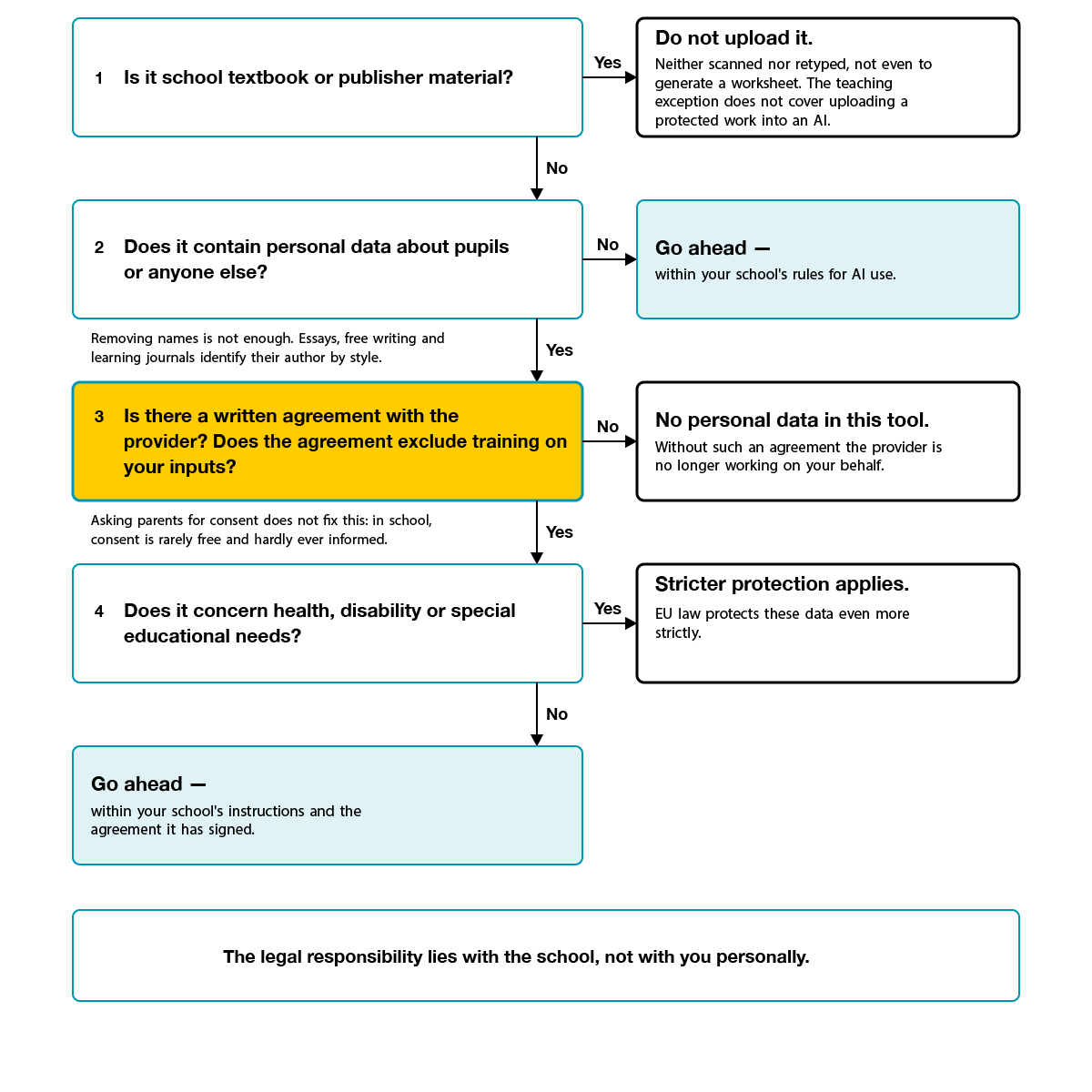
Keep these four steps in mind before typing, pasting or uploading anything. Please use the following overview as a general guide. Requirements in your country may differ from those listed here. Therefore, always check the regulations specific to your country and school.
The reading journal, third look
Our ninth-grade student, his reading journal, his teacher's suspicion. In Chapter 1.2, it was a question about learning; in Chapter 1.3, about professional judgment. Here it is a court file.
In December 2025 the Administrative Court of Hamburg, Germany, ruled on an urgent application in the case. The English teacher had noticed that the reading journal didwas notwritten matchat a far higher level of spelling, grammar and vocabulary than the boy's writing style in a class test.test Ason athe consequence,same book. He later admitted using ChatGPT, and the school treatedgraded itthe journal as deception.an Thisattempt wasto followeddeceive. byHis anfather applied to the court for urgent application to stop this, butrelief; the court refused. UndisclosedIts reasoning goes beyond this case: pupils must assume that they are to do their work entirely on their own unless an aid has been expressly allowed – so undisclosed AI use in schoolwork counts as deception even wherewithout thea school has no explicitwritten rule against AI. All(In studentsthis mustcase, assumethe theyteacher arehad toin work independently unless they have beenfact told whichthe aidsclass arethat ChatGPT was not allowed.) One caveat to keep in mind from the outset: this is a single court, in urgent proceedings, and the decision is not yet final.
This is a good moment to address the most common misconception in this field. There is no legal vacuum. There never has been.
The house has three floors
Most teachers envisage AI law as a single wall under construction somewhere in Brussels. However, it is more useful to picture a house that you already live in. The foundation is data protection. It is load-bearing. It was laid years ago. It governs your Tuesday morning. The upper floor is the EU AI Act, Europe's AI law, which categorizes systems by their potential for harm and imposes stricter obligations as risk rises. It is partly occupied and still under construction, with the completion date just pushed back. The doors and windows are copyright and examination law — small and specific, and touched daily without noticing.
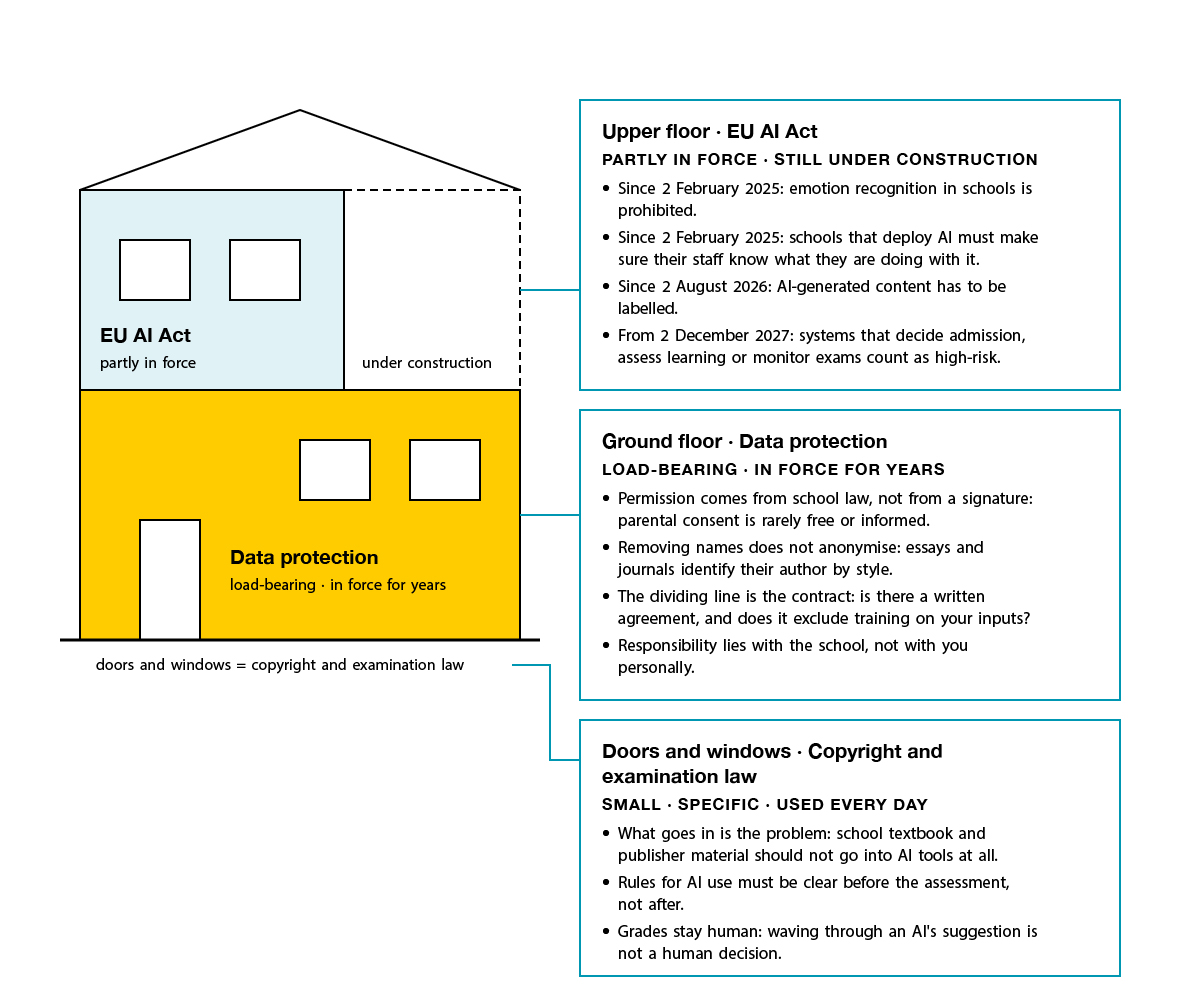
Fig. 2. Compliance is a house
Ground floor: data protection, clearer than many think
Handling someone's personal data always requires legal permission. As a public body, a school's permission essentially comes from its statutory duties under school law. Being a teacher does not come with a general license.
Three consequences follow, forming the practical core of this chapter.
Consent does not provide a solution. One obvious solution would be to simply ask the parents. However, this approach has two drawbacks. Firstly, consent must be freely given. In a school context where grades are a factor, a teacher's request does not constitute a free choice. Second, consent must be informed, which is difficult when nobody knows where the data will end up. Permission must come from school law, not a signature, as this shifts responsibility upwards, away from you.
Removing names does not anonymize data. In 2024, Germany's data protection authorities jointly stated that if someone could still be identified from the context, the data is still personal. This is particularly problematic in schools because the types of text that teachers most want help with — such as essays, free writing and learning journals — identify their author by style.
The dividing line is the contract: a provider may handle your data if it does so strictly on your instructions and there is a written agreement to this effect. However, the moment it uses what you type for its own purposes, the arrangement collapses because it is no longer working on your behalf. So the practical test is this: Is there such an agreement, and does it exclude training on your inputs? If not, no personal data should be entered.
Two footnotes worth noting: Datadata relating to health, disability,health and special educational needsdisability is subject to even stricter protection under EU law,law. andIt does not belong in an AI tool. And where teachers use private devices, at least onetwo German statestates (Baden-Württemberg)North hasRhine-Westphalia explicitlyand prohibitedBavaria) itsmake useclear in AI systems by ministerial decree. Where private devices are involved,that the legaldata-protection responsibility lies with the school,school notand youits personallyhead, whichwho relievesmust youapprove andthe obliges your head teacher.use.
Upper floor: what the AI Act does and does not require yet
Here is the correction that makes most existing guidance out of date. In July 2026, with an amending regulation known as the Digital Omnibus, the EU postponed the heaviest set of AI Act duties for education,education which are those attaching to systems classed as high-risk, meaning systems used to decide admissions, to assess what pupils have learned, or to monitor them during examinations, from August 2026 to 2 December 2027. A great many handouts written in 2025 and early 2026 still print the old date. If a document in your school does, it needs a footnote.
The more useful correction runs the other way: what already applies is underestimated, and what is endlessly discussed does not apply yet.
Two things have been binding since 2 February 2025.
- Emotion recognition in schools is
prohibited outright.prohibited. Systems that claim to read pupils' feelings—fromattentiontheirdetection,face, voice or body – mood analytics, "engagement" scoring from a webcam— are not a grey area. They– sit on the Act's short list of practices that are simplybanned.banned, with narrow exceptions for medical or safety reasons. Tools that only detect tiredness or whether someone is looking at the screen are a grey area; that is a question for procurement, not for the classroom. - Schools that deploy AI must
maketakesuremeasures to build theirstaffstaff'sknowAIwhatliteracy.theySinceareJuly 2026 the law states that no particular level has to be guaranteed – but doingwithnothingit.isNonot an option. There is no EU-level fineis attached tofor thisone,duty, which is why it is widelyoverlooked.overlooked;Itnational authorities can enforce it from August 2026.
From 2 December 2026, AI that creates sexualised deepfakes of identifiable people is bindingprohibited. all
Read that second duty alongside Chapter 1.3 and something clicks. The gap between knowing about AI and being able to teach with it is no longer only a professional problem. Since February 20252025, itschools hashave been alegally legalrequired obligation.to work on it.
Since 2 August 2026, chatbots must tell users that they are AI, and providers must mark AI-generated content hasin a machine-readable way; schools themselves must label deepfakes, and AI-written texts they publish to beinform labeledthe aspublic. such.A worksheet a teacher has checked needs no label. From 2 December 2027, the duties for high-risk systems apply – systems used to decide who gets admitted, to assess what pupils have learned, or to monitor them during examinations count as high-risk.examinations. Whoever uses such a system then assumestakes theon duties thatof comeits withown, it.including Thisassigning incorporatesoversight a requirement that theto people overseeing it be,with, in the Act's words, "competent,the trainednecessary competence, training and authorised"authority". Note the wording. The law has arrived at the same conclusion as the pedagogy: oversight without expertise is not oversight.
Doors and windows: copyright and examinations
Counter-intuitively, what comes out is the easy part. A text or image generated bythat an AI generallygenerates on its own has no human author in the sense copyright requires, so it is usually free of copyright itself.itself; where a person shapes it through their own creative choices, the result can be protected. It is not, however, guaranteed to be clean: in thea firstwidely majornoted European ruling of its kind,ruling, a Munich court found that a chatbot had memorizedmemorised song lyrics and reproduced them almost word-for-word for word. The court placed the liability on the provider, not on the person who typed the request. WhetherThe a teacher who passes on such material could be liable is, as things stand, an open question. What goes injudgment is the clearer problem, but note that this is a question of copyright, not of the AI Act. The AI Act says nothing about what teachers may feed into a system; that is an older and entirely separate body of law.final.
The exception that lets teachers copy material for their classes covers exactly that: copying a limited share of a work, for that class. Uploading a protected work into a commercial AI system is a different act, and the exception does not address it. Material intendedproduced specifically for school teaching, whichsuch as textbooks and workbooks, is mainlyin textbooks, isprinciple excluded from the exceptionexception, inas anylong case.as Solicences scanning a chapter to havefor it summarisedare isreadily an everyday act that the teaching exception does not obviously cover.available.
How much should that worry you? Less than the gap suggests, and more than nothing. The question is genuinely unsettled: no higher court has ruled on it, and the specialist literature regards the existing exceptions as a poor fit for the situation. Where a rights holder objects, the claim would be a civil one, and in practice, this is a matter for school policy and procurement rather than something an individual teacher can settle. What is notclear unsettledin practice is the narrow case,case. It is the line the educational publishers draw, and it is the lineone worth remembering: school textbook and publisher material should not go into AI tools at all — neither scanned nor retyped, not even to generate a worksheet.
Case law in this field seemsis currently inconsistent across Europe. In February 2026, the Administrative Court of Kassel, Germany, decided two university cases the same way, and sharply: whereeven a student has signed a declaration thatthough the workuniversity ishad theirno own,explicit ban on AI, the line iswas crossed "already with a single undisclosed use of generative AI". AThe judgments are not final. In the same month, a Paris administrative court, in Februaryurgent 2026,proceedings, forbadestopped a university tofrom sanctionsanctioning a student at all:because it had producedset out no rule governingon AI use, and without a rule set outuse in advance there was no disciplinary breach to find.[PRÜFEN]. A Swedish appeal court had reached thea samesimilar result earlier, on facts almost identical to a Dutch case that went the other way. In this case,earlier: a student submittedhad handed in three invented sources,quotations, but the course rules permittedallowed "all aids" in take-home work, so there was nothingno rule to have broken. WhereIn fabricationthe Netherlands, by contrast, the country's highest administrative court upheld a sanction in July 2025 against a law student who had submitted four non-existent sources: the fraud was clearlyproven proven,beyond reasonable doubt, and awhether rulehe existed,had courtsmeant haveto upheld sanctions. The Dutch Supreme Administrative Courtdeceive did sonot in 2025.matter.
So the pattern across jurisdictions is not about countries. It is about whether a rule existed beforehand, and whether the deception was actually shown.
Three rules follow for practice.
-
Detectors do not carry the burden of proof.
WhatThe school has to show thelawdeception.doesCourtsallowhaveisacceptedanconclusionsinferencedrawn fromtypicalconcretesigns. This includes repeated, oddly polished phrasing, a mismatch between what they can write and what they can say, andfacts: sources that turn out not toexist.exist, a clear gap between what a student writes and what they can explain orally, sudden jumps in level within the same text, an admission. The student can then explain.ThatWriting style alone is alegitimateweakroute,basisand– leading German legal commentators doubt that itdoescannotcarryrequireasoftware.finding at all. Detectoroutput,output is, at best,isaonereasonsigntoamonglookothers.more closely. The failure rate reported in Chapter 1.3rendersmakesthe instrumentit unusable as evidence. -
Rules must be clear before the assessment, not after. Neither a blanket ban nor a blanket permission holds up. What works is a declaration of independent work with a
generalclause about AI, plus a duty to state what was used.In Germany, Bavaria went furthest in 2026: its universities maynotforbid AI in unsupervised assessments at all, but must require students to declare it. LabelingDisclosure instead of banning. -
Grades stay human.
NoPeopledecisionhave the right not to be subject to decisions with legalconsequenceseffectfor a person may be made bythat a machine takes alone, and schools have no legal basis for making such decisions by software; a grade issuch a decision.one. Germany's Standing Conference of the Ministers of EducationMinistersand Cultural Affairs puts it even more strongly: assessment is a task only teachers can perform. Crucially, formally waving through an AI's suggestion does not count as a human decision. So the findingfromthatChapterpeople1.4,oftenwronggo along with flawed AI feedback isalsoa legal problem as well as a pedagogicalandone.a legal problem.
Law, ethics and didactics therefore converge on the same answer: assess the process, not just the product.
The real address of responsibility
In response, Germany has introduced state-provided school AI environments. These are vetted platforms with negotiated contracts, rather than leaving teachers to sign up to whatever is free. While these solve problems that individual teachers cannot solve alone, they are still criticizedcriticised for how they are governed, whether teachers actually accept them and whether the assessments they support are sound. SinceBecause the rollout isdiffers currentlyfrom limitedone federal state to athe selectnext, group of schools and specific subjects, weit will needtake time to monitor over the next few monthssee how teachers are faring with the platforms.
What is distinctive is narrower than it may initially appear, and it is worth stating precisely: Rather than putting it out to tender or buying access to someone else's,precisely. Germany is the only European system wherewe found in which a statepublic body builds– the FWU, owned by the federal states – develops and runs the platform itself.itself, with technical contractors. France also provides aadaptive platformpractice software for an entire year group, but it commissioned one and two private companies deliver it: one private company wrote the softwaresoftware, and the otheranother hosts the data. MostSeveral other countries have bought access to commercial chatbots; most of the rest ofoffer theguidance continent has simply purchased one. Slovakia has gone the furthest, with 20,000 licences for teacher training faculties that will be extended towards some 80,000 school teachers by 2026. The state will only pay for the licences actually used, and the provider is contractually barred from training on Slovak school data. Estonia negotiated a similar arrangement for its upper secondary schools, and Northern Ireland invested £10.7 million in licences for all teachers in all schools. The contractual guarantee that your inputs are not used for training — the feature that the German platform was designed to provide — can be purchased.only.
Building it yourself does not automatically give you more control. The German platform runs on the same commercial language models as everyone else's on European servers, as an industry association has pointed out. By contrast, the French system is hosted in France under the highest security certification issued by the French state. One country built the surface and rents the engine, while the other bought the software and keeps the keys to the building. Neither option is clearly the most sovereign choice, which is worth bearing in mind before using the term.
The Netherlands took a different approach, and it is worth knowing about because it offers a more honest answer to the same question. Rather than building or buying, Dutch schools and universities joined forces and had the major providers formally assessed. When they examined Microsoft's AI assistant, they found two issues that could not be resolved: the criteria for an automatic content filter that the provider would not disclose and the retention of eighteen months of diagnostic data that could not be justified. They negotiated. In March 2026, however, the provider declined to change. The assessment therefore remains amber, and Dutch schools are advised to exercise caution and use their own judgement on a case-by-case basis rather than granting clearance. One country removed the risk by building around it, while another took a closer look and decided it was not ready yet. Both approaches offer solutions to the problem set out at the start of this chapter.
The comparison also settles one more thing. The complaint that teachers prefer the free chatbot to the official one is not due to a failure of implementation in Germany. In Estonia, where the state negotiated access for every upper-secondary student,students, barely more than a third were using the official chatbot weekly seven months after athe year.programme Inbegan. It turned out,out that most of them had been using free tools before the programit started. Everywhere, the vetted environment competes with the more convenient one. Providing the official tool is necessary. But this is not sufficient.
However, the structural point stands: compliance is an enabling condition, not a hindrance. Remember what was said in Chapter 1.2? The schoolsSchools with clear rules werehad the ones whosemore teachers saidusing theyAI – and saved the mostmore time overall.. ThereRules isdid nothingnot inslow theuse sources behind these chapters that suggests otherwise.down