# Playbook EN
# 0. About this Playbook
# 0.1 Objectives and Structure of the Playbook
This playbook is aimed at you, as teachers, who wish to acquire the necessary knowledge about using AI in schools. AI will be used for a variety of purposes. With regard to teaching, we focus on the areas of ‘teaching about AI’ and ‘teaching with AI’ to impart subject-specific knowledge.
The development of Artificial Intelligence (AI) is advancing at an extremely rapid pace, and its use is increasingly permeating our society, entering aspects of everyday life such as education. This pervasiveness brings with it multiple and often interconnected implications, spanning ethical, social, economic, legal, and cultural dimensions, touching on issues such as data protection, fairness and non-discrimination, algorithmic transparency, technical safety, and accountability. Precisely because of the speed of this diffusion and the scale of its consequences, there is a growing need for shared guidelines, regulatory frameworks, and governance tools capable of steering technological development in a responsible and sustainable direction.
To meet our standards, we have structured the playbook as follows:
[**Chapter 1**](https://playbook.dualaiteacher.eu/books/playbook-en/chapter/1-ai-in-education "1. AI in Education") highlights the fundamental aspects that are essential to understand in order to use AI in the classroom. It begins with an [*assessment of the potential and risks of AI*](https://playbook.dualaiteacher.eu/books/playbook-en/page/11-potentials-risks "1.1 Potentials & Risks"). This is followed by a distinction between [*‘teaching about AI’ and ‘learning with AI’.*](https://playbook.dualaiteacher.eu/books/playbook-en/page/12-teaching-about-vs-teaching-with-ai "1.2 Teaching About vs Teaching with AI")
‘Teaching about AI’ is intended as the foundation for being able to use AI competently within the relevant subject. It is precisely the potential and challenges of AI that make it even more necessary than in other areas of school education to engage with the ethical and legal frameworks governing the use of AI. We address these questions in [*Chapters 1.4*](https://playbook.dualaiteacher.eu/books/playbook-en/page/14-compliant-use-of-ai "1.4 Compliant Use of AI") and [1.3](https://playbook.dualaiteacher.eu/books/playbook-de/page/13-verantwortungsbewusster-einsatz-von-ki "1.3 Verantwortungsbewusster Einsatz von KI"). Chapter 1 concludes with the country-specific legal requirements.
In [**Chapter 2**](https://playbook.dualaiteacher.eu/books/playbook-en/chapter/2-good-practices-classroom-examples-all "2. Good Practices & Classroom Examples (all)"), we move on to teaching practice and provide an ever-growing number of examples for different school subjects. All examples are based on a competence model, the learning objectives of which we describe in [**Chapter 3**](https://playbook.dualaiteacher.eu/books/playbook-en/chapter/3-ai-pedagogical-competency-framework-xWp "3. AI Pedagogical Competency Framework").
[**Chapter 4**](https://playbook.dualaiteacher.eu/books/playbook-en/chapter/4-certification-micro-credentials-icep "4. Certification & Micro-Credentials (ICEP)") then outlines how you can gain the necessary qualifications to use AI.
[**Chapter 5**](https://playbook.dualaiteacher.eu/books/playbook-en/chapter/5-ai-integration-roadmap "5. AI Integration Roadmap") is aimed at schools that want to systematically improve their teachers’ AI competence and integrate AI into everyday school life.
...
# 0.2 How to Use the Playbook
## [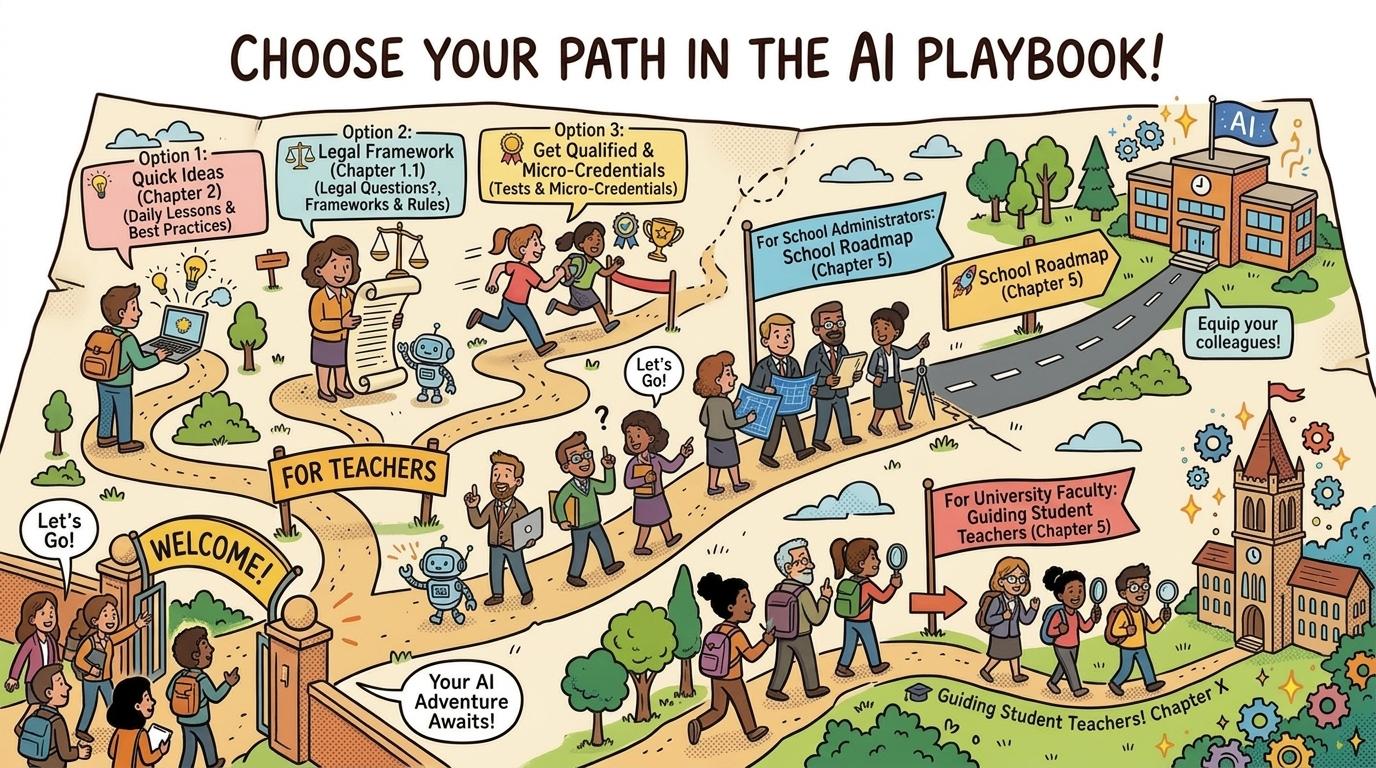](https://playbook.dualaiteacher.eu/uploads/images/gallery/2026-09/gemini-generated-image-t1spb4t1spb4t1sp.jpg)
Generated with Google Gemini
## For Teachers
There are different ways you can use the Playbook.
#### Option 1: You’re looking for ideas for your next school day to teach students about AI or to use AI to teach subject-specific content.
In this case, go directly to [Chapter 2](https://playbook.dualaiteacher.eu/books/playbook-en/chapter/2-good-practices-classroom-examples-all), where we’re continuously adding new best practices. We hope you’ll find what you’re looking for. If not, please email us so we can develop a new resource to address the gap you’ve identified.
#### Option 2: You want to learn about the legal framework governing the use of AI. In this case, go to [Chapter 1.1](https://playbook.dualaiteacher.eu/books/playbook-en/page/11-potentials-risks "1.1 Potentials & Risks").
#### Option 3: You would like to gain the qualifications needed to teach about AI effectively and incorporate AI into your subject-specific instruction.
In this case, we invite you to take our initial test and then follow our qualification modules. By earning micro-credentials, you can pursue comprehensive professional development tailored to your expertise.
## For School Administrators
Are you ready to set out with your school on an exciting journey to bring AI into your professional world? In [Chapter 5](https://playbook.dualaiteacher.eu/books/playbook-en/page/51-how-to-use-the-roadmap "5.1 How to Use the Roadmap"), we chart a clear roadmap to guide you every step of the way. Our qualification program empowers you to equip your colleagues for the adventure that lies ahead.
## For University Faculty
AI is making its mark on teacher education, sometimes in bold strokes, sometimes in subtle ways. Viewing teacher education as a journey that begins at university and builds over time, [Chapter 5](https://playbook.dualaiteacher.eu/books/playbook-en/page/51-how-to-use-the-roadmap "5.1 How to Use the Roadmap") offers you a roadmap to inspire and support student teachers as they explore the evolving landscape of AI.
# 1. AI in Education
# 1.1 Potentials & Risks
> *If you remember only one sentence form this page:* AI has made its way into schools like a medicine that comes without a patient information leaflet. As a teacher, you don’t know when to use AI, you lack dosage instructions, and there is no information on the side effects. This chapter serves as the patient information leaflet for the Playbook.
### Should AI come with a leaflet like a medicine?
You know that slip of paper tucked inside every medicine box? The one you likely toss aside without a glance? It may seem dull, but this little paper is a quiet triumph of the last century. That leaflet spells out four essentials: what the medicine treats, how much to take, the surprises it might bring, and who should steer clear.
Behind every line on that leaflet stands a whole machinery: clinical trials, regulators, and a responsibility to reveal mistakes. No one believes the leaflet itself heals you. Its real power is making the medicine safe for anyone. That is the magic we are missing when we let AI teach without guidance.
The AI tools now quietly settling into your school arrived with no instructions. In the UK, a review found that only 7 out of 100 education technology companies had ever put their products through a controlled trial, and only 12 out of 100 had sought outside certification. The classroom tells the same story. Only 11 out of 100 school leaders and teachers across 17 American states had ever requested peer-reviewed proof before adopting a new tool.
The result, in many cases, is wasted money. In the US, two-thirds of school software licenses gathered dust, and 98% saw almost no use. The EdTech Genome Project looked at about 7,000 teaching tools worth 13 billion dollars and found that 85% were either mismatched or misused.
This chapter may look like the dry, necessary section, but it reveals the hidden stories behind the rules. It tells what really happened, who was affected, and shines a light on the side effects, even those that quietly reached children who never signed up.
### Potentials of AI
Let's make this clear right from the start. Most studies on AI's potential focus on university students. School pupils have so far featured relatively rarely in these studies. Most studies relate to short-term interventions lasting from a few hours to a few weeks. Consequently, the so-called novelty effect may have positively influenced the results. Last but not least, the test used to assess effectiveness was often devised by the very people who delivered the lessons. This, too, may have confounded the data.
#### (1) Let AI explain a new topic and keep the practice for your lesson
**Imagine this.** Tomorrow, when a pupil misses a topic or needs that tricky concept explained yet again, let an AI tutor handle the first explanation. Reserve the practice for your lesson, where real learning comes alive.
**Why this matters.** AI can support acquisition of factual knowledge. In a Harvard study, 194 physics students learned two topics. For one topic, they used an AI tutor developed for this purpose. For the other topic, they learned in a traditional class. Each student completed both approaches, so no one can claim that the stronger group received the better treatment. In a test conducted immediately afterward, the students taught by the AI achieved significantly higher results. The researchers recorded a median time of 49 minutes to complete the task, compared with the 60 minutes allocated for the lesson in the timetable. The authors are cautious in their interpretation of these results: the material was new to the students, and much of the task simply involved explaining it well. They expressly reject the idea that the same would apply to tasks requiring the integration of multiple ideas. Furthermore, these were undergraduate students, not Year 8 pupils.
A large review pooling the results of 228 studies came to a similar conclusion. Generative AI-based chatbots produced a larger effect on knowing (and understanding) than intelligent tutoring systems and adaptive practice software.
**Go deeper.** Kestin, G., Miller, K., Klales, A., Milbourne, T., & Ponti, G. (2025). AI tutoring outperforms in-class active learning: An RCT introducing a novel research-based design in an authentic educational setting. *Scientific Reports, 15,* Article 17458. Free access, DOI 10.1038/s41598-025-97652-6. The article describes how the tutor was designed and controlled. This is useful for anyone wishing to develop an AI tutor themselves.
#### (2) Making better use of lesson planning time
**Imagine this.** Save some of the time you need for lesson planning by using AI to draft your first lesson plan and then revise it thoroughly.
**Why this matters.** No one disputes that teachers’ workloads are heavy. Therefore, one potential benefit of AI is using working hours more efficiently. A UK study investigated the extent to which the targeted use of AI for lesson planning can help to reduce teachers’ workload. Researchers randomly assigned 259 science teachers at 68 schools to either a group using a chatbot alongside brief written instructions or a group that continued lesson planning as before. **The weekly planning time for science lessons in Years 7 and 8 fell from around 81 minutes to around 56.** A panel of subject experts assessed the quality of the lesson plans. They did not know whether the plans had been created with or without the aid of AI. The experts found no evidence to suggest that the quality of the lesson plans differed. However, two points must be highlighted. (1) **The teachers used the tool less and less as the weeks went on,** meaning that the time saved does not occur automatically and does not sustain itself. (2) The trial measured the time spent by teachers on lesson planning, not their pupils’ learning outcomes.
**Go deeper.** Roy, P., Poet, H., Staunton, R., Aston, K., & Thomas, D. (2024, 12 December). *ChatGPT in lesson preparation: A Teacher Choices Trial.* NFER, commissioned by the Education Endowment Foundation and the Hg Foundation. Free at educationendowmentfoundation.org.uk.
#### (3) Providing better support for learners who do not benefit fully from standard lessons
**Imagine this.** Your school decides how it wishes to spend its funds. It wants to purchase an AI chatbot. How likely do you think it is that the chatbot providers will provide you with evidence of the bot’s benefits for different subjects?
**Why this matters.** The provider may point out the following application. Chatbots are the oldest and best-documented application of ‘AI’ in education, and this is precisely what is often overlooked when allocating funds. In an analysis of 29 studies involving 41 groups of learners with disabilities, researchers found moderate benefits across a wide range of settings. But read the small print. In **seven out of ten of these studies**, ‘AI’ meant a **robot**: a small physical machine sitting on a table, often operated by a researcher in another room. Only one in five studies used software. So this is no proof that a chatbot will help an autistic pupil in your class. Nor could the reviewers say **what** makes these interventions effective. Based on their research, they could not identify why the studies that worked differed from those that did not.
**Go deeper.** Zhang, L., Carter, R. A., Jr., Liu, Y., & Peng, P. (2026). Let's CHAT about artificial intelligence for students with disabilities: A systematic literature review and meta-analysis. *Review of Educational Research, 96* (1). DOI 10.3102/00346543241293424. The real gem is the table of included studies: it instantly reveals just how little of this field actually focuses on the tools currently being marketed to schools.
#### (4) Teaching learners how AI fails
**Imagine this.** Ask your class to create ten images of 'a doctor' and ten of 'a nurse.' Tally up who appears in each set, then spark a discussion: where did these patterns come from, and who made those choices?
[ ](https://playbook.dualaiteacher.eu/uploads/images/gallery/2026-08/gemini-generated-image-mfaur1mfaur1mfau.jpg)
Fig 1. Image created with NanoBanana 2, created August, 20, 2026, One shot prompt: a doctor, a nurse
**Why this matters.** The classic version of this lesson feels outdated, and that is exactly why it deserves attention. For years, the demonstration was predictable: ask for a doctor, and a man appears. In one systematic test, Midjourney almost always pictured doctors as white men, while Adobe Firefly made visible, if imperfect, attempts to diversify.
Try the same prompt today, and you might see a female doctor or a male nurse appear (Fig. 1). But do not be fooled into thinking the bias has vanished. A 2026 analysis of 1,344 images from three popular generators revealed the opposite: when asked for a 'competent person,' one system showed no women.
**What changed is not the bias but the layer it lives in - and this the important lesson!** Human decisions stand behind any of these pictures: what the system was trained on, and what its makers afterward decided it should show. The second is adjustable, invisible, and made by a company.
**The first layer of human decisions is what the system has absorbed.** Millions of images, crafted and labeled by people, each one echoing the world as it already was. This is the layer that the classic bias lesson reveals, and pupils grasp it easily: the machine became a reflection of what it was fed.
**The second layer is shaped by what a company chooses to show you next,** yet this influence leaves no trace in the image itself. Three things unfold here, each one described by the creators in their own words.
- **Your words are rewritten before the model receives them.** From OpenAI’s own developer documentation: “we use GPT-4 to optimize all of your prompts before they’re passed to DALL-E” — and “this feature isn’t able to be disabled at the moment.” What your pupil typed is not what the machine was asked.
- **Appearance gets filled in when the prompt leaves it open.** OpenAI, describing its diversity technique: “This technique is applied at the system level when DALL·E is given a prompt describing a person that does not specify race or gender, like ‘firefighter.’” Afterwards, users were twelve times more likely to say the images showed people of diverse backgrounds. “A doctor” is exactly that kind of prompt.
- **And that tuning can miss.** Google, after pausing Gemini’s image generation in 2024: “Our tuning to ensure that Gemini showed a range of people failed to account for cases that should clearly not show a range.”
So when a pupil types “a doctor” and a woman appears, the image offers no clue about which layer brought her into being. **That uncertainty is not a flaw in the lesson. It is the lesson itself.**
The old story claimed the machine simply soaked up society’s prejudices. The new story cuts deeper and lasts longer: the image is no mirror, and it is no accident. A company made a choice! You cannot spot that choice in the outcome, and it might shift on a Tuesday, quietly, without warning. That truth endures through every new model. The stereotype lesson fades away.
This is the lesson that deserves a student's attention, and it will outlast the next model update: **the image is not a simple reflection of reality, and it did not happen by chance. Someone made a choice.**
This lesson can start early. When 209 Finnish students in 12 classes, grades 4 and 7, explored this topic, the number who could explain the bias using data jumped from about 7 out of 100 to 44 out of 100. The honest reservation: the study measured what children could explain, not what they would do later.
**Go deeper.** Vartiainen, H., et al (2025). Enhancing children's understanding of algorithmic biases in and with text-to-image generative AI. *New Media & Society, 27*(9). Free, DOI 10.1177/14614448241252820
Weinmann, H., et al (2026). Gender bias in text-to-image generative artificial intelligence: Neglect and stereotypical presentations across three popular platforms. *New Media & Society,* Online First
#### How solid are the research results on the potentials of AI at this very moment?
**The most important thing.** If someone quotes a study to you, ask two questions before agreeing: "Who were the learners, and how long did the study last?"
**Why this matters.** In 2025, a meta-analysis of 51 studies reported a **significant benefit** of ChatGPT for pupils’ academic performance. The article was read hundreds of thousands of times and served as the basis for numerous confident statements in staff rooms. **On 22 April 2026, the journal retracted the article.** A \*retraction\* means that a journal officially withdraws something it has published; the article remains visible, marked with the note ‘RETRACTED’, so that anyone who has cited it can recognise this. Two external researchers had identified inconsistencies in the synthesis of the studies. The journal's editor wrote that the problems ‘undermine the editor’s confidence in the validity of the analysis’. The authors did not respond to correspondence on this matter.
**This does not mean that AI has no impact**. There are reputable studies that demonstrate moderate benefits. This field of research is also not yet well defined because it is relatively new and highly dynamic. It means that the figure that was frequently cited was incorrect, and that it took a year and two external experts to realise this.
Another reservation worth mentioning is: The closer the evidence gets to school, at least at the moment, the smaller the effect.
**Go deeper.** The retraction itself is one page, free, and worth reading precisely because it is short: Wang, J., & Fan, W. (2026). Retraction note: The effect of ChatGPT on students' learning performance, learning perception, and higher-order thinking. *Humanities and Social Sciences Communications, 13*, 528. DOI 10.1057/s41599-026-07310-z.
The **retracted** original was *HSSC 12,* 621 (2025). Still standing: Wu, X., Zhu, P., Zhang, J., Yin, M., & Wang, Y. (2026). \*HSSC, 13\*, 684. Free, DOI 10.1057/s41599-026-07019-z.
The school-only figure: Yi, L., Liu, D., Jiang, T., & Xian, Y. (2025). \*International Journal of Science and Mathematics Education, 23\*(4), 1105–1126. DOI 10.1007/s10763-024-10499-7.
### Risks of AI
#### (1) Doing something is not the same as learning
**Imagine this.** Before you set a homework task that a chatbot can complete, think about what the purpose of the task is. Might it be a good idea to change the task?
**Why this matters.** Do you learn faster with a chatbot? Around a thousand pupils in Years 9 to 11 practised maths in three groups: one using a standard chatbot, one using a version programmed to withhold the answer and ask a follow-up question, and one without a chatbot. Whilst using the chatbot, the group with the standard chatbot completed 48 percent more practice exercises than the group without one. Afterwards, everyone sat the same exam without a chatbot. The result, which seemed surprising at first, was that the group using the standard chatbot performed 17 percent worse than the pupils who had not used a chatbot. The group that had worked with the chatbot which withheld the answer showed no drop in performance in the test compared to the group without a chatbot, but practised more. The pupils using the standard chatbot were neither lazy nor did they cheat. They worked harder and learnt less, because what the tool eliminated was not the effort, but the cognitive challenge that constitutes learning.
**Go deeper.** Bastani, H., Bastani, O., Sungu, A., Ge, H., Kabakcı, Ö., & Mariman, R. (2025). Generative AI without guardrails can harm learning: Evidence from high school mathematics. \*PNAS, 122\*, e2422633122. DOI 10.1073/pnas.2422633122.
#### (2) AI Detectors punish the wrong pupils
**Imagine this.** You receive a student’s essay to grade. Curious about its authenticity, you feed it into an AI detector. The result flashes: the essay was almost certainly written by AI.
**Why it matters.** You use the AI detector to ensure fairness, **yet for a particular group, the detectors have exactly the opposite effect.** A detector does not recognise machine-generated text. It measures how predictable the wording is. And that is precisely where the problem lies, for example, when a pupil is writing in a foreign language, is unpractised in writing, or has a limited everyday vocabulary. Their writing is predictable. When seven commercial detectors analysed 91 essays written by non-native speakers sitting an English exam, these essays were incorrectly flagged as machine-generated in around six out of ten cases. By contrast, essays written by 14-year-old Americans in their native language, English, were almost all classified correctly. A tool that triggers false positives for exactly one group is not neutral. Furthermore, this group is the least able to defend itself.
**Go deeper.** Liang, W., Yuksekgonul, M., Mao, Y., Wu, E., & Zou, J. (2023). GPT detectors are biased against non-native English writers. *Patterns, 4*(7), 100779. Free, DOI 10.1016/j.patter.2023.100779.
#### (3) Where on earth will the pupils' data be?
**Imagine this.** You use an AI tool your school offers. Try to find out where the pupils' data go.
**Why it matters.** Can your school ensure that the data is not passed on to a third party? A third party is company that is neither your school nor the app’s developer. Typically, these are advertising or analytics companies that receive data whilst the pupil is working. No one at the school chose this company. When researchers carried out a technical analysis of 163 learning products recommended by governments during the pandemic-related school closures, 145 of them processed children’s data in a way that jeopardised or infringed their rights by transmitting data to 196 third-party company or granting them access, predominantly from the advertising industry. **Of the 42 governments that developed their own products rather than purchasing them, 39 had developed products with the same problem. The study covers products from 2021, and some may have changed since then**. However, we cannot rule out that the same applies to AI applications.
**Go deeper.** Human Rights Watch (2022). *"How dare they peep into my private life?:* Children's rights violations by governments that endorsed online learning during the Covid-19 pandemic. Free at hrw.org. The country annexes let you look up what was endorsed where.
#### (4) AI arrives last where it is needed most
**Imagine this.** How much training did you already receive on learning about AI or subject-specific teaching with AI?
**Why this matters.** Adults who had completed their education were provided with an AI assistant. The performance gap between those with higher and lower levels of formal education narrowed significantly. When the researchers then withdrew the assistant, the gap partially re-emerged. The researchers concluded that the AI assistant had carried out the work, but had not helped participants develop any skills.
A survey of American school principals revealed the following picture: the more disadvantaged a school’s pupils were, the less impact AI had on teaching.
If we combine the findings from both studies, they allow us to make the following statement: A good tool can bridge a gap as long as it is in the hands of a learner. However, it usually does not reach those who need it, and leaves no skills behind when it is removed.
German figures show the same patte. Among 1,590 young people aged 14 to 20, 80 percent in the most affluent families and 55 percent in the least affluent saw AI as an opportunity. And recognition is followed by action: 70 percent of grammar school pupils used AI for homework, compared with 58 percent at lower secondary schools.
**What about teacher professional development?** A survey of more than ten thousand teachers in England found that 45 percent of teachers at private schools had already received training on AI. This compared with 21 percent at state schools. Within the state school system, the figures ranged from 26 percent at the wealthiest schools to 18 percent at the poorest schools.
#### (5) What improves when learning with AI is not necessarily what you see
**Imagine this**. You introduce a new ChatBot into your teaching and the pupils enthusiastic about using the new tool.
Why this matters. A large review found four different things about learning (Knowing and understanding, working with AI, engagement, motivation, confidence, ability to plan, monitor and correct their own work). The last one didn't improve whereas the others did.
- For knowing and understanding generative AI had larger effects than intelligent tutoring systems and adaptive practice software that is already used in schools.
- For applying knowledge, and for motivation and engagement, AI did not perform better that already existing software.
- For self-steering we do not have enough studies to tell any effect.
Here’s a quick side note: t**he greatest impacts are found in the arts and humanities, rather than in mathematics or the natural sciences.**
**Go deeper.** Yeo, G. H., & Lansford, J. E. (2025). Effects of artificial intelligence on educational functioning: A review and meta-analysis. *Educational Psychology Review, 37*(4), article 110. DOI 10.1007/s10648-025-10085-5.
# 1.2 Teaching About vs Teaching with AI
### Take Home message
- ***AI is a satnav.*** AI can save the driver who already carries the map and prevent the one who doesn't from learning. The effect depends on the person, not the product.
- ***Teaching about AI is the precondition for Teaching with AI. Y***ou need to know the machine to check the answer the machine produced.
- **Knowing is not doing.** Teachers rate their AI knowledge above their ability to teach with it, and training alone does not close that gap.
- ***Teachers use AI backstage, not in class.*** Half of the teachers use AI regularly, under a third use it with students.
- ***Pedagogy beats technology.*** Transforming lessons beats chatting with AI; working in pairs beats working alone; feedback beats gamification.
- ***Better feedback is not better learning.*** AI comments judged clearly better than teachers' produced revisions that were no better at all. What decides is whether feedback is *taken up.*
- ***AI raises output, not self-directed learning.***
- ***Clear rules and heavy use go together.*** Teachers in schools with a written AI policy report saving more time, not less — the opposite of what most people expect.
- ***Guard your own map.** Relief becomes deskilling where AI absorbs the work that builds and maintains judgment.*
> *If your remember only one sentence from this page:* **AI is a satnav. It saves the driver who already has a map in her head and quietly stops the driver who hasn't from ever building one**
### The satnav problem
To drive a London taxi, you must first pass a knowledge test: 320 set routes across the 113 square miles within six miles of Charing Cross, for which Transport for London allows up to two years before the examinations even begin.
Examined drivers also use a satnav, and nobody thinks less of them for it. The knowledge test did not become worthless when the device arrived. The satnav became the thing that makes the drive safe. A driver with the city in her head uses the satnav for what she cannot know: the accident on the bridge or tonight's traffic. And she notices when it routes her down a street that has been dug up since April.
Now put a newcomer in the same taxi with the same satnav. She arrives at every address. For a while, she is indistinguishable from the experienced driver. But following the satnav’s instructions, she is building nothing. After a year of turning left when instructed, she still cannot cross the city without the device, and she cannot tell when it is wrong.
[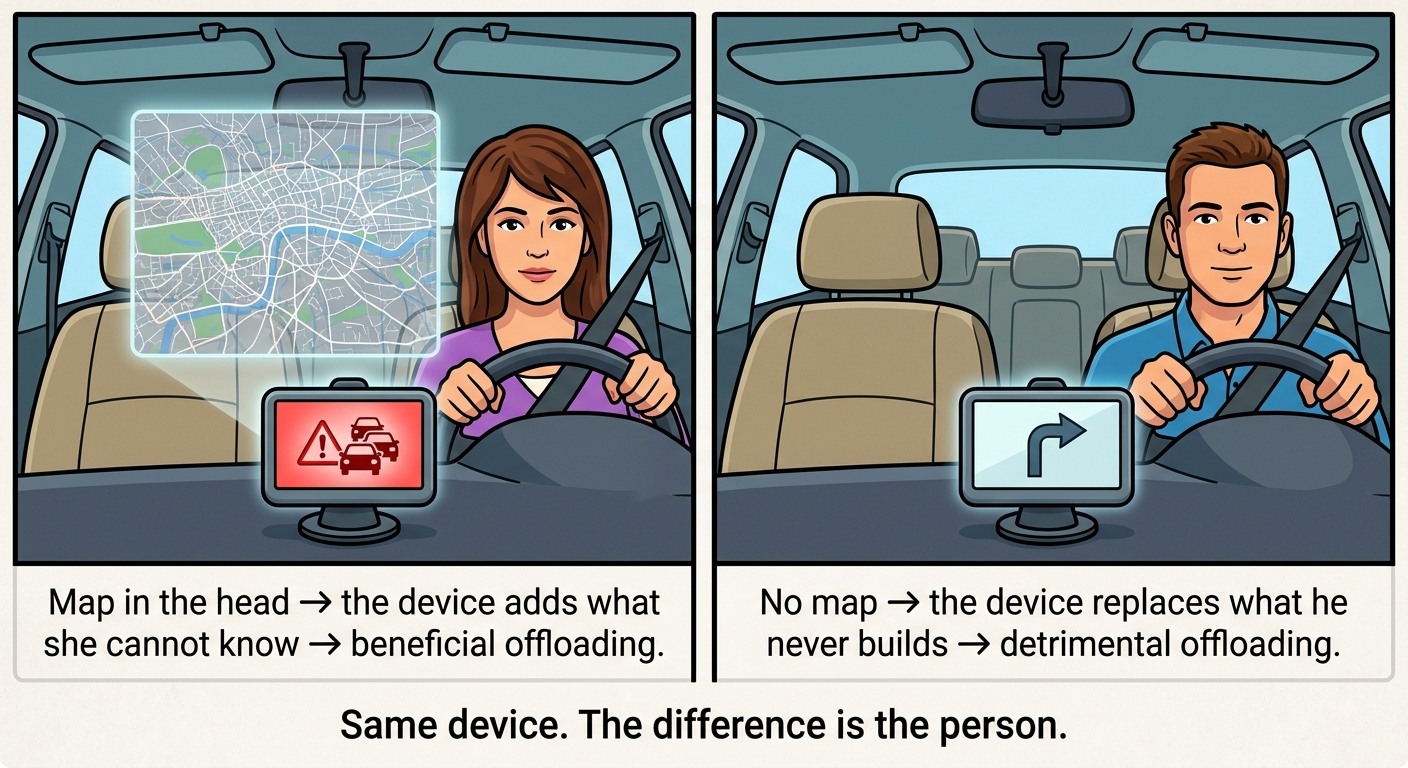](https://playbook.dualaiteacher.eu/uploads/images/gallery/2026-08/gemini-generated-image-wxvxhlwxvxhlwxvx.png)
Fig. 1. The outcome depends on the driver. Image created with GoogleGemini.
Same satnav, two drivers, opposite outcomes. **The difference was never in the device.**
That is a decade of research on AI use in one image, and it holds without the image too. The effect of an AI tool depends far more on what the user already knows than on the tool itself. This is what researchers call a [schema](https://playbook.dualaiteacher.eu/books/playbook-en/page/table-of-technical-terms "Table of technical terms"), the organized prior knowledge of a person. Where it is in place, handing work over to a machine frees you up. Researchers call this beneficial [cognitive offloading](https://playbook.dualaiteacher.eu/books/playbook-en/page/table-of-technical-terms "Table of technical terms"). However, when knowledge needs to be developed, the same process can prevent it from forming. This is called detrimental [cognitive offloading](https://playbook.dualaiteacher.eu/books/playbook-en/page/table-of-technical-terms "Table of technical terms").
A study with around a thousand secondary students shows this happening in a mathematics classroom. One group practiced with an unrestricted chatbot, another without. While they had it, the chatbot group solved **48 % more practice problems!** Then came an exam with the chatbot taken away. Now, the same students who solved practice problems so well scored **17% worse** than the group that had never used the AI chatbot. A third group used an AI version built to withhold answers and ask questions instead. That group lost nothing.
That third group is the whole design question. A satnav that names the destination and helps you find the route teaches you the city. A satnav that says *turn left in 200 meters* does not, however good its data. Researchers call the difference [guardrails](https://playbook.dualaiteacher.eu/books/playbook-en/page/table-of-technical-terms "Table of technical terms"), and the **design decides whether you help your students learn the city's map or simply find the destination.**
Please remember: **You have the knowledge. Your students, in the subject you teach, do not yet.** That asymmetry is the whole chapter.
### Two floors, not two topics
In academic literature, these two areas are considered distinct fields. You could think of them as two floors of a building, with most teachers located on the ground floor and no staircase leading to the first floor.
When asked to rate their knowledge of AI, teachers at German vocational schools gave themselves an average rating of 3.4. However, they rated their ability to apply this knowledge in the classroom much lower, at 2.6. Knowing and doing had become disconnected. A trial across five European countries then tested whether training could close that gap. In the trial, 736 teachers in France, Ireland, Italy, Luxembourg and Slovenia were given a course and support. The results showed that their knowledge and ability to judge what a tool could do increased. However, their teaching did not change. They tried things and went back to what they had been doing before.
This is the knowledge–action gap. Courses produce knowledge, but changing practice needs accompaniment, trialing and colleagues to think with. **Transfer has to be designed, not hoped for.**
### What teachers are actually doing
The most robust finding across countries is quietly surprising: t**eachers use AI intensively for themselves and hardly at all with their students**. In Germany, 52% use AI at least once a month. Only 29 % use it in lessons with a class in front of them. So the public debate about "AI in the classroom" is largely a debate about something that is not yet happening at scale.
[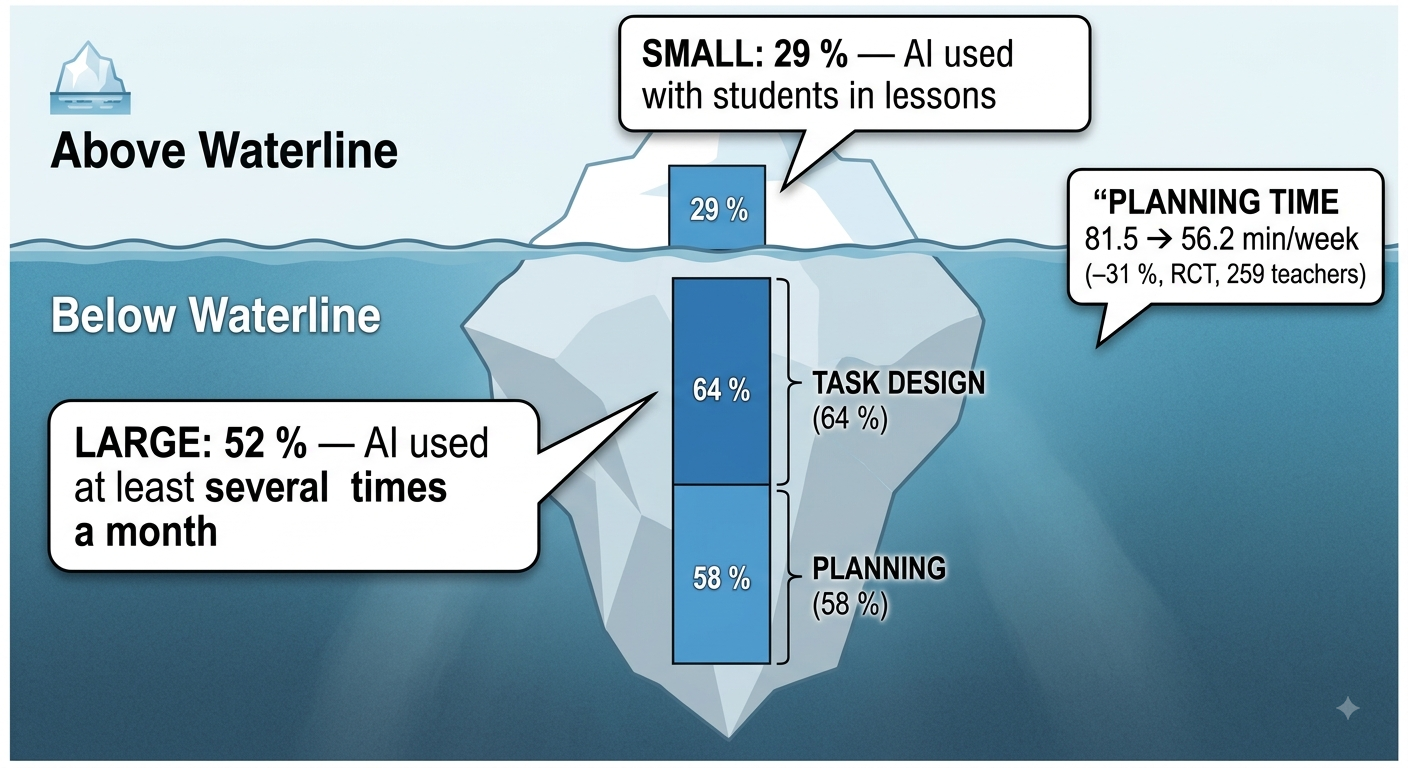](https://playbook.dualaiteacher.eu/uploads/images/gallery/2026-08/gemini-generated-image-rh2xsorh2xsorh2x-2.png)
Fig. 2: Difference in AI use for preparation compared to usage in the classroom. Image created with GoogleGemini
What **is** happening is workload relief, and here the news is good. In a British trial, 259 teachers across 68 schools were given AI support for planning science lessons for 11- to 13-year-olds. Planning time fell **from 81 to 56 minutes a week**. When independent assessors reviewed the resulting materials, they found no drop in quality. Teachers' own estimates of the time they save across all subjects are even higher, at around six hours a week for regular users.
And one pattern is worth pausing on. In a large American survey, **teachers in schools with a clear written AI policy reported saving about a quarter more time than teachers in schools without one.** That is the teachers' own account rather than a measurement, and a survey cannot show which way the arrow runs. Well-organized schools may simply do both things well. But it is the opposite of what most people expect, and it is worth noting that nothing in the sources behind these points the other way: wherever this has been examined**, clear rules and heavy use go together.** -> [1.5 Compliant use of AI](https://playbook.dualaiteacher.eu/books/playbook-en/page/14-compliant-use-of-ai "1.5 Compliant Use of AI")
### Why the tool is not the point
If you wanted a ranking of the best AI tools, the research will disappoint you and then, on second reading, set you free. When researchers gather many separate studies and ask what separates the classrooms where AI helped a great deal from those where it barely helped at all, the answer is never the brand of software. It is what the students were asked to *do* with it.
There are three comparisons that really drive the point home.
- Students who used AI to transform something, e.g., rework a draft or build on their own attempt, gained about two and a half times as much as students who simply held a conversation with a chatbot.
- Students who used AI in pairs gained about 70% more than students who used it alone.
- AI was used to provide feedback on student work, and it's fair to say it made one of the biggest gains in this area. In contrast, using AI to incorporate gamification into lessons produced a gain too small to call proven..
Pedagogy beats technology, and by a wide margin. This is what happens every time somebody sorts the studies by what the students were actually doing. Two limits should be considered equally.
**Good feedback is not the same as feedback that works.** In one experiment, 70 university students wrote an argumentative essay and revised it a week later. They were assigned at random to three groups: one got feedback from an experienced teacher, one from a chatbot given a plain instruction, and one from the same chatbot prompted to reason through the essay step by step. Marked against the same rubric, the step-by-step chatbot produced the **best feedback of the three.** The feedback was better than the plain chatbot and better than the teacher. Then came the revisions, and **all three groups improved by much the same amount.** The best feedback in the study brought no more improvement than the lowest-rated feedback. **Better comments did not produce a better essay.**
That deserves a moment because it challenges a common assumption that better feedback leads to better learning. It does not, on its own. Feedback only does anything if it is **taken up**: read, understood, acted on, and understood well enough that the student could get it right unaided next time. **Uptake is the bottleneck, not quality**.
Two things appear to get in the way, and both are usable.
**More isn't always better.** In a second study, with 60 Year 11 students and 240 pieces of writing, the AI produced way more content-related comments than the teachers did. 333 against 241. It was the teachers' comments that the students acted on more often. When confronted with thirty precise corrections, a student might either stop diagnosing and start triaging or just comply. If a student follows the rules, they're basically saying that the revision was unnecessary. It's the satnav again, but on a different level. It gives you really detailed feedback, like 'Turn left in 200 meters' for your own writing.
**Who says it matters.** We're not really sure why teacher comments are taken up more often. This is all about interpretation, not measurement, but the most likely explanation is that feedback is seen as an act between people. What someone who knows what you did last term and will see what you do with it has to say is different from the same sentence generated on request.
**What follows for practice.** All the evidence we've seen on automated feedback shows that it works best when students take what they've learned in one task and apply it to a new task. It's least effective when they just copy and paste what they've learned straight from the text in front of them. And it's way more effective when you use it over a longer period of time, like a whole term, rather than just in one go. **So, we shouldn't be asking whether the AI's feedback is good enough**. **We should be asking whether this student will ever have to use it again. If the answer is no, better comments are unlikely to help.**
**And the same split shows up at scale.** One team pooled 228 studies: AI clearly and consistently improved what students could produce, while any gain in their ability to plan, monitor and correct their own learning was small enough to have been chance. Programming shows it sharpest. Students with an AI assistant were measurably faster, and no better at the end than those without one. **Getting more done and getting better are not the same thing, and AI separates them.**
### Europe as mirror
Across Europe the share of teachers using AI runs from **89 % in Czechia to 14 % in France.** Please consider that the surveys differ in method and timing, so read the spread, not the individual figures.
France is the instructive case. It built one of the continent's most ambitious state AI programs, an AI tutoring scheme in maths and French. Nevertheless, France still sits at the bottom of that table, as only 9 % of French teachers have received any training in AI, compared with roughly 38 % across comparable countries. **Providing tools is the easy half but qualification is the half that decides.**
Two countries have written the satnav problem into policy the way a driving school would: map first, device later. Norway recommended in June 2026 that generative AI remain essentially out of primary school and be taught only in lower secondary school, where teachers have been trained, and AI should be taught as a deliberate skill. Luxembourg stages it similarly. Note carefully: Norway issued a **recommendation**, not a binding ban, however the international press reported it.
### The blind spot
One risk of AI is rarely named, and the image reaches it too: knowledge about the London city map **is not permanent.** A driver who follows the arrows for five years does not keep the city in her head. It fades, and she stops noticing the dug-up street. Your expertise is maintained by doing the very things AI is best at absorbing: writing the task, anticipating the misconception and drafting the explanation. **Where AI takes over the work through which judgment forms, relief turns into deskilling. In a German expert panel, 65 % of education experts identified this risk for the teaching profession, rising from 44 % the year before.**
Use the satnav. Just keep the map.
# 1.3 Responsible Use of AI
### Take Home message
- **Responsibility is a design task, not a control task.** Detection of AI does not work properly.
- **And AI detection is unfair when it fails.** There is a risk of mistakenly identifying answers as AI-generated, or vice versa. Several European countries have already ruled out these tools.
- **Confident invention and inherited bias follow from how these systems are built and judged.** The consequence should be: teach them rather than waiting for a fix.
- **The working principle is: think first, then AI.** Making people commit to their own answer beats explaining the machine; building limits into the software beats banning it.
- **Prompts alone don't hold.** A chatbot tasked with acting as a tutor tends to drift back to giving answers, which makes reliable limits a purchase question.
- **Amplification is the default; equalization must be built** from access, design and scaffolding together — and the scarcest of the three is a trained teacher.{{rev}}
- **Inclusion is the clearest win**, and where teachers themselves see the strongest case.
> If you remember only one sentence from this page: **The dams are breaking. Teach swimming.**
### The reading journal, second look
Back to our ninth-grade student and his suspiciously polished reading journal. The instinct is almost universal, and it is the instinct of a good teacher: *find out whether he used AI.* Build a better dam.
This chapter is about why that instinct, on its own, leads nowhere. We will come to what works instead.
Start with the uncomfortable part. **Teachers cannot reliably tell AI text from student text.** In a German study, 289 teachers of different experience were given a mix of student writing and chatbot writing and asked to sort it. Neither group could. But both groups were confident they could. Experience made almost no difference. At scale, it is worse. At one university, researchers submitted chatbot-generated answers into the real examination system through the normal channels, without notifying the markers. **94 % were never questioned**. Moreover, on average, they were graded *above* the work of actual students. So, what's the consequence? We reach for the machine! And here the finding stops being awkward and becomes an ethical problem!
### The detector that fails the wrong students
Researchers tested seven of the most widely used [AI detectors](https://playbook.dualaiteacher.eu/books/playbook-en/page/table-of-technical-terms "Table of technical terms") on TOEFL essays written by students learning English as a foreign language. Alongside, they put essays by native-speaking American eighth-graders. The native speakers' work was classified correctly almost every time. Of the foreign-language essays, **more than six in ten were wrongly flagged as machine-written**.
The mechanism is not mysterious. These tools do not detect the work of Large Language models, they detect *predictability*. Text that uses common words in expected orders scores as artificial. Anyone writing in a second language, with a smaller vocabulary and safer sentence structures, produces exactly that signal. **The tool's mistakes fall systematically on the students who are already carrying the most.** Institutions have done the arithmetic. Vanderbilt University pointed out that even if such a tool were wrong only 1 % of the time, that would still mean roughly **750 wrongly accused students a year** out of its 75,000 submissions. Consequently, they switched it off. The guidance issued by Germany's federal education ministry is blunt: the technology is *"not sufficiently reliable to provide legally secure proof."*
Much of Europe has stopped debating this. France, the Netherlands and Switzerland advise against detectors or forbid them. The United Kingdom's exam regulator has deliberately chosen human judgment over software. The Dutch argument goes one step further and is worth carrying home: **pasting a student's work into a detector is itself an act of processing their personal data**, and doing it without permission breaks data protection law. → [1.5 Compliant Use of AI](https://playbook.dualaiteacher.eu/books/playbook-en/page/14-responsible-use-of-ai "1.4 Responsible Use of AI")
It seems that the cheating panic is thinner than the noise around it. Researchers surveyed students at three secondary schools before ChatGPT existed and againafterward. Cheating stayed broadly where it was. Most students rejected having a chatbot simply produce their work, while thinking it fair to use one to get started or to have something explained.
The real question was never, "How *do I catch him"?* It is: **what does a homework task still measure, once its product can be generated on demand?**
### Two things that will not be fixed, so they must be taught
**Confident invention is built in.** These systems generate plausible continuation of a text, which are not the same as true ones. Researchers have now formally shown where this comes from: the standard tests used to judge Large Language model reward confident guessing over admitting uncertainty, so as long as they are measured that way, a certain rate of fluent, well-formed falsehood persists. It is a property of how they are built and graded, not a bug awaiting a patch.
**The slants in the training material are built in too.** Moreover, they do not shrink as the technology improves. A European study of gender stereotyping across languages found that bigger models, even after the extra training intended to make them safer and fairer, sometimes stereotype *more* rather than less. If a property cannot be engineered away, it becomes curriculum. And it can be taught: in one Finnish programme, the share of students who could identify bias in an AI system's output rose from **7 % to 44 %**. The consequence for teaching must be training error analysis instead of error avoidance. In other words: the machine's failures become the lesson.
### What works: design, not control
The evidence points to one simple principle that's easy to remember: **think first, then AI.**
- **Make the human commit first.** In a series of experiments, people who had to write down their own answer *before* seeing the machine's suggestion caught far more of its mistakes than people who were shown detailed explanations of how the machine reasoned. Explaining the AI did not help to solve that issue, but forcing the judgement did. With one honest caveat: the versions that worked best were the ones participants liked least, and they helped most those who already enjoy effortful thinking. So it is a phenomenon also known as the Matthew Effect: To those who have, more will be given. They benefit the most from this approach.
- **Build the limits in.** The chatbot from [Chapter 1.3](https://playbook.dualaiteacher.eu/books/playbook-en/page/12-teaching-about-vs-teaching-with-ai "1.3 Teaching About vs Teaching with AI"), that withheld answers and asked questions instead is the same idea in software: the students who used it lost nothing on the exam, while those with the unrestricted version lost badly.
- **Make the process visible instead of hunting the product.** Drafts, working notes, a short conversation about the work. These show you what a student can do without anyone having to prove what they did.
- **Denmark is piloting the principle:** at participating schools, students may use AI while preparing for the oral English examination, and the written examination includes a handwritten, aid-free part.
Two limits are worth knowing before you rely on this. The first: the popular advice that teachers should simply instruct a chatbot to act as a Socratic tutor does not survive contact with a long conversation. At least at the moment, the system tends to drift back into supplying answers. Reliable limits have to be built into the system, which makes them a purchasing decision rather than a prompting skill. The second: making an AI explain its reasoning sounds like the obvious safeguard, but explanations do not reliably prevent over-trust. In one study they left people's acceptance of *wrong* advice unchanged, and explanations that are too technical or too simplified can increase misplaced confidence. Explanation is a condition, not a solution.
### Attitude: two failure modes, not one
We worry that teachers are placing too much trust in AI. However, we should be equally concerned about the reverse. Even experienced people can be caught out by over-trusting. In one study, teachers reviewed AI-generated grades. They judged 42% of the machine's feedback to be vague or wrong, but changed only 9% of it. **Spotting an error and correcting it are different processes.**
The opposite pole is concealment. Teachers hide their own use of AI from colleagues and students, forbidding them to do what they do themselves: 77% use AI privately, while 57% say students should never use it to generate ideas. Meanwhile, a study of academically able students in grades 6 to 8 found that between a third and two-fifths already said the AI knows more than their teachers. **A profession that hides its practices cannot model responsible practice**, and transparency is not just a courtesy. It is the mechanism by which teaching by example works.
### Does AI level the field or tilt it?
For work-related tasks, AI evens out differences. In one experiment, participants with higher levels of education performed significantly better than those with lower levels of education. When each person was given an AI assistant, these differences disappeared almost entirely. Then take the assistant away again, and much of it came back. **What the AI closed was the gap in output, not the gap in ability.**
In learning tasks, it does the opposite. One study found no average benefit at all, but a widening distance between students who already knew a lot and students who did not. Another looked at students writing in a foreign language: the weaker writers received *more* corrections from the AI and successfully acted on *fewer* of them, and several found the flood of feedback dispiriting. **Feedback without the ability to sort it does not help; it buries.**
The gap also exists before anyone touches a tool. In Germany, **80 % of students from the most advantaged homes see AI as an opportunity, against 55 % from the least advantaged**. In Britain, the divide runs through the staffroom rather than the device cupboard: **45 % of teachers at private schools have had formal training in using AI, against 21 % at state schools.** Within the state sector, wealthier schools again outpace poorer ones. A survey of children across 20 European countries finds the same social split in how much and how variedly they use AI. One line captures the whole problem better than any figure: *"the rich have access to technology and people to help them use it, while the poor have access to technology only."* Which is the strongest available argument that teachers matter to close this gap.
So the bottleneck is what learner has a teacher who has been trained. **AI compensates when three things hold together: secure access, a tool designed for learning rather than answering, and a teacher scaffolding its use.** Remove any one, and it amplifies instead. Since all three tend to be present in the same schools and absent in the same schools, **amplification is the default and equalisation is something you have to build.**
# 1.4 Compliant Use of AI
### Take Home message
- ***There is no legal vacuum.*** Data protection law has applied all along.
- ***The timetable moved.*** The high-risk duties for education AI start on **2 December 2027**, not August 2026. Check your school's handouts.
- ***Already binding since February 2025.*** Emotion recognition in schools is prohibited, and schools deploying AI must ensure staff competence. Labelling of AI-generated content starts in August 2026.
- ***The hardest layer is data protection.*** No personal data about pupils without a contract that excludes training on your inputs; consent usually does not carry; deleting names is not anonymizing.
- ***In copyright, the upload is the problem.*** The teaching exception does not cover feeding protected works into an AI.
- ***Detectors do not hold up as evidence.*** Reasoned inference from concrete signs does. Rules must be clear in advance, and labeling beats banning.
- ***Grades stay human*** — and rubber-stamping an AI's suggestion is not a human decision.
- ***Responsibility sits with procurement, not with you** — and* ***compliance enables.*** The schools with clear rules are the ones whose teachers report saving the most time.
> If you remember only one sentence from this page: **Compliance is a house, not a wall.**
### The reading journal, third look
Our ninth-grade student, his reading journal, his teacher's suspicion. In [Chapter 1.2](https://playbook.dualaiteacher.eu/books/playbook-en/page/13-teaching-about-vs-teaching-with-ai "1.3 Teaching About vs Teaching with AI"), it was a question about learning; in [Chapter 1.3](https://playbook.dualaiteacher.eu/books/playbook-en/page/14-responsible-use-of-ai "1.4 Responsible Use of AI"), about professional judgment. Here it is a court file.
In December 2025 the Administrative Court of Hamburg, Germany, ruled on an urgent application in the case. The teacher had noticed that the journal did not match the boy's writing style in a class test. As a consequence, the school treated it as deception. This was followed by an urgent application to stop this, but the court refused. Undisclosed AI use in schoolwork counts as deception even where the school has no explicit rule against AI. All students must assume they are to work independently unless they have been told which aids are allowed. One caveat to keep in mind from the outset: this is a single court, and the decision is not yet final.
This is a good moment to address the most common misconception in this field. **There is no legal vacuum.** There never has been.
### The house has three storeys
Most teachers envisage AI law as a single wall under construction somewhere in Brussels. However, it is more useful to picture a house that you already live in. **The foundation is data protection.** It is load-bearing. It was laid years ago. It governs your Tuesday morning. **The upper storey is the EU AI Act,** Europe's AI law, which categorizes systems according to their potential for harm and imposes stricter obligations the higher the risk. It is partly occupied and still under construction, with the completion date just pushed back. **The doors and windows are copyright and examination law** — small and specific, and touched daily without noticing.
#### Ground floor: data protection, clearer than many think
Handling someone's personal data always requires legal permission. As a public body, a school's permission essentially comes from its statutory duties under school law. There is no general license that comes with being a teacher.
Three consequences follow, forming the practical core of this chapter.
**Consent does not provide a solution.** One obvious solution would be to simply ask the parents. However, this approach has two drawbacks. Firstly, consent must be freely given. In a school context where grades are a factor, a teacher's request does not constitute a free choice. Secondly, consent must be informed, which is difficult to achieve when nobody knows where the data will end up. **Permission must come from school law**, not a signature, as this shifts responsibility upwards, away from you.
**Removing names does not anonymize data.** In 2024, Germany's data protection authorities jointly stated that if someone could still be identified from the context, the data is still personal. This is particularly problematic in schools because the types of text that teachers most want help with — such as essays, free writing and learning journals — identify their author by style.
**The dividing line is the contract:** a provider may handle your data if it does so strictly on your instructions and there is a written agreement to this effect. However, the moment it uses what you type for its own purposes, the arrangement collapses because it is no longer working on your behalf. So the practical test is this: I**s there such an agreement, and does it exclude training on your inputs?** If not, no personal data should be entered.
Two footnotes worth noting: Data relating to health, disability, and special educational needs is subject to even stricter protection under EU law, and at least one German state (Baden-Württemberg) has explicitly prohibited its use in AI systems by ministerial decree. Where private devices are involved, **the legal responsibility lies with the school, not you personally**, which relieves you and obliges your head teacher.
#### Upper floor: what the AI Act does and does not require yet
Here is the correction that makes most existing guidance out of date. In July 2026, the EU postponed the heaviest set of AI Act duties for education, which are those attaching to systems classed as **high-risk**, meaning systems used to decide admissions, to assess what pupils have learned, or to monitor them during examinations, **from August 2026 to 2 December 2027**. A great many handouts written in 2025 and early 2026 still print the old date. If a document in your school does, it needs a footnote.
The more useful correction runs the other way: **what already applies is underestimated, and what is endlessly discussed does not apply yet.**
Two things have been binding since **2 February 2025**.
- **Emotion recognition in schools is prohibited outright.** Systems that claim to read pupils' feelings — attention detection, mood analytics, "engagement" scoring from a webcam — are not a grey area. They sit on the Act's short list of practices that are simply banned.
- **Schools that deploy AI must make sure their staff know what they are doing with it.** No fine is attached to this one, which is why it is widely overlooked. It is binding all the same.
Read that second duty alongside [Chapter 1.3](https://playbook.dualaiteacher.eu/books/playbook-en/page/13-teaching-about-vs-teaching-with-ai "1.3 Teaching About vs Teaching with AI") and something clicks. The gap between knowing about AI and being able to teach with it is no longer only a professional problem. **Since February 2025 it has been a legal obligation.**
Since **2 August 2026**, AI-generated content has to be labeled as such. From **2 December 2027**, systems used to decide who gets admitted, to assess what pupils have learned, or to monitor them during examinations count as high-risk. Whoever *uses* such a system then assumes the duties that come with it. This incorporates a requirement that the people overseeing it be, in the Act's words, *"competent, trained and authorised"*. Note the wording. The law has arrived at the same conclusion as the pedagogy: **oversight without expertise is not oversight.**
#### Doors and windows: copyright and examinations
Counter-intuitively, **what comes out is the easy part.** A text or image generated by an AI generally has no human author in the sense copyright requires, so it is usually free of copyright itself. It is not, however, guaranteed to be clean: in the first major European ruling of its kind, a Munich court found that a chatbot had memorized song lyrics and reproduced them almost word-for-word. The court placed the liability on the **provider**, not on the person who typed the request. Whether a teacher who passes on such material could be liable is, as things stand, **an open question**. What goes in is the clearer problem, but note that this is a question of **copyright, not of the AI Act.** The AI Act says nothing about what teachers may feed into a system; that is an older and entirely separate body of law.
The exception that lets teachers copy material for their classes covers exactly that: copying a limited share of a work, for that class. **Uploading a protected work into a commercial AI system is a different act, and the exception does not address it.** Material intended for school teaching, which is mainly textbooks, is excluded from the exception in any case. So scanning a chapter to have it summarised is an everyday act that the teaching exception does not obviously cover.
**How much should that worry you?** Less than the gap suggests, and more than nothing. The question is **genuinely unsettled**: no higher court has ruled on it, and the specialist literature regards the existing exceptions as a poor fit for the situation. Where a rights holder objects, the claim would be a civil one, and in practice, this is a matter for school policy and procurement rather than something an individual teacher can settle. What is *not* unsettled is the narrow case, and it is the line worth remembering: **school textbook and publisher material should not go into AI tools at all — neither scanned nor retyped, not even to generate a worksheet.**
Case law in this field seems currently inconsistent across Europe. In February 2026, the Administrative Court of Kassel, Germany, decided two university cases the same way, and sharply: where a student has signed a declaration that the work is their own, the line is crossed *"already with a single undisclosed use of generative AI"*. A Paris administrative court, in February 2026, forbade a university to sanction a student at all: it had produced no rule governing AI use, and without a rule set out in advance there was no disciplinary breach to find. A Swedish appeal court had reached the same result earlier, on facts almost identical to a Dutch case that went the other way. In this case, a student submitted invented sources, but the course rules permitted "all aids" in take-home work, so there was nothing to have broken. Where fabrication *was* clearly proven, and a rule existed, courts have upheld sanctions. The Dutch Supreme Administrative Court did so in 2025.
So the pattern across jurisdictions is not about countries. It is about **whether a rule existed beforehand, and whether the deception was actually shown.**
**Three** rules follow for practice.
1. **Detectors do not carry the burden of proof.** What the law does allow is an inference from typical signs. This includes repeated, oddly polished phrasing, a mismatch between what they can write and what they can say, and sources that turn out not to exist. The student can then explain. That is a legitimate route, and it does not require software. Detector output, at best, is one sign among others. The failure rate reported in [Chapter 1.3](https://playbook.dualaiteacher.eu/books/playbook-en/page/13-responsible-use-of-ai) renders the instrument unusable as evidence.
2. **Rules must be clear before the assessment, not after.** Neither a blanket ban nor a blanket permission holds up. What works is a declaration of independent work with a general clause about AI, plus a duty to state what was used. In Germany, Bavaria went furthest in 2026: its universities may **not** forbid AI in unsupervised assessments at all, but must require students to declare it. Labeling instead of banning.
3. **Grades stay human.** No decision with legal consequences for a person may be made by a machine alone, and a grade is such a decision. Germany's Standing Conference of the Education Ministers puts it even more strongly: assessment is a task only teachers can perform. Crucially, **formally waving through an AI's suggestion does not count as a human decision.** So the finding from Chapter 1.4, wrong AI feedback is also a pedagogical and a legal problem.
Law, ethics and didactics therefore converge on the same answer: **assess the process, not just the product.**
### The real address of responsibility
In response, Germany has introduced state-provided school AI environments. These are vetted platforms with negotiated contracts, rather than leaving teachers to sign up to whatever is free. While these solve problems that individual teachers cannot solve alone, they are still criticized for how they are governed, whether teachers actually accept them and whether the assessments they support are sound. Since the rollout is currently limited to a select group of schools and specific subjects, we will need to monitor over the next few months how teachers are faring with the platforms.
What is distinctive is narrower than it may initially appear, and it is worth stating precisely: Rather than putting it out to tender or buying access to someone else's, Germany is the only European system where a state body builds and runs the platform itself. France also provides a platform for an entire year group, but it commissioned one and two private companies deliver it: one wrote the software and the other hosts the data. Most of the rest of the continent has simply purchased one. Slovakia has gone the furthest, with 20,000 licences for teacher training faculties that will be extended towards some 80,000 school teachers by 2026. The state will only pay for the licences actually used, and the provider is contractually barred from training on Slovak school data. Estonia negotiated a similar arrangement for its upper secondary schools, and Northern Ireland invested £10.7 million in licences for all teachers in all schools. The contractual guarantee that your inputs are not used for training — the feature that the German platform was designed to provide — can be purchased.
**Building it yourself does not automatically give you more control.** The German platform runs on the same commercial language models as everyone else's on European servers, as an industry association has pointed out. By contrast, the French system is hosted in France under the highest security certification issued by the French state. One country built the surface and rents the engine, while the other bought the software and keeps the keys to the building. Neither option is clearly the most sovereign choice, which is worth bearing in mind before using the term.
The Netherlands took a different approach, and it is worth knowing about because it offers a more honest answer to the same question. Rather than building or buying, Dutch schools and universities joined forces and had the major providers formally assessed. When they examined Microsoft's AI assistant, they found two issues that could not be resolved: the criteria for an automatic content filter that the provider would not disclose and the retention of eighteen months of diagnostic data that could not be justified. They negotiated. In March 2026, however, the provider declined to change. The assessment therefore remains amber, and Dutch schools are advised to exercise caution and use their own judgement on a case-by-case basis rather than granting clearance. One country removed the risk by building around it, while another took a closer look and decided it was not ready yet. Both approaches offer solutions to the problem set out at the start of this chapter.
The comparison also settles one more thing. The complaint that teachers prefer the free chatbot to the official one is not due to a failure of implementation in Germany. In Estonia, where the state negotiated access for every upper-secondary student, barely more than a third were using the official chatbot weekly after a year. In turned out, that most of them had been using free tools before the program started. **Everywhere, the vetted environment competes with the more convenient one.** Providing the official tool is necessary. But this is not sufficient.
However, the structural point stands: compliance is an enabling condition, not a hindrance. Remember what was said in [Chapter 1.2](https://playbook.dualaiteacher.eu/books/playbook-en/page/12-teaching-about-vs-teaching-with-ai "1.2 Teaching About vs Teaching with AI")? **The schools with clear rules were the ones whose teachers said they saved the most time**. There is nothing in the sources behind these chapters that suggests otherwise.
# 1.5 Current State of AI in Education
### Take Home message
- **AI is already widely used in educational contexts.**
- **Teaching with AI.** AI is currently used by teachers to prepare or improve lesson plans, for assessment and to distinguish content across different educational levels.
- **Teaching about AI.** AI is used by students though they have no groundings on what is AI, which are its limitations and to use it responsibly.
- **Technical understanding and critical thinking are needed.** Teachers and students need to understand how language models work (training, data handling, predictive nature) and develop practical verification skills, from spotting fabricated citations to fact-checking AI-generated content.
- **Responsible use and ethical stance are to be defined**. A grasp of the legal and ethical landscape (AI Act, GDPR) is needed, along with an approach to AI as a support rather than a substitute for human thinking, grounded in transparency and accountability, plus explicit instruction in prompting as a teachable skill.
- **Equity and new assessment models are needed.** Equitable access to AI tools needs safeguarding (public funding, open models, minimum age policies), alongside a shift in assessment from grading the final product to evaluating the process and students' ability to critically engage with AI output.
> If you remember only one sentence from this page: **AI is already present in educational contexts but is not regulated. Structured frameworks are needed to support educators' professional development improving their knowledge and letting them teach with AI and about AI.**
### Current Uses of AI in Educational Contexts
Nowadays, artificial intelligence (AI) is embedded in everyday educational practice, well beyond pilot projects. Common applications include adaptive learning platforms, intelligent tutoring systems, automated grading, and AI-assisted lesson planning for teachers ([OECD, 2026](https://www.oecd.org/en/publications/oecd-digital-education-outlook-2026_062a7394-en.html)). The most visible shift, however, is the direct use of general-purpose tools by students and teachers alike.
#### Teaching With AI
AI is increasingly used by teachers as a support tool across multiple stages of their work, from lesson planning to grading. According to OECD's TALIS survey, 37% of lower secondary teachers reported using AI in 2024, with 57% saying it helps them write or improve lesson plans (OECD, 2026). Beyond lesson design, teachers are using AI to differentiate content for different skill levels, generate practice materials, and support the grading process. At the same time, adoption is not without friction: 72% of teachers expressed concern that AI could enable students to pass off AI-generated work as their own, reflecting a broader tension between AI's practical benefits for teaching and its implications for academic integrity (OECD, 2026).
#### Teaching About AI
Alongside using AI as a teaching aid, there is a growing need to teach students about AI itself: how it works, its limitations, and how to use it responsibly. This includes building a basic understanding of language models as prediction engines rather than databases, which explains their tendency to hallucinate, as well as practical skills such as fact-checking AI output and recognising fabricated citations (UNESCO, 2024). It also involves developing critical thinking around prompting, shifting students from simply following instructions to formulating them, and instilling awareness of the ethical and legal dimensions of AI use, including data privacy and the EU AI Act. UNESCO's *AI Competency Framework for Teachers* (2024) frames this as a core professional competency, arguing that teachers themselves need training in these areas before they can effectively teach them to students.
### What is missing?
Alongside institutional frameworks and adoption data, it is important to understand how these dynamics play out in practice. A series of workshops was conducted in the context of the DUAL.AI.TEACHer project. Numerous education stakeholders were called to gather first-hand perspectives on the current use of AI in teaching. These workshops surfaced a set of concrete needs and concerns expressed by educators, covering practical, pedagogical, and training-related aspects. The following sections outline these needs in detail.
- **Understanding How AI Works.** Both students and teachers need to understand how language models are built and trained, and what happens to their data once provided. They also need to grasp the nature of these models as prediction engines rather than databases, which explains their tendency to hallucinate. Teachers need a simple high-level course covering the basics of how LLMs work.
- **Critical Thinking, Questioning and Verifying AI.** Students and teachers need to be able to question AI-generated answers and to recognize fabricated information. Practical verification skills are also needed, from checking AI output against official sources to spotting AI-generated images and videos. Students need to shift from following instructions to formulating them, thinking critically about the desired output.
- **Ethics, Data Protection and Regulation.** A general understanding of the ethical and legal aspects of AI use is needed, including the EU AI Act and GDPR. Safe and responsible use is essential to prevent illegal practices along with awareness of related issues like bias in teaching materials and the unreliability of AI detectors.
- **Responsible Use.** AI needs to be used mindfully as a support, not a replacement, leaving room for students' own thinking. Transparency matters, with students expected to flag which parts are their own, echoing "cyborg writing", where AI extends rather than replaces the writer's thinking. Student ownership and accountability are also needed.
- **Practical Skills.** Prompting needs to be treated as a teachable skill, not something acquired independently. Both teachers and students need explicit instruction in writing effective prompts, and teachers need training in prompt engineering for lesson planning, differentiation, and grading. Broader tool familiarity is also needed to match tools to subjects.
- **Equity and Infrastructure.** Access to AI is at the centre of growing equity concerns, as wealthier districts can afford better tools, widening competence gaps between schools. Public funding is needed to guarantee equal access regardless of a school's resources, preferring open AI models over corporate ones as part of this effort. A minimum age for AI use also needs to be defined.
- **Assessment.** A different approach to assessment is needed, focused on process rather than final product, including students' reflections on AI-generated drafts. AI-integrated assignments are also needed, grading students on their ability to critique, fact-check and edit AI output, raising questions about the human role when teachers themselves rely on AI for grading. Concrete classroom methods are needed too, such as fact-checking AI text, comparing chatbot responses, debating AI use in homework, and incorporating non-digital tools like flip charts.
# 1.6 Legislation
### Take Home message
- **The EU AI Act is the legal basis.** The EU’s rulebook for AI is in force since August 2024 and phasing in through 2027. It applies not just tech companies, but also to schools.
- **AI literacy is a duty, not a course to tick off.** Schools must support staff in building AI literacy.
- **Several AI uses are banned outright.** Among them: inferring students’ emotions from facial or vocal data, AI that exploits children’s vulnerabilities to distort their behaviour, and building facial-recognition databases or inferring traits like race or religion from biometric data.
- **Risk depends on the decision, not the product.** Ordinary writing, research, translation and lesson-planning tools are not high-risk simply because they are used at school. They become high-risk once they influence admission, learning pathways, exam outcomes or employment decisions.
- **Not everything AI-generated needs a label.** The disclosure duty mainly sits with the provider; teacher-reviewed material with human editorial control is exempt.
- **High-risk AI needs a human who can overrule it.** AI output is never the final decision. You must understand its limits and be able to disregard or override it.
- **The AI Act sits on top of other law, it doesn’t replace it.** National data protection, education, employment, child protection and copyright law continue to apply alongside it.
- **The GDPR governs the data, not just the tool.** Even an AI system that is fine under the AI Act can still be off-limits if it processes personal data about students or staff without a valid legal basis.
> If you remember only one sentence from this page: **Use AI to support your professional judgement, not replace it—stricter rules apply as soon as AI helps make decisions about grades, educational pathways or people.**
### The EU AI Act
The EU AI Act ([Regulation (EU) 2024/1689](https://eur-lex.europa.eu/legal-content/EN/TXT/?uri=CELEX%3A02024R1689-20260727)) is the EU’s single, risk-based rulebook for artificial intelligence. Instead of regulating specific products, it classifies AI systems by the risk they pose and attaches obligations accordingly — from an outright ban for a small set of practices, through extra duties for “high-risk” uses, to no special rules at all for everyday tools. It applies directly in every member state, to public and private organisations alike.
The Act phases in step by step. It has applied since 1 August 2024; since 2 February 2025, the banned practices below and the duty to build AI literacy ([Art. 4](https://overview.legal/laws/ai-act/art-4)) are already binding; from 2 August 2026, most of its remaining provisions apply.
### Who is responsible for the use of AI?
If a school introduces and controls an AI system, the school or school authority is usually the *deployer* ([Art. 3(4)](https://overview.legal/laws/ai-act/art-3)). The teacher is normally not a separate deployer when using the tool under the school’s instructions, but must still follow those instructions and all relevant school and data-protection rules.
### Teachers need to know what they are using
Schools and school authorities must take appropriate measures to support the development of AI literacy among those who use AI systems on their behalf ([Art. 4](https://overview.legal/laws/ai-act/art-4)). The AI Act does not specify a particular level of competence, certificate or training format. These rather depend on the AI system used, how it is used, and who may be affected.
### AI practices banned outright for schools
The AI Act bans eight AI practices outright ([Art. 5](https://overview.legal/laws/ai-act/art-5)); four of them are directly relevant to schools:
1. Using AI systems in educational institutions to **infer emotions or intentions from biometric data** (such as students' facial or vocal characteristics) is generally forbidden. Narrow exceptions exist for medical or safety purposes ([Art. 3(39)](https://overview.legal/laws/ai-act/art-3); [Art. 5(1)(f)](https://overview.legal/laws/ai-act/art-5)).
2. AI systems that exploit someone’s vulnerabilities due to age (as with children), disability, or social or economic situation, in a way that distorts their behaviour and causes them harm, are banned regardless of intent ([Art. 5(1)(b)](https://overview.legal/laws/ai-act/art-5)).
3. Building or expanding a facial-recognition database through untargeted scraping of images from the internet or from CCTV footage is banned. This is relevant if a school considers a facial-recognition tool for attendance or exam monitoring ([Art. 5(1)(e)](https://overview.legal/laws/ai-act/art-5)).
4. Using biometric data to categorise people in order to infer protected traits such as race, political opinions, religion or sexual orientation is banned. This is relevant for any biometric-based tool, such as exam-proctoring software, that goes beyond its stated purpose ([Art. 5(1)(g)](https://overview.legal/laws/ai-act/art-5)).
### Does AI-generated content always need a label?
If students interact directly with an AI system, such as a chatbot, they must be informed that they are interacting with AI. Usually the system provider is responsible for making this clear ([Art. 50(1)](https://overview.legal/laws/ai-act/art-50)).
Schools and teachers must disclose deepfakes, or AI-generated text published on matters of public interest, when these are used in the classroom ([Art. 50(4)](https://overview.legal/laws/ai-act/art-50)). This requirement does not apply where the AI-generated content has undergone effective human review or editorial control, and a person or institution assumes editorial responsibility for its publication. An AI-assisted worksheet reviewed by a teacher therefore does not automatically require a label.
### When AI in education becomes high-risk
Ordinary writing, translation, research and lesson-planning tools are not high-risk simply because they are used for work. Classification depends on the system's intended purpose, not simply on which product is used ([Art. 6](https://overview.legal/laws/ai-act/art-6) · [Annex III](https://ai-act-service-desk.ec.europa.eu/en/ai-act/annex-3)).
AI systems may be classified as high-risk when they are intended to:
| For Teachers | For Schools |
| - decide about students' access, admission or assignment to educational or vocational institutions and programmes;
- evaluate students' learning outcomes or steer their learning processes;
- assess the appropriate level of education a student will receive or can access; or
- detect students' prohibited behaviour during examinations.
*([Annex III](https://ai-act-service-desk.ec.europa.eu/en/ai-act/annex-3), point 3)*
| - recruit or select teachers, including screening applications;
- decide on contract terms, promotion or termination of a teacher's employment;
- allocate tasks based on a teacher's behaviour or personal traits; or
- evaluate teachers' performance.
*([Annex III](https://ai-act-service-desk.ec.europa.eu/en/ai-act/annex-3), point 4)*
|
A limited checking or preparatory tool may also fall outside the high-risk category if it does not significantly influence a decision. However, an education system that profiles individuals is always considered high-risk.
### What high-risk AI means for schools and teachers
Classification of an AI system as high-risk does not automatically rule it out from use in schools. But high-risk systems come with obligations ([Art. 26](https://overview.legal/laws/ai-act/art-26)):
These obligations for high-risk AI in education apply from **2 December 2027** — but the prohibitions above and the AI-literacy duty already apply today.
| For Teachers | For Schools |
| - use it only for its approved purpose and follow its instructions;
- do not treat its output as a final decision;
- understand its main limitations and likely sources of error;
- watch for overreliance on apparently convincing results; and
- be prepared to disregard or override its output.
| - provide competent and authorised human oversight;
- ensure that any input data under its control is relevant and sufficiently representative;
- monitor the system and respond to risks or serious incidents;
- keep automatically generated logs for at least six months where those logs are under its control; and
- inform students, teachers or affected people in advance when the system assists decision-making about them.
|
Public bodies and private organisations providing public services may also have to complete a fundamental rights impact assessment before using high-risk AI ([Art. 27](https://overview.legal/laws/ai-act/art-27)). Public authorities and organisations acting on their behalf may additionally have to register the system in the EU database ([Art. 49](https://overview.legal/laws/ai-act/art-49)). Whether this is the responsibility of the school or its governing authority depends on the national school system.
### The AI Act is not the only law that matters
The AI Act does not replace european or national regulations on data protection, education, employment and worker participation, child protection or copyright ([Art. 2(7)](https://overview.legal/laws/ai-act/art-2)). For example, the fact that a tool is not high-risk does not mean that you may upload students' work or personal data to it.
**A tool may be acceptable under the AI Act but still prohibited by data-protection law or your school's rules.**
### The GDPR
The [GDPR](https://gdpr.eu) (Regulation (EU) 2016/679) is the EU’s law on data protection. It plays a supporting role alongside the AI Act: while the AI Act asks whether and how an AI system may be used at all, the GDPR asks whether this particular data about this particular person may be processed this way?
- **It applies as soon as personal data is involved.** Names, school email addresses, student work, voice recordings, transcripts, photos, grades, attendance and learning-progress data all count as personal data ([Art. 4](https://overview.legal/laws/gdpr/art-4)).
- **Some data needs extra protection.** Health information, biometric data and data revealing racial or ethnic origin, religion or similar traits are “special category data” and are, in principle, off-limits without a specific exception ([Art. 9](https://overview.legal/laws/gdpr/art-9)) — one reason the AI Act separately bans several biometric-inference practices in schools.
- **Know who is responsible.** The school is normally the “controller”; an AI provider processing data on the school’s behalf is a “processor” and needs a data-processing agreement that spells out its obligations ([Art. 28](https://overview.legal/laws/gdpr/art-28)). Check this before rolling a new tool out school-wide.
- **Data leaving the EU needs a safeguard.** Many popular AI tools are hosted outside the EU. Personal data may only travel there if an adequacy decision or another approved safeguard, such as standard contractual clauses, is in place ([Art. 44](https://overview.legal/laws/gdpr/art-44)).
- **Students and staff keep their rights.** They can ask what is held about them, have it corrected or deleted, and object to decisions based solely on automated processing that significantly affects them ([Art. 15](https://overview.legal/laws/gdpr/art-15)–[Art. 22](https://overview.legal/laws/gdpr/art-22)) — a right that runs alongside, and reinforces, the AI Act’s human-oversight requirements for high-risk systems.
### Where to find help
Enforcement is organised differently in each EU country. Because national responsibilities may change, use the European Commission's current [list of national market-surveillance authorities](https://digital-strategy.ec.europa.eu/en/policies/market-surveillance-authorities-under-ai-act). Anyone (a teacher, a student, a parent) can lodge a complaint with that authority if they believe the Act has been breached ([Art. 85](https://overview.legal/laws/ai-act/art-85)). Where a high-risk system, such as an admission or exam-monitoring tool, has led to a decision that significantly affects a student, they (or their parents) can also ask for an explanation of that individual decision ([Art. 86](https://overview.legal/laws/ai-act/art-86)).
### National rules for your country
The AI Act is EU-wide, but enforcement bodies, school law and data-protection practice differ by country. Country-specific notes for the Playbook's partner countries will be added here:
- [Austria](https://playbook.dualaiteacher.eu/books/playbook-de/page/17-gesetzgebung-osterreich)
- [Czechia](https://playbook.dualaiteacher.eu/books/playbook-cz/page/16-legislativa)
- [Germany](https://playbook.dualaiteacher.eu/books/playbook-de/page/16-gesetzgebung)
- [Latvia](https://playbook.dualaiteacher.eu/books/rokasgramata-lv/page/16-tiesiskais-regulejums)
- [Poland](https://playbook.dualaiteacher.eu/books/playbook-pl/page/16-przepisy-prawne)
- [Slovakia](https://playbook.dualaiteacher.eu/books/playbook-sk/page/16-legislativa)
- [Slovenia](https://playbook.dualaiteacher.eu/books/playbook-slo-oZf/page/16-zakonodaja)
- [Spain](https://playbook.dualaiteacher.eu/books/playbook-es/page/16-legislacion)
# 2. Good Practices & Classroom Examples (all)
# 2.1 Introduction
# 2.2. Biology: Vibe Coding Simulations in the Classroom
### Predator–Prey Dynamics (Lotka–Volterra model)
**Subject:** Biology · **Grade:** 9 (age 14–15) · **Duration:** 1 double lesson (90 min) · **AI:** Learning **WITH** AI
| AI-related competencies (DUAL.AI.TEACHer Framework) – teacher level | Subject-specific learning objectives – student/learner level |
| **AF-TL-2b**
*(AI foundations and applications × Teaching & Learning, Level 2 – Reflective Implementation)*:
“Teachers can organise lesson elements that embed AI use with clear pedagogical roles and strategies to verify the output elements.”
**AF-FC-2b**
*(AI foundations and applications × Facilitating Learners’ (AI) Digital Competence, Level 2 – Reflective Implementation)*:
“Teachers can implement guidance that helps learners developing practical AI skills, adapting the tasks to learners’ prior knowledge and the AI tools available.”
| By the end of the lesson, students can:
- describe the key variables (prey population, predator population) and parameters (growth rate, predation rate, conversion efficiency, mortality rate) of the Lotka–Volterra model;
- form and test hypotheses about population dynamics using an interactive simulation;
- extend an existing simulation with additional layers of ecological complexity (e.g. a carrying capacity, a second species, a seasonal factor) by writing structured prompts for an AI language model;
- critically evaluate the model’s assumptions and limitations (Nature of Science), including why introducing randomness or an additional factor can destabilise it.
|
> **Take-home message:** Students don't need to code from scratch. Reading and testing an existing simulation, then using an LLM to add one layer of ecological realism at a time, is enough to build genuine understanding of a dynamic biological model — and, sooner or later, to discover for themselves exactly where that model reaches its limits.
[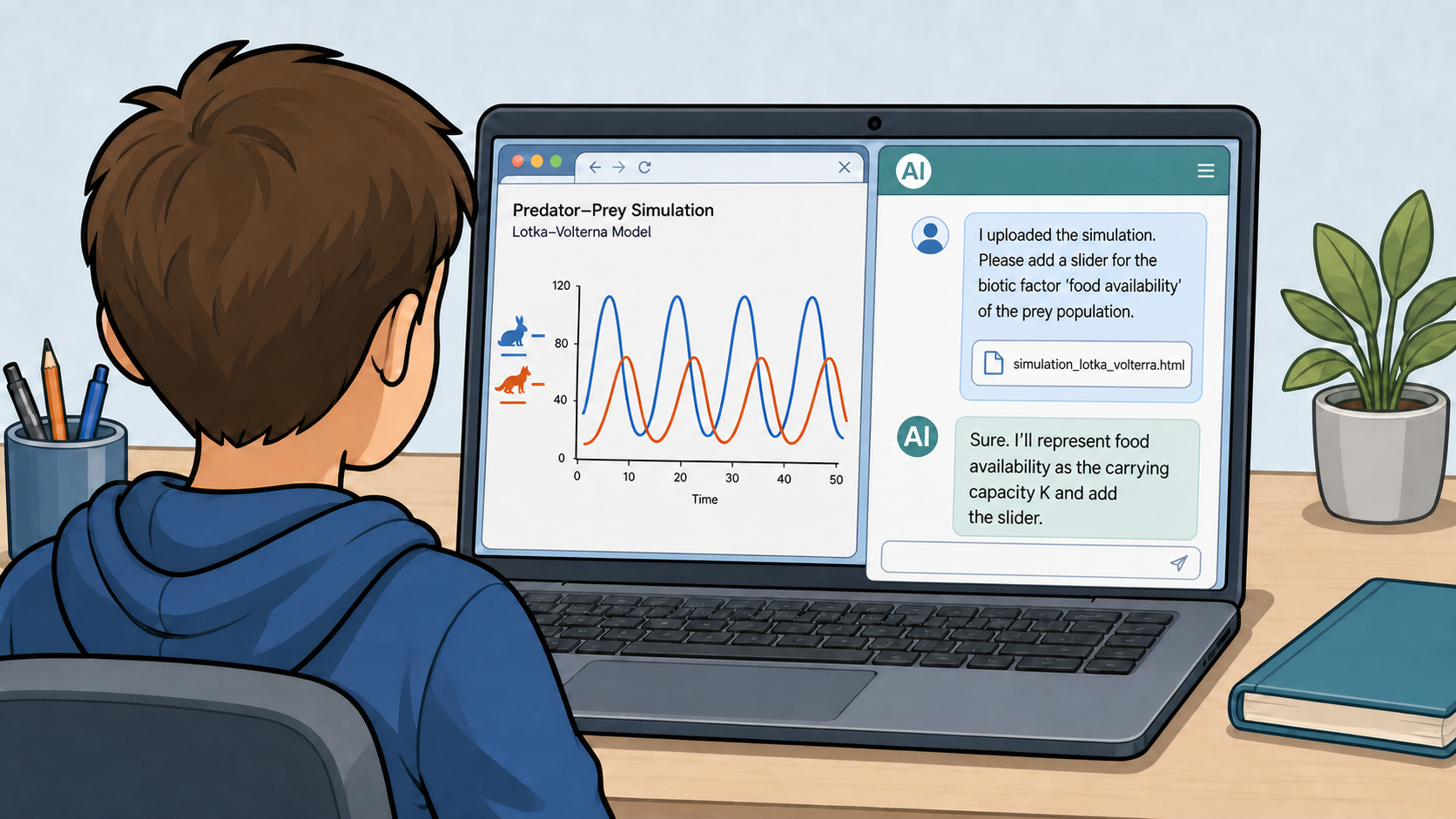](https://playbook.dualaiteacher.eu/uploads/images/gallery/2026-08/vibe-coding-simulations.png)
Fig 1. Image generated with ChatGPT (GPT Image 2), August 27, 2026.
#### Content
Mathematical models and computer simulations are especially valuable tools in ecology, because they can express highly complex systems through mathematical equations. This makes it possible to run experiments *in silico* and test hypotheses on the model in situations where a real experiment would be too costly, too slow, ethically difficult, or outright dangerous. Manipulating a real predator population, for instance, is rarely an option. At the same time, every model is necessarily a simplification of reality, and this is exactly where its weaknesses lie: real ecosystems are far more complex than any model can fully capture.
The Lotka–Volterra model is a classic example of such a simplification applied to predator–prey dynamics. It represents the system using two state variables (the prey and predator population sizes) and four parameters (the prey’s intrinsic growth rate, the predation-rate coefficient, the predator’s reproduction rate per prey consumed, and the predator’s mortality rate). Under its idealized assumptions, the model predicts sustained, periodic oscillations in which changes in the predator population lag behind those in the prey population. This behavior arises from a feedback loop: as the prey population increases, more food becomes available to predators, allowing the predator population to grow. Increased predation then causes the prey population to decline, which reduces the predators’ food supply and leads to a decline in the predator population. With fewer predators, the prey population can recover, and the cycle begins again.
To produce this clean cycle, the model makes several strong assumptions. It is **deterministic** (the same starting values always produce exactly the same curve); it is a **closed two-species system** that excludes every abiotic factor (temperature, precipitation, season) and every other biotic factor (food plants for the prey, a third species, disease); and it makes each population's growth depend on nothing except the size of the other population.
Real populations rarely meet these assumptions. Births, deaths and encounters are subject to chance, and a stochastic (randomised) version of the same model tends to drift away from the clean cycle and can even collapse (e.g. the predator population dying out) in cases where the deterministic version predicts stable oscillation. Likewise, adding just a single missing factor (e.g. a temperature-dependent growth rate, or a limit on the prey's own food supply) is often enough to break the clean two-variable cycle. This is not a flaw to hide from students, it is the central Nature-of-Science lesson of the activity. A model can be genuinely useful, while still being a deliberately narrow approximation of reality and using it well means knowing exactly which factors it leaves out. In this lesson's main activity, students discover this for themselves by trying to add exactly these kinds of factors.
#### Lesson plan
| Phase | Time | Activity |
| Introduction | 8 min | The teachers shows an unlabelled graph of a real predator–prey data series (e.g. lynx/hare); students describe the pattern and form first hypotheses. |
| Input | 12 min | The teacher introduces the model’s variables and parameters using a simple diagram (no differential equations needed). |
| Exploration | 15 min | Students test their hypotheses in pairs on a ready-made HTML simulation and record their observations. |
| Adaptation | 35 min | In pairs, students work through 2–3 rounds of *predict → prompt → test → diagnose* (guiding questions below), each time asking the LLM to add one more layer of ecological realism to the simulation (a limit on the prey's food supply, a second species, a seasonal/abiotic factor) until the clean two-variable cycle visibly breaks down. |
| Reflection | 20 min | Whole-class discussion, guided by questions such as: At which round did the simulation stop producing a clean, repeating cycle? What does the original model deliberately leave out, and why? What makes it a useful simplification rather than simply a wrong one? |
**Guiding questions: layering complexity**
Pairs work through as many of the following rounds as time allows in the 35 minutes (most manage two; the third is an extension for early finishers). Each round follows the same four-step cycle:
1. **Round 1 — limit the prey's food supply (a carrying capacity):**
- *Predict:* Before you start prompting, aks yourself: what do you expect to happen to the cycle if the prey's growth slows down once the population gets large, instead of growing without limit? Sketch the curve you expect.
- *Prompt:* Ask the AI to add a maximum sustainable prey population to the simulation, and to explain in its own words how it changed the growth equation to do this.
- *Test & compare:* Run the new simulation with the same starting values as before. Compare the previous simulation with the new one: how did the variables change? Why is that?
- *Diagnose:* Which assumption of the original model (unlimited food for the prey) did you just remove? Is this factor biotic or abiotic?
2. **Round 2 — add another (biotic or abiotic) factor:**
- *Predict:* If a third species now competes with the prey for food, or preys on it as well, or if prey growth now depends on temperature what do you expect this to do to the original two-species cycle?
- *Prompt:* Choose another factor and write a prompt asking the AI to add it as a new variable linked to the existing ones — specify exactly how it should interact with the prey or predator population.
- *Test & compare:* Observe the simulation over several cycles. Does the original two-species rhythm survive, get distorted, or disappear?
- *Diagnose:* The original model assumed each population depends only on the other. Is that still true after this round? What real ecological relationship does your new factor represent.
3. **Optional round 3 — introduce randomness:**
- *Predict:* If one parameter (e.g. the predation rate) is no longer fixed but drawn randomly within a range at each time step, what do you expect for the long-term stability of the populations?
- *Prompt:* Ask the AI to replace one constant parameter with a randomised value and to keep track of whether either population reaches zero.
- *Test & compare:* Run the simulation several times with the same settings. Do you get the same result every time? Does either population ever collapse?
- *Diagnose:* Why can the same “average” parameter values sometimes lead to extinction here, when the deterministic model never predicted that?
**Closing question (for the Reflect phase):** At which round did the simulation stop producing a clean, repeating cycle — and what does that tell you about how many real-world factors the original Lotka–Volterra model has to leave out in order to stay solvable and easy to interpret?
#### Materials
- One laptop per student pair, with a browser
- Access to an LLM chat interface via the internet, or a locally installed model if internet access is restricted at school
- Ready-made HTML predator–prey simulation (single file, sliders for selected parameters)
- A short prompting / worksheet template for the “layering complexity” rounds (predict → prompt → test → diagnose)
- Guiding questions for the exploration phase and the Nature-of-Science reflection (model purpose vs. model limits)
# 2.10. Programming: Assistance in selected tasks
### Learn to program code without AI writing code
**Subject:** Programming · **Grade:** 9 (age 14–15) · **Duration:** 1 double lesson (90 min) · **AI:** Assistance **WITH** AI
| AI-related competencies (DUAL.AI.TEACHer Framework) – teacher level | Subject-specific learning objectives – student/learner level |
| **AF-TL-2b**
*(AI foundations and applications × Teaching & Learning, Level 2 – Reflective Implementation)*:
“Teachers can organise lesson elements that embed AI use with clear pedagogical roles and strategies to verify the output elements.”
**AF-FC-2b**
*(AI foundations and applications × Facilitating Learners’ (AI) Digital Competence, Level 2 – Reflective Implementation)*:
“Teachers can implement guidance that helps learners developing practical AI skills, adapting the tasks to learners’ prior knowledge and the AI tools available.”
| By the end of the lesson, students can:
- know how to use AI to do repetitive or supportive tasks in programming, like indenting the code or writing the comments
- ask an AI model to propose improvements in the code, without giving the code itself, so students can auto-evaluate their knowledge
- critically evaluate the AI model when asking it how it will optimize the given code
|
> **Take-home message:** Students need to know the basics of programming if they want to evaluate the results given by a model. So students in the first steps of learning programming must use AI models to do supportive and repetitive tasks related with programming, but not use them to produce code. They can also use the model to ask for possible improvements in the code, so students can test their programming abilities.
[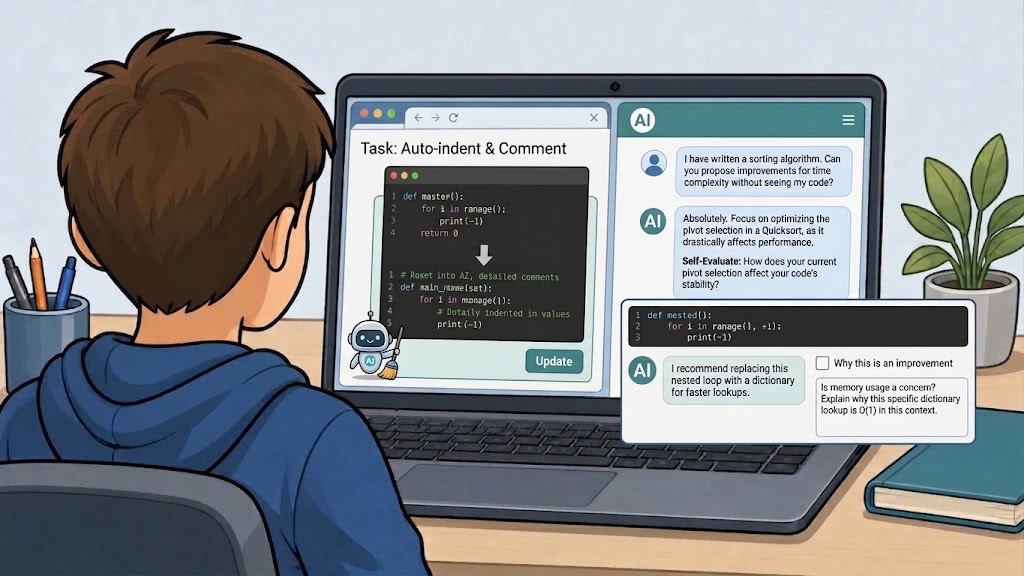](https://playbook.dualaiteacher.eu/uploads/images/gallery/2026-09/imagen.png)
Fig 1. Image generated with Gemini (3.6 Thinking), September 8, 2026.
#### Content
Programming education is changing in a context where AI systems can generate, explain, and review code. While these tools offer new opportunities for learning, they also introduce an important educational challenge: students need sufficient programming knowledge to evaluate whether an AI-generated suggestion is correct, efficient, or even relevant to the task at hand. Without a basic understanding of programming concepts, students may accept incorrect solutions, overlook errors, or fail to recognize better alternatives. For this reason, learning programming fundamentals remains essential, even when AI tools are available.
In introductory programming courses, AI should be positioned as a learning support tool rather than as a substitute programmer. Students can use AI effectively for repetitive or low-level tasks that do not reduce the cognitive effort involved in learning to program. Examples include formatting and indenting code, generating documentation comments, explaining error messages, summarizing syntax rules, or helping students understand the purpose of specific programming constructs. These uses allow students to focus their attention on the underlying logic, algorithms, and problem-solving processes that are central to programming competence.
Another productive use of AI is code review. Instead of asking an AI model to write a solution, students can write their own code first and then ask the model to identify potential improvements. The AI might suggest clearer variable names, better code organization, reduced redundancy, improved readability, or alternative approaches that the student can evaluate independently. This transforms the AI into a feedback partner, allowing students to compare their own reasoning with external suggestions and assess the strengths and weaknesses of their solutions.
However, AI-generated feedback should not be accepted uncritically. Models may recommend changes that are unnecessary, inefficient, or based on incorrect assumptions about the code's purpose. A central goal of this lesson is therefore to develop students' ability to critically evaluate AI suggestions. Students will learn to ask an AI model not only what improvements it proposes, but also why it considers those changes beneficial. By comparing the model's reasoning to established programming principles, students can judge whether the proposed optimization genuinely improves the code or merely represents a different design choice.
This lesson treats AI as a tool that supports reflection, self-assessment, and code quality improvement rather than code generation. Students practice writing their own programs, using AI to perform supportive tasks, requesting feedback on their work, and critically analyzing the quality of the responses they receive. The ultimate objective is to help students become both better programmers and more informed users of AI systems.
#### Lesson plan
| Phase | Time | Activity |
| Introduction | 10 min | The teacher presents two short code solutions to the same problem, one written by a student and one generated by an AI model. Students discuss which solution appears clearer, more efficient, or easier to understand.
|
| Input | 10 min | The teacher introduces appropriate uses of AI in programming education, emphasizing the distinction between support tasks, code review, and code generation. |
| Exploration | 15 min | Students work in pairs on a small programming exercise and identify which tasks could appropriately be delegated to an AI assistant and which should remain their responsibility. |
| Improvement Cycle
| 35 min | Students write their own solution and complete 2 to 3 rounds of write → ask → evaluate → revise, using AI only for supportive tasks and improvement suggestions. |
| Reflection | 20 min | Whole-class discussion about the usefulness and limitations of AI feedback, focusing on how students determined whether suggestions were valuable or not. |
**Guiding questions: layering complexity**
Students work through as many rounds as time allows during the 35-minute Improvement Cycle. Each round follows the same four-step process: Write → Ask → Evaluate → Revise
1. **Round 1 — Using AI for Supportive Tasks**
- Write: Complete a short programming exercise independently.
- Ask: Request support from the AI for a non-programming task related to the code, such as:
- improving indentation,
- generating comments,
- explaining an error message,
- describing what a function does.
- Evaluate: Does the AI explanation accurately describe the code? Are the generated comments useful and understandable?
- Revise: Incorporate any helpful changes while ensuring that the program logic remains entirely your own work.
2. **Round 2 — Requesting Improvement Suggestions**
- Write: Review your completed program and identify parts that could potentially be improved.
- Ask: Request improvement suggestions without allowing the AI to rewrite the code. For example:
"Suggest three ways to improve this program's readability and maintainability, but do not provide replacement code."
1. - Evaluate: Which suggestions seem valuable? Which suggestions would have little impact on the program?
- Revise: Implement any improvements you agree with and test whether the program still behaves correctly.
2. **Round 3 — Critically Evaluating Optimization Advice**
- Write: Select a section of your code that performs a repetitive task or uses loops.
- Ask: Request optimization suggestions and require the AI to justify its recommendations.
Example prompt:
"Explain how this code could be optimized and why each proposed optimization would improve performance or readability. Do not provide the optimized code."
- - Evaluate: Are the proposed optimizations actually beneficial? Which ones are supported by clear reasoning? Which ones appear unnecessary or difficult to justify?
- Revise: Decide which recommendations to implement and explain your reasoning.
**Reflection Questions:**
- Which AI suggestions were most useful for improving your code?
- Did the AI provide any suggestions that you disagreed with? Why?
- How did you determine whether an optimization was worthwhile?
- When is AI most helpful during the programming process?
- Which programming tasks should still be performed by the student?
- Why is programming knowledge necessary for evaluating AI-generated feedback?
- How can students avoid becoming overly dependent on AI tools when learning programming?
**Closing question (for the Reflect phase):**
How much programming knowledge is necessary to determine whether an AI suggestion actually improves a program, and what risks arise when users rely on AI-generated advice without understanding the code themselves?
####
#### Materials
- One laptop per student pair with a programming environment
- Access to an AI chat assistant or locally hosted language model
- A short programming exercise appropriate to students' experience level
- A worksheet following the cycle write → ask → evaluate → revise
- Reflection questions focused on AI literacy and critical evaluation
- Optional code examples illustrating good and poor coding practices
# 2.3 English as a Foreign Language
### Communicative Appropriateness in English
**Subject:** English as a Foreign Language · **Grade:** 9 (age 14–15) · **Duration:** 1 double lesson (90 min) · **AI:** Learning **WITH** AI
| AI-related competencies (DUAL.AI.TEACHer Framework) – teacher level | Subject-specific learning objectives – student/learner level |
| **AF-TL-2b**
*(AI foundations and applications × Teaching & Learning, Level 2 – Reflective Implementation)*:
“Teachers can organise lesson elements that embed AI use with clear pedagogical roles and strategies to verify the output elements.”
**AF-FC-2b**
*(AI foundations and applications × Facilitating Learners’ (AI) Digital Competence, Level 2 – Reflective Implementation)*:
“Teachers can implement guidance that helps learners develop practical AI skills, adapting the tasks to learners’ prior knowledge and the AI tools available.”
| By the end of the lesson, students can:
- distinguish between grammatically correct and contextually appropriate English;
- identify differences in vocabulary, tone and register across communicative situations;
- formulate structured prompts that specify audience, purpose, context, language level and tone;
- compare AI-generated language and identify inappropriate or unnatural formulations;
- revise AI-generated language using their own linguistic judgement;
- check whether an AI-generated response follows the requirements given in a prompt.
|
> **Take-home message:** AI can generate fluent and grammatically correct English, but this does not automatically make the language natural or appropriate for a particular situation. By changing the audience, purpose and context of an AI-generated conversation, students learn to evaluate AI suggestions and use their own language knowledge to make the final decisions.
#### [](https://playbook.dualaiteacher.eu/uploads/images/gallery/2026-09/chatgpt-image-sep-1-2026-at-03-17-43-pm.png)
Fig 1. Image generated with ChatGPT (GPT Image 2), September 1, 2026.
#### Content
Communicating successfully in a foreign language requires more than producing grammatically correct sentences. Speakers constantly adapt their vocabulary, sentence structure, politeness and tone according to the audience, purpose and context of communication. The same intention can therefore be expressed in very different ways depending on who is speaking to whom. A request made to a close friend may be short and informal, while the same request addressed to a teacher, employer or unfamiliar person usually requires different vocabulary, more polite structures and a different degree of formality. These differences are part of register, which describes how language changes according to the social and communicative situation.
For language learners, register can be difficult to recognise because a sentence may be grammatically correct while still sounding unnatural or inappropriate in a particular context. Textbook examples often provide clear distinctions between formal and informal language, while real communication is much more flexible. Age, relationship between speakers, cultural expectations, medium of communication and communicative purpose can all influence the language that is used. A message that sounds natural in a conversation between teenagers, for example, may sound too informal in an email to a teacher, while an expression that is suitable for a formal letter may sound unnecessarily distant in everyday conversation.
Generative AI can produce and adapt dialogues very quickly, which makes it useful for exploring these differences. By changing individual elements of a prompt, such as the relationship between speakers, language level, purpose or degree of formality, learners can generate several versions of the same communicative situation and compare how the language changes. At the same time, AI-generated language is not automatically reliable simply because it sounds fluent. A model may produce language that is too formal, repetitive, culturally awkward, inconsistent with the requested level or not fully aligned with the instructions given in the prompt. Generative AI also works probabilistically, which means that similar prompts can produce different formulations.
This limitation is central to the activity rather than something to hide from learners. AI becomes most useful when students treat its output as language material to analyse rather than an answer to accept. In this lesson, students first examine how register changes across communication contexts and then use an LLM to modify one communicative variable at a time. They compare the resulting dialogues, identify which linguistic choices work and which do not, and revise parts of the output themselves. In this way, students practise both communicative competence in English and practical AI literacy: giving clear instructions, checking whether those instructions were followed and using their own linguistic judgement to decide whether the final result is appropriate.
#### Lesson plan
| Phase | Time | Activity |
| Introduction | 10 min | The teacher shows two short messages communicating the same request, for example one addressed to a friend and another to a teacher. Students identify differences in vocabulary, politeness and tone and suggest who might have written each message. |
| Input | 10 min | The teacher introduces the concepts of audience, purpose, context and register. Together, students identify features of formal and informal English and discuss why grammatically correct language is not necessarily appropriate language. |
| Exploration | 15 min | In pairs, students examine a short AI-generated dialogue for an everyday situation. They identify useful expressions and highlight anything that sounds unnatural, too formal, too informal or unsuitable for their English level. |
| Adaptation | 35 min | Students work through 2–3 rounds of predict → prompt → compare → diagnose. In each round, they change one aspect of the communication context and ask the AI to adapt the dialogue. |
| Reflection | 20 min | Students compare their versions and discuss which changes affected the language most. They identify where AI followed the instructions well, where it did not, and which expressions they would change themselves. |
**Guiding questions: layering complexity**
Pairs work through as many of the following rounds as time allows during the 35-minute adaptation phase. Most pairs should complete two rounds, while the third can be used as an extension:
1. **Round 1 — Change the relationship between speakers:**
- *Predict:* Imagine that the same request is made to a close friend and to a teacher. What do you expect to change? Think about vocabulary, greetings, sentence structure and politeness.
- *Prompt:* Ask the AI to rewrite the dialogue for a different relationship between the speakers.
For example:
> Rewrite this conversation between two friends as a conversation between a student and a teacher. Keep the meaning the same, but use polite, natural English suitable for a B1 learner.
- *Compare:* Compare the original and new dialogues. Identify at least three linguistic changes.
- *Diagnose:* Did the AI change only individual words, or did it also change sentence structure, greetings, requests and closing expressions? Which changes are appropriate? Is there anything you would change yourself?
2. **Round 2 — Change the communicative purpose:**
Students now change what one speaker wants to achieve. For example:
asking for information → making a complaint
accepting an invitation → declining politely
asking for help → requesting permission
informal conversation → formal request
- *Predict:* What language do you expect to change when the purpose of the conversation changes?
- *Prompt:* Create a more detailed prompt that includes: speaker + situation + purpose + language level + tone
For example:
> Create a short B1-level dialogue between a customer and a café employee. The customer received the wrong order and wants to solve the problem politely. Use natural everyday English and keep the dialogue to eight lines.
- *Compare:* Check whether the generated dialogue follows each part of the instruction.
- *Diagnose:* Select one expression that works well and one that you would rewrite. Explain why.
3. **Optional round 3 — Add constraints and challenge the AI:**Students make their instructions more specific.
For example:
> Rewrite the conversation for two 15-year-olds. Keep the English at B1 level. Make it friendly and natural, but avoid slang. Keep the same communicative purpose.
- *Predict:* Which parts of the previous dialogue do you expect to change?
- *Prompt:* Ask the AI to produce the revised version.
- *Compare:* Check the response against every requirement in the prompt.
- *Diagnose:* Which instructions did the AI follow successfully? Which did it ignore or interpret differently?
**Closing question (for the Reflect phase):** At which point did changing the communication situation require more than simply replacing a few words, and what does this tell you about communicating effectively in another language?
Follow with: If an AI-generated dialogue is grammatically correct, how can you decide whether it is actually appropriate and natural for this particular situation?
#### Materials
- One laptop or tablet per student pair, with a browser
- Access to an approved LLM chat interface via the internet, or a locally installed model if internet access is restricted at school
- One short starter dialogue at approximately B1 level
- A short prompting / worksheet template for the adaptation rounds (predict → prompt → compare → diagnose)
- A language-evaluation checklist covering meaning, grammar, vocabulary, register, naturalness and fulfilment of instructions
- Teacher-prepared examples of formal and informal communication
- A short AI-use guideline reminding students not to enter personal information and to treat AI-generated language as material to analyse and improve, not as an answer key
# 2.4. Social Studies: AI, Media and Reality
### Can We Believe Everything We See?
**Subject:** Social Studies · **Grade:** 5 (age 10–11) · **Duration:** 1 double lesson (90 min) · **AI:** Teaching **ABOUT** AI
> **Take-home message:** AI can produce convincing text and images, but convincing does not mean true. Before we believe or share something, we need to ask where it came from, what evidence supports it and whether we can verify it elsewhere.
#### Content
Artificial intelligence is increasingly becoming part of everyday communication. AI systems can generate texts, pictures and other forms of content that may look as if they were created by a person. This creates new possibilities, but also new challenges for how people understand and evaluate information. For students at this age, the important question is not necessarily **how AI works technically, but how AI-generated content can affect people and society.**
The lesson introduces AI through a familiar social situation: information encountered in everyday life. The teacher presents examples of texts and images and asks students to decide whether the content is real, edited, or AI-generated. The emphasis is not on teaching students to detect AI perfectly. In fact, one of the central conclusions of the lesson is that **appearance alone is not a reliable way of establishing whether something is true.**
Students instead learn a simple verification process:
**STOP → QUESTION → CHECK → COMPARE → DECIDE**
The activity connects with the Social Studies curriculum's emphasis on developing critical thinking, analysing evidence, forming and expressing opinions, and researching the social environment. The curriculum specifically includes the **role and influence of the media** as one of the proposed social issues for Grade 5. The curriculum also explicitly encourages teachers to develop rational and critical thinking through posing questions that require reasoning, investigating evidence, analysing data that support or challenge conclusions, and considering different interpretations. Importantly, **students do not interact directly with an AI system during the lesson**. The teacher operates the AI tool and presents selected outputs to the class. Students' role is to observe, question, compare and evaluate the content.
#### Lesson plan
| **Phase** | **Time** | **Activity** |
| Introduction | 10 min | The teacher shows two or three images or short texts connected to a familiar situation. Students individually decide: *Is this real? How do you know?* |
| Input | 15 min | The teacher introduces AI in age-appropriate language: what generative AI can do and why AI-generated content can look convincing. |
| Demonstration | 15 min | The teacher uses an AI tool live to generate an image or short text based on a simple prompt. Students observe how quickly the content can be created and discuss what the AI actually produces. |
| Investigation | 30 min | Groups receive several examples of information/content. They use a verification checklist and decide what they would trust, what they would question and what they would check further. |
| Reflection | 20 min | Whole-class discussion: *Can we trust an image simply because it looks real? What about a text? Who is responsible if we create or spread false information?* |
**Guiding questions:**
Students work through the following situations with the teacher. The AI is operated only by the teacher.
**1. Round 1 — STOP: Don't believe it immediately**
The teacher shows students an AI-generated image of a familiar situation — for example, an apparently realistic photograph of an unusual event in Slovenia.
1. Before revealing anything, students answer:
1. Does this image look real?
2. What makes you think so?
3. Which details make it seem believable?
4. Is there anything that looks unusual?
2. The teacher reveals that the image was generated with AI and briefly explains how generative AI can create realistic-looking images.
1. What made us believe the image was real?
2. Did we look for evidence, or did we simply trust what we saw?
3. Could a person use such an image to mislead other people?
**Diagnose:** Students identify the difference between **"This looks real,"** and **"I have evidence that this is real."**
**Key idea:** A realistic appearance is not proof that something is true.
---
**2. Round 2 — QUESTION: Who created it and why?**
The teacher presents a short piece of **AI-generated news-style text.** For example, the teacher asks an AI system to produce a short article about an imaginary event at a Slovenian school.
1. Students do not interact with the AI. Instead, they analyse the output.
1. Who wrote or created this?
2. Where does the information supposedly come from?
3. Does the text identify a source?
4. Does it provide evidence?
5. Can we verify the information?
6. Why might someone want to publish such information?
7. Does the text sound certain even though we don't know whether it is true?
2. Students discover that a text can sound confident, informative and convincing while still lacking a reliable source or evidence.
**Key idea:** A confident-sounding answer is not necessarily a correct answer.
---
**3. Round 3 — CHECK & COMPARE: Let's verify it**
The teacher presents a fictional claim: **“A new rule has been introduced in Slovenia: students are no longer allowed to use mobile phones on Saturdays.”**
The statement is deliberately simple and plausible enough to prompt students to consider how they would check it.
1. Students are **not** asked simply to answer "true" or "false". Instead, they have to design **a verification strategy.**
1. Where would you check this information?
2. Who could you ask?
3. Would you trust a social media post?
4. Would you check only one source or several?
5. What would count as good evidence?
6. Which source would you trust more?
7. What would make you change your mind?
2. The teacher then demonstrates how the claim could be checked using different types of sources.
Students recognise that checking information is a process rather than simply deciding whether something "feels true".
---
**4. Optional Round — AI vs. Human**
1. The teacher asks an AI system: **“Why is it important to preserve cultural heritage?”** - The AI generates a short answer.
2. Students then independently construct **their own answer without AI.**
3. The class compares the two.
1. What did the AI answer well?
2. What is missing?
3. Is the AI giving information, an opinion, or both?
4. Does the AI know our local environment as well as we do?
5. Which answer would be more useful when presenting our local cultural heritage?
6. Can an AI-generated answer replace our own thinking?
This connects with the curriculum's emphasis on cultural heritage, students' understanding of the past and present, and their ability to explain and justify their own viewpoints.
---
**Closing activity: Building a classroom rule**
At the end of the lesson, the teacher and students jointly create a simple classroom poster:
**5 QUESTIONS BEFORE WE SHARE**
- **STOP**
- Do I need to believe this immediately?
- **QUESTION**
- Who created or published this?
- **CHECK**
- Where can I verify the information?
- **COMPARE**
- Do other reliable sources say the same thing?
- **DECIDE**
- Do I have enough evidence to believe or share it?
The poster becomes the main practical outcome of the lesson.
**Closing question:** If a computer can create an image or text that looks completely real, what should we do before we believe it or share it with other people?
#### Materials
- One computer and projector for the teacher;
- access to an LLM/AI tool operated by the teacher;
- 2–3 prepared AI-generated images and texts;
- several examples of real and fictional information;
- a STOP → QUESTION → CHECK → COMPARE → DECIDE worksheet;
- different sources that students can use for verification;
- a board or poster for constructing the class's "5 questions before we share" rule.
---
#### The teacher's role and the students' role
A central design principle of this lesson is that **AI use is teacher-led**.
| **Teacher** | **Students** |
| Operates the AI tool. | Observe the AI output. |
| Creates selected examples. | Ask questions about the content. |
| Demonstrates how AI generates text/images. | Identify reasons to trust or question information. |
| Provides examples and counterexamples | Compare different sources. |
| Models verification strategies | Develop their own verification strategy. |
| Guides discussion | Explain and justify their conclusions. |
| Makes the limitations of AI visible.
| Reflect on responsible information sharing. |
The students are therefore learning *about the capabilities, limitations and social consequences* of AI without needing their own access to an AI system.
# 2.5 Cross-Curricular: AI-Assisted Lesson Design
### AI-Assisted Instructional Design
**Subject:** Teacher Professional Development · **Target Group:** Teachers · **Duration:** 1 workshop (90 min) · **AI:** Teaching **WITH** AI
| AI-related competencies (DUAL.AI.TEACHer Framework) – teacher level | Subject-specific learning objectives – student/learner level |
| **AF-DR-2b**
*(AI Foundations and Applications × Digital Resources, Level 2 – Reflective Implementation)*:
“Teachers can implement prompting, iteration, and refinement strategies to obtain usable AI-generated resources.”
**AF-TL-2b**
*(AI Foundations and Applications × Teaching & Learning, Level 2 – Reflective Implementation)*:
“Teachers can organise lesson elements that embed AI use with clear pedagogical roles and strategies to verify the output elements.”
| By the end of the lesson, participants can:
- formulate a structured prompt for creating a learning activity in their own subject area;
- evaluate an AI-generated activity for pedagogical relevance, accuracy and suitability for the target group;
- identify elements of AI-generated material that require human verification or adaptation;
- improve an initial AI output through prompting, iteration and manual revision;
- integrate AI into a lesson while maintaining a clear pedagogical role for the teacher and learner.
-
|
> **Take-home message:** Generative AI can accelerate lesson preparation, but a usable learning activity rarely comes from a single prompt. Effective AI-supported lesson design is an iterative process in which teachers define the pedagogical goal, generate ideas, evaluate the output, refine it and make the final instructional decisions.
[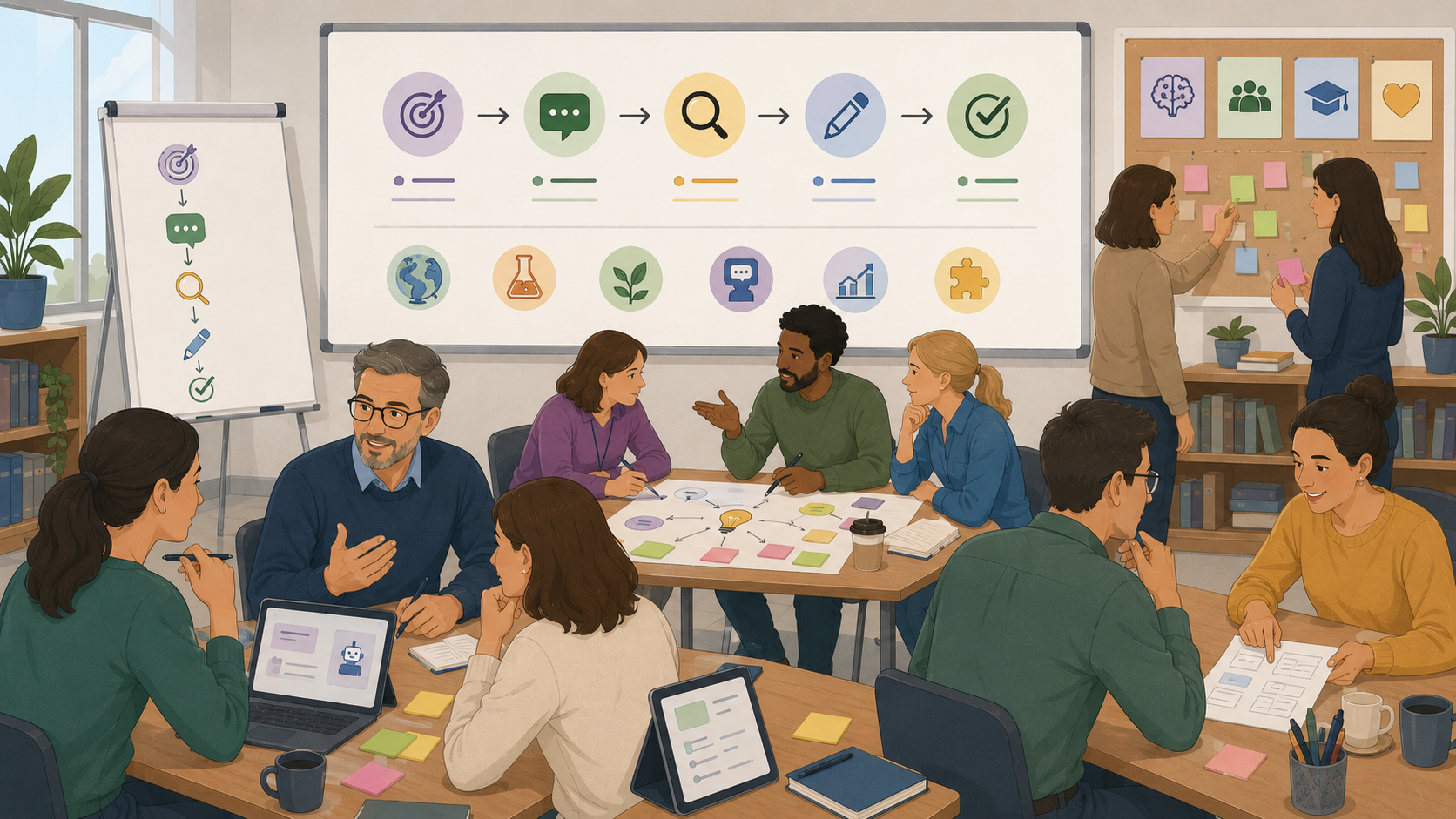](https://playbook.dualaiteacher.eu/uploads/images/gallery/2026-09/chatgpt-image-sep-1-2026-at-04-27-24-pm.png)
Fig 1. Image generated with ChatGPT (GPT Image 2), September 1, 2026.
#### Content
Generative AI can support teachers with many tasks involved in lesson preparation, including generating activity ideas, adapting materials to different learner groups, producing examples and questions, or suggesting alternative ways of explaining a topic. The Latvian Datorium case study demonstrates this practical approach to teacher AI competence development: teachers first become familiar with AI and its educational applications and then move towards practical experimentation, lesson planning, assessment and differentiated material development. Classroom application is followed by reflection and feedback, making AI use part of an iterative professional learning process rather than a one-time technical exercise.
The usefulness of generative AI for lesson design depends heavily on the information and constraints provided by the teacher. A request such as *“Create a lesson about climate change”* leaves most pedagogical decisions to the AI system. A more structured prompt can specify the subject, learner age, existing knowledge, learning objective, duration, teaching method, available resources and expected learner output. Adding these elements does not guarantee a good lesson, but it gives the teacher greater control over what the AI produces and makes the resulting material easier to evaluate against the intended learning goal.
Even a detailed prompt can produce material that is factually inaccurate, pedagogically weak, unrealistic for the available lesson time or unsuitable for a particular group of learners. AI may suggest activities without considering classroom dynamics, assume resources that are unavailable, generate tasks that do not actually measure the stated learning objective, or provide content that appears convincing but requires factual verification. For this reason, AI-generated educational material should be treated as a draft rather than a finished teaching resource.
The central learning process in this activity is therefore not simply learning how to write a “good prompt”. Teachers work through a repeated cycle of define → prompt → evaluate → refine → verify. They begin with a real learning objective from their own teaching context, use AI to propose an activity, evaluate the result against pedagogical criteria, refine the prompt where necessary and finally make their own modifications before the activity is considered classroom-ready. This reflects the Datorium case study's emphasis on practical experimentation, co-creation, classroom application and reflection, while keeping pedagogical responsibility and validation with the teacher.
#### Lesson plan
| Phase | Time | Activity |
| Introduction | 10 min | Participants identify one lesson-preparation task for which AI could potentially be useful. The facilitator introduces AI as an assistant/co-creator rather than an autonomous lesson designer. |
| Input | 15 min | Participants compare a simple prompt with a structured educational prompt and examine how additional context changes the generated learning activity. |
| Exploration | 15 min | Each participant selects a real learning objective from their subject and asks an LLM to generate a short classroom activity addressing it. |
| Adaptation | 35 min | Participants work through two or three rounds of prompt → evaluate → refine → verify, progressively adding pedagogical constraints and checking the resulting activity. |
| Reflection | 25 min | Participants compare their original AI output with the final classroom-ready version and identify which improvements came from prompting and which required their own professional judgement. |
**Guiding questions: from AI output to classroom-ready activity**
1. **Round 1 — Define the pedagogical purpose:** Before prompting the AI, define:
- Who are the learners?
- What should they know or be able to do?
- What prior knowledge do they have?
- How much time is available?
- What should learners actually do during the activity?
Generate an initial activity and compare it with the intended learning objective.
- *Diagnose:* Does the activity actually help learners achieve the objective, or does it merely relate to the same topic?
2. **Round 2 — Add classroom constraints:**Refine the prompt by adding realistic conditions such as class size, available materials, lesson duration, learner level, teaching method or accessibility requirements.
Generate the revised activity and compare it with the first version.
*Compare:* Check whether the generated dialogue follows each part of the instruction.
- *Diagnose:* Which changes improved the activity? What classroom conditions has the AI still failed to consider?
3. **Optional round 3 — Verify and take back control:**Evaluate the final AI-generated activity for:
- factual accuracy;
- alignment with the learning objective;
- suitability for the learner group;
- realistic timing;
- clarity of instructions;
- accessibility and inclusion;
- teacher and learner roles.
Participants then make at least one manual change without asking AI to revise it.
The final comparison is therefore not *“Which prompt produced the best AI answer?”* but rather **“***What did the teacher have to contribute to turn an AI-generated idea into a usable learning activity?***”**
**Closing question (for the Reflect phase):** At which point did the AI-generated activity require more than simply improving the prompt, and what does this tell you about the teacher’s role in AI-supported lesson design?
Follow with: If an AI-generated learning activity appears complete and well structured, how can you decide whether it is actually pedagogically appropriate and ready to use with learners?
#### Materials
- One laptop or tablet per participant, with a browser
- Access to an approved LLM chat interface, or a locally installed model
- One real learning objective or lesson topic from each participant's teaching context
- A structured educational prompting template
- A short worksheet for the define → prompt → evaluate → refine → verify cycle
- An evaluation checklist covering pedagogical relevance, accuracy, learner suitability, feasibility and alignment with learning objectives
- Example of a simple prompt and a more structured educational prompt
# 2.6 History: Reconstruction of the past
### A Day in Medieval Riga: What Can Sources Really Tell Us?
**Subject:** History Grade · **Target Group:** 7 (age 13–14) · **Duration:** 1 double lesson · **AI:** Learning **WITH** AI
| AI-related competencies (DUAL.AI.TEACHer Framework) – teacher level | Subject-specific learning objectives – student/learner level |
| **AF-TL-2b**
*(AI foundations and applications × Teaching & Learning, Level 2 – Reflective Implementation)*:
“Teachers can organise lesson elements that embed AI use with clear pedagogical roles and strategies to verify the output elements.”
**AF-FC-2b**
*(*AI foundations and applications × Facilitating Learners’ (AI) Digital Competence, Level 2 – Reflective Implementation*)*:
“Teachers can implement guidance that helps learners develop practical AI skills, adapting the tasks to learners’ prior knowledge and the AI tools available.”
| By the end of the lesson, participants can:
- extract information about medieval urban life from written, visual and archaeological sources;
- distinguish between evidence, reasonable inference and speculation;
- explain aspects of trade, crafts and everyday life in medieval Riga;
- combine evidence from several sources to con
struct a historical recon struction;
- formulate prompts that require AI to work from supplied historical evidence;
- analyze information to understand the importance of reliable sources.
|
> **Take-home message:** What is shown is not necessarily what happened. Historical reconstructions combine evidence, reasonable inference and speculation. Understanding the past means recognising the difference between what we know from sources, what we can reasonably conclude, and what has been imagined to fill the gaps and to tell a better story.
[](https://playbook.dualaiteacher.eu/uploads/images/gallery/2026-09/chatgpt-image-sep-2-2026-at-01-30-35-pm.png)
Fig 1. Image generated with ChatGPT (GPT Image 2), September 2, 2026.
#### Content
Historians cannot directly observe everyday life in the Middle Ages. Instead, they reconstruct it from traces that people left behind: written documents, buildings, objects, images, archaeological finds and other evidence. Different sources answer different questions. A trade record may reveal what goods entered a city, while an archaeological object may tell us something about what people owned or used. Neither source alone can recreate an entire day in someone's life.
Medieval Riga provides a useful case study. Riga developed rapidly after the beginning of the 13th century and became an important centre connecting trade between western Europe, Livonia and lands further east. By the late 13th century, it had become a major Hanseatic trading city. Trade and crafts supported the growth of merchant and craft organisations such as guilds.
Modern media can make the past feel much more complete than the surviving evidence actually allows. AI-generated history content such as **Chloe VS History**, for example, presents vivid “time-travel” scenes in which viewers appear to visit historical settings such as London during the Black Death. Clothing, streets, buildings, people and everyday activities are presented as if they were being directly observed. Yet these scenes are reconstructions: some details may be based on historical evidence, some may be reasonable inferences, and others may be speculative or inaccurate.
The same issue appears in historical films. **A Knight's Tale** creates a recognisably medieval world through armour, tournaments, clothing, architecture and social roles, while also deliberately introducing modern music, language and behaviour. **It therefore provides a useful reminder that something can look convincingly historical without representing exactly what happened**.
Generative AI works in a similar way. It can combine fragments of historical evidence into a coherent reconstruction of a day in medieval Riga, but it may also fill gaps with details that were never present in the sources. Some additions may be historically plausible; others may belong to another region, century or social group.
Students therefore need to distinguish between three levels of certainty:
**Evidence** – what historical sources directly support.
**Inference** – what can reasonably be concluded from that evidence.
**Speculation** – what has been imagined to fill the gaps.
#### Lesson plan
| Phase | Time | Activity |
| Hook | 10 min | Watch a Chloe VS History medieval AI video. Students identify what makes it believable and question which details are actually supported by evidence. |
| Input | 10 min | Introduce **evidence** – **inference** – **speculation** and practise distinguishing them. |
| Exploration | 15 min | Students analyse sources about medieval Riga without AI and establish what can genuinely be known. |
| Adaptation 1 | 20 min | AI reconstructs a day in medieval Riga from limited evidence. Students identify where it fills gaps. |
| Adaptation 2 | 20 min | More sources and stricter prompting are added. Students compare the two reconstructions. |
| Reflection | 25 min | Students transfer the same critical-thinking framework to a medieval historical film. |
**Guiding questions: from AI output to classroom-ready activity**
- **Hook — Show approximately 30-60 seconds of Chloe VS History ([TikTok](https://www.tiktok.com/@chloe.tiktok33/video/7613244697523408150?is_from_webapp=1&sender_device=pc&web_id=7668702239284266518)/[Youtube](https://www.youtube.com/shorts/oQu-Acwyayc)) AI-generated visit to London during the Black Death 1348:**
- *Discussion question:* "What makes this look like a real visit to medieval London?"
- *Introduce the problem: "*How do we actually know that these details are historically accurate?" Key principle for this lesson (The importance of sources)
- *Introduce the problem:* "How do we actually know that these details are historically accurate?" Key principle for this lesson (The importance of sources)
- Historical evidence → inference→ speculation
- **Input — Archaeological object: a medieval comb:**
- Provide statements about the object that need to be categorized into categories - evidence, inference, speculation. Example:
- A bone comb was discovered in medieval Riga - e*vidence*
- Some inhabitants of Riga used combs - i*nference*
- The owner combed their hair before going to the market every morning - s*peculation*
- **Exploration — Group work. Analysing sources:**4 different sources about medieval Riga.
A) Riga as a Hanseatic trading city. Text from museum of the History of Riga and Navigation, “Riga as Part of Livonia (13th–16th cent.)”
B) Archaeological evidence of Hanseatic trade. Pictures from the museum of the History of Riga and Navigation, “Archaeological Evidence of the Hansa Trade in Riga.”
C) List of imports and exports from Riga. Trade information from museum of the History of Riga and Navigation, “Archaeological Evidence of the Hansa Trade in Riga.”
D) Riga's 1293 building regulations that restricted the construction of wooden houses after a fire outbreak.
Students fill out a worksheet for each source by answering the following question about each source: What do we know? What can we reasonably infer? What do we still not know?
- **AI fills in the missing gaps:**Promp that is used by students: Using only Sources A and B, describe one morning in medieval Riga from the perspective of a young citizen. Write approximately 150 words. Make the scene vivid, but do not introduce information that cannot reasonably be inferred from the sources.
Students annotate the AI response:
- Evidence
- Reasonable inference
- Unsupported / speculation
- **AI revises its work using more evidences:** *Improved prompt*: Revise the reconstruction using Sources A–D. After every important historical detail, identify its source, for example \[Source B\]. If something is not directly stated but is reasonably inferred from the sources, write \[Inference\]. Remove details that cannot be supported or reasonably inferred.
*Compare:*
Version 1 → Version 2
Find:
- one detail that became more precise;
- one detail AI removed;
- one new detail supported by evidence;
- one detail that still needs questioning.
- **Reflection/Transfer of knowledge** Show a short classroom-appropriate scene or still from A Knight's Tale (2001)
*Discussion question:*
- Based on the key principles from this lesson, what stands out as evidence, inference, speculation.
- If filmmakers change historical details to make a better story, is that necessarily wrong?
*Final individual reflection:*
Students complete:
1. Something can look historically convincing when...
2. Before believing something I see in a historical film, I should...
3. A historical film can invent or change details, but..
#### Materials
- Projector/interactive whiteboard with speakers.
- Chloe VS History medieval AI video for the hook.
- Image of a medieval bone comb from Riga.
- Evidence–Inference–Speculation mini worksheet.
- Medieval Riga Source Pack: Hanseatic trade text, pictures of archaeological finds, imports/exports list, 1293 building regulations.
- Source-analysis worksheet.
- Student devices with access to an approved generative AI tool.
- AI prompt and comparison worksheets for Rounds 1 and 2.
- Short clip or still from A Knight’s Tale (2001) for reflection.
# 2.7 Informatics / Natural Science: AI for a Real School Problem
### Can AI Help Us Sort Waste at School?
**Subject:** Informatics/Natural Science · **Target Group:** 7 (age 13–14) · **Duration:** 1 double lesson · **AI:** Learning **WITH** AI
| AI-related competencies (DUAL.AI.TEACHer Framework) – teacher level | Subject-specific learning objectives – student/learner level |
| **AF-TL-2b**
*(AI foundations and applications × Teaching & Learning, Level 2 – Reflective Implementation)*:
“Teachers understand basic principles of AI and machine learning and can demonstrate them through practical examples.”
**AF-FC-2b**
*(*AI foundations and applications × Facilitating Learners’ (AI) Digital Competence, Level 2 – Reflective Implementation*)*:
“Teachers can guide students in experimenting with AI tools, testing their outputs and critically reflecting on their reliability.”
| By the end of the lesson, students can:
- explain in simple terms how an AI model learns from examples
- train and test a simple image-classification model
- identify cases in which the model produces incorrect results
- explain how the quality of examples influences AI performance
- improve the model based on testing; • assess whether the AI solution would be useful and reliable in a real school situation.
|
> **Take-home message:** AI can help with real-life problems, but it does not automatically understand what it sees. It learns from examples provided by people, and its results must therefore be tested and evaluated.
[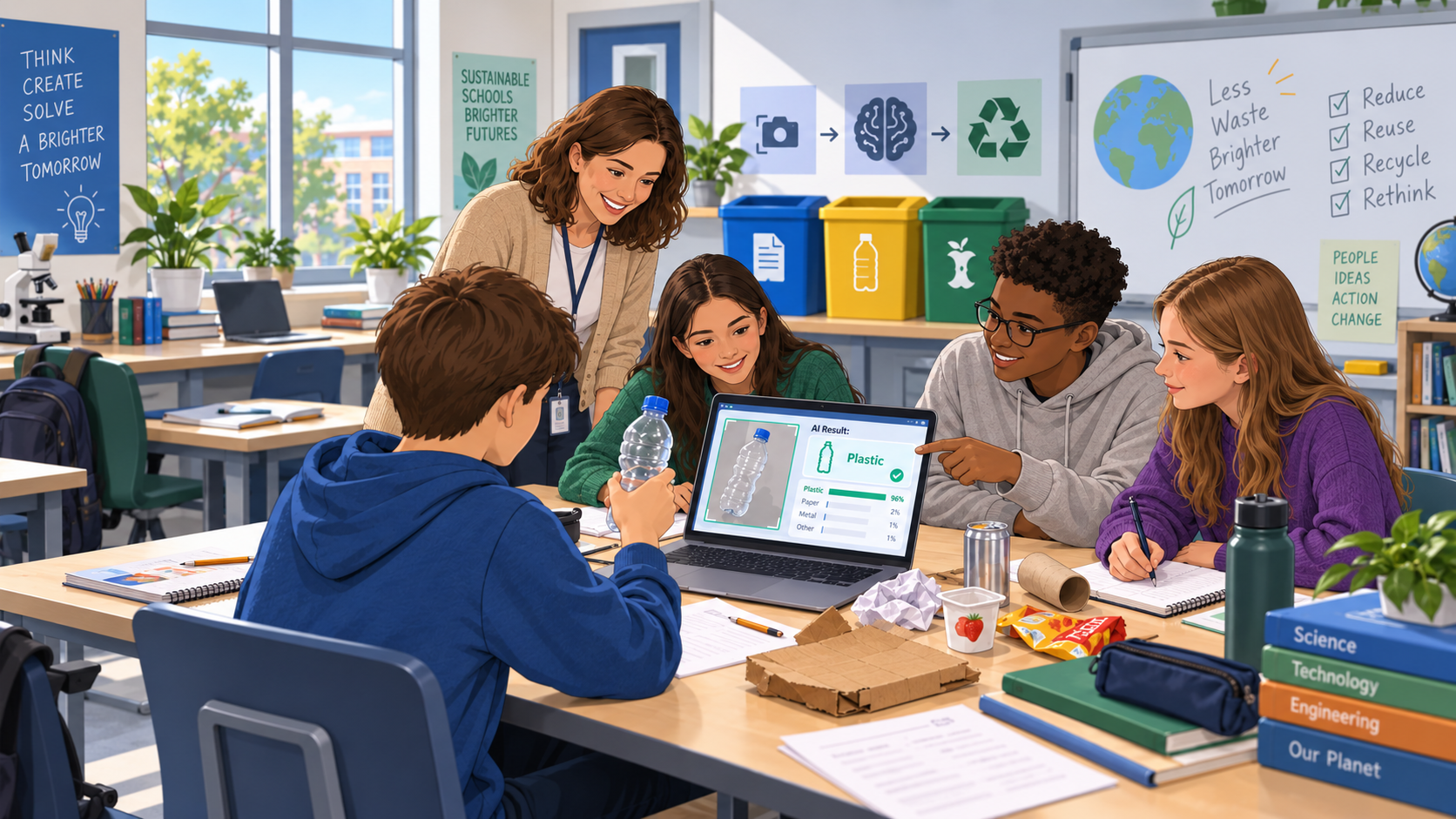](https://playbook.dualaiteacher.eu/uploads/images/gallery/2026-09/YTEimage.png)
Fig 1. Image generated with ChatGPT (GPT Image 2), September 7, 2026.
#### Content
Waste sorting is an everyday issue in many schools. Students use paper, plastic bottles, food packaging and other materials every day, but these items do not always end up in the correct recycling bin.
This familiar situation provides a simple way to explore how artificial intelligence works. Students investigate whether an AI system could recognise an object and recommend which recycling bin it belongs in.
During the activity, students create a basic **image-classification model** with categories such as *paper*, *plastic* and *other waste*. They provide the AI with several examples, train the model and then test it with new objects.
The activity demonstrates an important principle of machine learning: **the AI learns patterns from the examples it receives**. If the examples are too similar, incomplete or poorly selected, the model may produce unexpected results.
Students therefore do more than simply create a working model. They deliberately test it with difficult examples, investigate its mistakes and try to improve it. For example, they may discover that a crushed plastic bottle is classified differently from a normal bottle, or that the background of an image affects the result.
The lesson connects a basic AI concept with a real school situation. At the same time, it encourages students to think critically about reliability and human responsibility: even if an AI system gives a recommendation, people still need to decide whether the result makes sense.
#### Lesson plan
| Phase | Time | Activity |
| Hook | 10 min | The teacher shows several everyday waste objects and asks students where they belong. The class discusses whether AI could make the same decision automatically. |
| Input | 10 min | The teacher introduces image classification and explains that AI learns from examples. The selected AI tool is briefly demonstrated. |
| Exploration | 20 min | In small groups, students create categories such as paper, plastic and other waste, prepare examples and train their first model. |
| Adaptation 1 | 20 min | Students test the model with new objects and record where it succeeds and where it makes mistakes. |
| Adaptation 2 | 20 min | Students improve the training examples, retrain the model and compare the new results with the first version. |
| Reflection | 10 min | Students discuss whether their AI system would be reliable enough for real use at school and what its limitations are. |
**Guiding questions: from AI experiment to real-life application**
- - ##### **Hook – Could AI decide where our waste belongs?**
- **The teacher shows several common objects, for example:**
- a sheet of paper,
- a plastic bottle,
- a cardboard box,
- a yoghurt cup,
- a pencil.
Students first decide themselves where each object should go.
**Then ask:**
- Could a computer make the same decision from a camera image?
- How would it know that something is paper or plastic?
- What information would it need?
- Could it ever make the wrong decision?
Introduce the challenge:
**Create an AI model that can help students decide which recycling bin to use.**
- ##### **Input – How does an AI classifier learn?**
- The teacher demonstrates a simple image-classification tool.
Three categories can be created:
**Paper – Plastic – Other**
Explain that the model does not receive a definition such as:
> “Plastic is a material made from polymers.”
Instead, it receives **examples** and tries to identify patterns.
**Ask students:**
- If we show the AI only plastic bottles, will it understand all types of plastic?
- How many examples might it need?
- Should all photos look the same?
- What might happen if all paper objects are photographed on a white desk?
**Key idea:** The examples we provide influence what the AI learns.
- ##### **Exploration - Build the first model**
Students work in small groups.
Each group collects or uses prepared examples for the three categories.
For example:
**Paper**
- worksheet
- newspaper
- cardboard
- paper bag
**Plastic**
- plastic bottle
- plastic cup
- packaging
**Other**
- pencil
- metal object
- food packaging of another type
- fabric
Students train their first model.
They then test several easy examples.
For each test they record:
**Object → Expected result → AI result → Correct / Incorrect**
At this stage, the goal is not to achieve perfect accuracy. Students should first understand how the system behaves.
- ##### **Adaptation 1 – Try to make the AI fail**
Students now test the system with more difficult examples.
For example:
- a crushed plastic bottle;
- coloured paper;
- cardboard with a plastic coating;
- an object from a different angle;
- an object further away from the camera;
- the same object against a different background.
Ask:
- Which examples did the AI recognise correctly?
- Where did it make mistakes?
- What was different about these examples?
- Could the AI be reacting to colour or background instead of the object itself?
- What information may be missing from the training examples?
Students identify one weakness in their model.
- ##### **Adaptation 2 – Improve the model**
Each group makes one or more changes.
For example:
- add more examples;
- use different types of paper or plastic;
- photograph objects from several angles;
- use different backgrounds;
- balance the number of examples in each category.
Students retrain the model and repeat some of their earlier tests.
They compare:
**Version 1 → Version 2**
Ask:
- Did the model improve?
- Which change helped?
- Are there still examples it cannot classify reliably?
- Would adding more data always solve the problem?
- How much testing would be necessary before using the system in reality?
- ##### **Reflection - Would we really use this AI at school?**
Introduce a hypothetical situation:
**The school wants to install a camera next to the recycling bins. Students show an object to the camera and the AI recommends which bin to use.**
Students decide whether they would recommend the idea.
Discuss:
- Would you trust the current model?
- What could happen if it gives the wrong answer?
- Should students always be able to ignore its recommendation?
- What additional testing would be necessary?
- Could the camera create privacy issues?
- Where could a similar AI system be useful outside school?
Students complete:
1. **Our AI worked well when…**
2. **Our AI had problems when…**
3. **Before using this system in real life, we would need to…**
**Final reflection question:**
When an AI system gives a recommendation, who should decide whether that recommendation is good enough to use?
#### Materials
- - Computer or tablet for each group
- Internet connection
- Access to a simple image-classification AI tool
- Webcam or device camera
- Clean examples of paper, plastic and other everyday objects
- Alternatively, prepared photographs of the objects
- Simple worksheet for recording test results
- Projector / interactive whiteboard for the teacher
- Optional prepared table for comparing **Version 1** and **Version 2** of the model
# 2.8 Mathematics: Can the Machine Actually Calculate?
### A First Encounter with AI in the Primary Maths Classroom - Speech Recognition with the „Recheneule“
**Subject:** Mathematics · **Grade:** 2 (age 7–8) · **Duration:** 1 lesson (50 min) · **AI:** Learning **ABOUT** AI
**Real-school example:** This exemplar is modelled on the documented practice of the **Volksschule Hagenberg im Mühlkreis** (Upper Austria), an official KI-Pilotschule of the Austrian Federal Ministry of Education. From the second grade, its teachers introduce AI playfully to prepare children for its chances and risks (director Martina Ketterer-Hager). A central element is the digicase / DLPL project, in which children practise algorithmic thinking - including the maths speech-recognition game „Die schlaue Recheneule“, developed with the PH Linz. This lesson builds one class period around that real tool. It aligns with the Ministry’s KI-Initiative and the four-direction compass Verstehen, Anwenden, Reflektieren, Mitgestalten.
> **Take-home message:** Children don’t just use the tool - they watch it. By doing their sums out loud with the „Recheneule“ and seeing when it hears the right number and when it gets confused, second-graders make their very first discovery about AI: it is a helpful but imperfect machine, and the child is still the one who knows the right answer. This lays the foundation for a lifelong habit of checking, not just trusting.
[](https://playbook.dualaiteacher.eu/uploads/images/gallery/2026-09/TNachatgpt-image-8-sept-2026-13-34-19.png)
Fig #. Image generated with ChatGPT (GPT Image 2), September 8, 2026.
#### Content
Young children meet artificial intelligence long before they can explain it: voice assistants at home, cameras that find faces, apps that finish their sentences. The Austrian KI-Basiscurriculum and the Ministry’s KI-Initiative both stress that **AI literacy should begin early** **and playfully**, and that it belongs as much in the primary classroom as in later grades. The Volksschule Hagenberg im Mühlkreis, a KI-Pilotschule, does exactly this: from the second grade its teachers introduce AI through games, with the digicase / DLPL project at the centre, so that children build a first, concrete sense of what these machines can and cannot do.
**The „Recheneule“** (the “clever calculating owl”) is one of these games, and it fits the maths lesson perfectly. It uses speech recognition - a form of AI - o that a child can say a number out loud and the program tries to recognise it and use it in a calculation. The tool is deliberately simple and, as its makers note, still experimental: whether it hears correctly depends on the microphone, how clearly the child speaks, and how quiet the room is. For a seven-year-old this is not a flaw to hide but the whole lesson. When the owl shows the wrong number, the child can see with their own eyes that the clever machine did not understand — and that they, the child, still know that three plus four is seven.
This is what makes the tool valuable for teaching **ABOUT** AI at this age. Children are not asked to understand how speech recognition works inside; they are asked to observe it, to make it work better by speaking clearly and being close to the microphone, and to notice when it fails. In the language of the KI-Basiscurriculum, this is the first step from Verstehen (a machine is listening, not a person) to Reflektieren (it doesn’t always get it right, and I can check it). The teacher keeps the mathematics in the foreground: the point of the sum is still the sum, and the owl is a playful partner whose answers the child learns to check.
In this lesson, children predict whether the owl will hear them, try it, look at what it shows, and talk about why it sometimes gets it wrong — a simple, age-appropriate version of the **predict → try → check → talk cycle** used throughout these exemplars. The aim is a first, cheerful experience of AI as a useful helper that still needs a human to check it.
#### Lesson Plan
| **Phase**
| **Time**
| **Activity**
|
| Warm-up
| 8 min
| On the carpet, the teacher asks where the children have heard a machine “listen” to a voice (phone, speaker, tablet). Together they agree a simple idea: a computer can try to hear us, but it is not a person and can make mistakes.
|
| Show
| 7 min
| The teacher demonstrates the „Recheneule“ once on the big screen, saying a number clearly and then mumbling one, so the class sees the owl hear right and then wrong. The class guesses why.
|
| Try (pairs)
| 20 min
| In pairs at a tablet with a headset, children take turns: one says a simple sum answer aloud (e.g. “three plus four” → says “seven”), the other watches what number the owl shows and ticks a smiley (heard right) or a straight face (heard wrong) on a simple sheet.
|
| Check
| 8 min
| For every “heard wrong”, the pair works out the right answer themselves and decides together: did the child say it wrong, or did the owl hear it wrong? They circle who made the mistake.
|
| Talk
| 7 min
| Back on the carpet: What helped the owl hear us? (speak clearly, be close, be quiet). When the owl was wrong, did we still know the right answer? Who is the boss of the sum — the owl or us?
|
**Guiding questions: predict → try → check → talk**
Pairs work through these short rounds during the “Try” phase. The wording is kept simple for the teacher to say aloud; younger or faster pairs can do more rounds.
1. **Round 1 - will the owl hear me?**
- - **Predict**: Before you speak: do you think the owl will hear your number this time? Thumbs up or thumbs down.
- **Try**: Say your answer to the sum out loud, clearly, close to the microphone.
- **Check**: Look at the number the owl shows. Is it your number? Tick a smiley (yes) or a straight face (no).
- **Talk**: If it was wrong, what could we change? Speak louder? More slowly? Be quieter in the room?
2. **Round 2 - who made the mistake?**
- - **Predict**: You know the answer to the sum in your head first. What should the owl show?
- **Try**: Say the answer. Watch the owl.
- **Check**: If the owl shows a different number, work out the sum yourselves. What is the right answer?
- **Talk**: Did we say it wrong, or did the owl hear it wrong? Circle the child or the owl on your sheet.
3. **Round 3 (extension) - make it hard on purpose:
**
- - **Predict**: What will happen if we whisper, or talk while a friend is talking? Will the owl still hear us?
- **Try**: Try it once whispering and once with a bit of noise - just to see.
- **Check**: Did the owl get more numbers wrong when it was harder? Count the straight faces.
- **Talk**: So what does the owl need from us to work well? Say it in one sentence.
**Closing question (for the Talk phase):** When the owl showed the wrong number, did we still know the right answer? So who has to check the sum — the computer, or us?
**Follow with:** The owl is clever, but it can hear wrong. Where else might a clever machine get something wrong - and what could we always do to check?
#### Materials
- One tablet (or computer) per pair with a working microphone; a headset per tablet is strongly recommended, as the tool’s makers note that microphone quality and a quiet room matter.
- The „Recheneule“ speech-recognition maths game from the digicase / DLPL project (dlpl.at), opened in a browser; microphone access allowed.
- A big screen or projector for the teacher demonstration.
A very simple worksheet per pair: rows with a smiley / straight-face tick box and a small “child or owl?” circle for the check step.
- A short list of prepared sums at the class’s level (addition and subtraction within 20), so the maths stays the focus.
A quiet corner or spaced-out seating so the speech recognition has the best chance of working.
# 2.9 Example: Computer Science
# 2.10 Engineering: Trust, but Verify the Circuit
#### Does It Actually Work? Checking AI's Circuit Explanations Against Real Measurements
**Subject: **Physics / Technology (Basic Engineering) · **Target Group:** 8 (age 13–14) · **Duration:** 1 double lesson · **AI:** Learning **WITH** AI
# Content
Engineers and physicists never simply trust a circuit diagram or a written explanation of how a circuit works. Instead, they build it, measure it, and calculate the expected values from first principles — Ohm's Law and Kirchhoff's laws. A diagram can look entirely correct on paper, but only a real measurement confirms whether current actually flows the way it is claimed to.
A simple series circuit — a battery, a resistor and an LED — provides a useful case study. Ohm's Law (V = I × R) predicts exactly how much current should flow for a given voltage and resistance. Because the components' real-world behaviour can vary slightly (tolerance, internal resistance, temperature), the measured current is usually close to, but not always identical to, the calculated prediction — which is itself a useful lesson in the difference between a model and reality.
AI tools can now generate circuit diagrams and explanations of circuit behaviour in seconds. These explanations often sound fluent and confident, and may even include a full Ohm's Law calculation — but they can also contain real errors: an incorrect resistor value, a broken or incomplete loop, a component connected with the wrong polarity, or a plausible-sounding but physically impossible claim about current flow.
This is a well-documented weak spot: language models are not calculators, and they can produce technical-sounding explanations that do not hold up when a circuit is actually built and tested. A confident tone is not evidence that a technical claim is correct.
Students therefore need to distinguish between three levels of certainty:
**Measurement** – the value a multimeter actually reads on the real, built circuit.
**Calculation** – the value predicted from Ohm's/Kirchhoff's laws using the known component values.
**Claim** – what an AI tool states about the circuit's behaviour, which must be checked against the other two before it can be trusted.
# Lesson plan
| **Phase**
| **Time**
| **Activity**
|
| Hook
| 10 min
| Show an AI-generated explanation of a simple LED circuit that contains a hidden error (e.g. a wrong resistor value). Students guess whether it is correct and why.
|
| Input
| 10 min
| Introduce Measurement – Calculation – Claim and practise Ohm's Law on a simple worked example.
|
| Exploration
| 15 min
| Students build a simple series circuit on a breadboard and measure voltage, current and resistance without AI.
|
| Adaptation 1
| 20 min
| AI predicts/explains the circuit's behaviour from a diagram or description alone. Students compare its claims to their own measurements and calculations.
|
| Adaptation 2
| 20 min
| Students give AI exact component values and require a step-by-step Ohm's Law calculation. They compare the two AI responses.
|
| Reflection
| 25 min
| Students transfer the same verification habit to another domain, such as an AI fitness or health calculator.
|
**Guiding questions: from AI output to classroom-ready activity**
• **Hook — Show an AI-generated explanation of a simple LED circuit containing a hidden error (e.g. a resistor value too low to protect the LED):**
◦ *Discussion question: *“Does this explanation sound correct? How would we actually check?”
◦ *Introduce the problem: *“An explanation can sound confident and still be wrong — what would prove it right or wrong?” Key principle for this lesson (measurement over confident wording)
◦ Measurement → calculation → claim (to be checked)
• **Input — Worked example with a simple series circuit (battery, resistor, LED):**
◦ Provide statements about the circuit that need to be categorised into measurement, calculation, claim. Example:
◦ The multimeter reads 9 mA of current through the circuit – *measurement*
◦ Ohm's Law predicts 9.1 mA for these component values – *calculation*
◦ The AI states that this circuit “will work reliably in any configuration” – *claim (to verify)*
• **Exploration — Group work. Building and measuring a real circuit:**
Materials and steps for each group, e.g.:
A) A circuit diagram showing a battery, one resistor and one LED in series.
B) A breadboard, jumper wires and the listed components.
C) A multimeter and a short reference sheet on how to measure voltage, current and resistance.
D) A resistor colour-code chart and the LED's forward-voltage rating.
Students fill out a worksheet answering: What do we measure? What does Ohm's Law predict? Where do the two differ, and by how much?
• **AI predicts/explains the circuit:**
Prompt used by students: Given a circuit with a 9V battery, a 470Ω resistor and a red LED in series, explain how much current will flow and why. Show your reasoning.
Students annotate the AI response:
◦ Matches our measurement
◦ Matches our calculation
◦ Unsupported / needs checking
• **AI revises its work using stricter requirements:**
*Improved prompt: *Recalculate the current step by step using Ohm's Law, showing the formula and each substituted value. State any assumptions you make about the LED's forward voltage drop, and flag anything that would need to be measured to confirm.
*Compare:*
Version 1 → Version 2
Find:
◦ one figure that became more precise;
◦ one assumption AI made explicit;
◦ one value that now matches your measurement;
◦ one claim that still needs independent checking.
• **Reflection/Transfer of knowledge**
Show a short, classroom-appropriate example of an AI-generated fitness, nutrition or health calculation (e.g. “your recommended daily calorie intake is…”).
*Discussion question:*
◦ Based on the key principles from this lesson, what here is a measurement, a calculation, and a claim?
◦ If an AI answer sounds confident and uses correct-looking formulas, does that mean the result is trustworthy?
*Final individual reflection:*
Students complete:
1. A technical claim becomes trustworthy when…
2. Before trusting an AI's explanation of how something works, I should…
3. AI can sound confident about a technical process, but…
# Materials
• Projector/interactive whiteboard.
• Breadboards, jumper wires, resistors, LEDs and battery packs (one set per group).
• Multimeters (one per group).
• Resistor colour-code chart and LED forward-voltage reference sheet.
• Measurement–Calculation–Claim mini worksheet.
• Circuit diagram worksheet and source-analysis worksheet.
• An AI-generated circuit explanation containing a deliberate error, for the hook.
• Student devices with access to an approved generative AI tool.
• AI prompt and comparison worksheets for Rounds 1 and 2.
• Example of an AI-generated fitness/health calculation for the reflection.
# 2.11 Art: Fingerprints of Style
#### Whose Brush, Whose Voice? Detecting Artists' Characteristics with AI
**Subject: **Art & Literature · **Target Group:** 9 (age 14–15) · **Duration:** 1 double lesson · **AI:** Learning **WITH** AI
# Content
Art historians and literary scholars rarely have direct access to an artist's intentions. Instead, they reconstruct an artist's “style” by comparing many works: brushstroke, colour and composition in painting, or word choice, imagery and rhythm in poetry. A single painting or poem can hint at a preference, but only a pattern that recurs across several works turns that preference into a genuine characteristic.
Vincent van Gogh provides a useful case study. Over roughly a decade of intense production, he developed instantly recognisable characteristics: thick impasto, short directional brushstrokes, and bold, often complementary colour contrasts. Because these features recur across hundreds of paintings, scholars can describe them as a real stylistic signature rather than a one-off choice.
AI image tools can now generate convincing pictures “in the style of Van Gogh” in seconds. These images often reproduce recognisable surface markers — swirling brushwork, yellow-and-blue palettes — but they may also exaggerate or invent details that were never characteristic of his actual body of work, or blend in features borrowed from other artists entirely.
The same issue appears with text. AI writing tools can imitate a poet such as Emily Dickinson by reproducing surface markers — dashes, slant rhyme, short lines — without necessarily capturing the thematic and structural qualities that scholars consider genuinely characteristic of her work.
Students therefore need to distinguish between three levels of certainty:
**Feature** – what is directly observable in one specific work.
**Pattern** – a feature that recurs across several confirmed works and can reasonably be called characteristic.
**Attribution** – a claim about meaning, influence or authorship that goes beyond what the works themselves can support.
# Lesson plan
| **Phase**
| **Time**
| **Activity**
|
| Hook
| 10 min
| Show two AI-generated “in the style of Van Gogh” images — one closer to his actual technique, one exaggerated. Students guess which is more faithful and discuss why.
|
| Input
| 10 min
| Introduce Feature – Pattern – Attribution and practise distinguishing them using a genuine painting detail.
|
| Exploration
| 15 min
| Students study 3–4 authentic works by one artist/poet without AI and log which features actually recur.
|
| Adaptation 1
| 20 min
| AI writes a style description from a single work or limited prompt. Students identify where it invents unsupported characteristics.
|
| Adaptation 2
| 20 min
| More works and a stricter, source-citing prompt are added. Students compare the two style descriptions.
|
| Reflection
| 25 min
| Students transfer the same critical-thinking framework to a contested art-authentication or attribution case.
|
**Guiding questions: from AI output to classroom-ready activity**
• **Hook — Show two AI-generated “in the style of Van Gogh” images (one closer to his real technique, one exaggerated/stereotyped):**
◦ *Discussion question: *“What makes this look like a real Van Gogh?”
◦ *Introduce the problem: *“How do we know which stylistic details are actually characteristic of this artist?” Key principle for this lesson (comparing multiple authentic works)
◦ Observable feature → recurring pattern → attribution/interpretation
• **Input — Close look at a genuine work (e.g. a detail from The Starry Night or a stanza of a Dickinson poem):**
◦ Provide statements about the work that need to be categorised into feature, pattern, attribution. Example:
◦ Short, choppy brushstrokes are visible in this painting – *feature*
◦ Van Gogh regularly used short, directional brushstrokes across his late works – *pattern*
◦ He used these brushstrokes to express his inner emotional turmoil – *attribution*
• **Exploration — Group work. Analysing authentic works:**
3–4 works by the same artist/poet, e.g.:
A) Two or three reproductions of paintings from the same period of the artist's career.
B) Close-up/detail images showing brushwork or handwriting.
C) Short technique or biography notes from a museum or literary source.
D) A contrasting work by a different artist or poet, for comparison.
Students fill out a worksheet for each work by answering: What features do we observe? What patterns recur across the works? What is still just our interpretation?
• **AI writes a style description:**
Prompt used by students: Based only on this one image/poem, describe the artist's characteristic style in approximately 150 words. Only mention features that are actually visible or present in the work.
Students annotate the AI response:
◦ Feature
◦ Reasonable pattern
◦ Unsupported / attribution
• **AI revises its work using more evidence:**
*Improved prompt: *Revise the style description using Sources A–D. After every stylistic claim, cite the specific work that supports it, for example \[Work B\]. If a claim is a broader pattern inferred from several works, write \[Pattern\]. Remove any claim that cannot be supported.
*Compare:*
Version 1 → Version 2
Find:
◦ one detail that became more precise;
◦ one detail AI removed;
◦ one new feature supported by evidence;
◦ one claim that still needs questioning.
• **Reflection/Transfer of knowledge**
Show a short, classroom-appropriate example of a contested art-authentication or poem-attribution case.
*Discussion question:*
◦ Based on the key principles from this lesson, what stands out as feature, pattern, attribution?
◦ If an AI-generated pastiche successfully imitates the surface of a style, does that mean it has captured the artist's actual characteristics?
*Final individual reflection:*
Students complete:
1. A stylistic feature becomes a real “characteristic” when…
2. Before trusting an AI's description of an artist's style, I should…
3. AI can imitate the surface of a style, but…
# Materials
• Projector/interactive whiteboard with speakers.
• Two AI-generated “in the style of …” images for the hook.
• Detail image or excerpt from a genuine work by the chosen artist/poet.
• Feature–Pattern–Attribution mini worksheet.
• Source pack: 3–4 authentic works (images/poem texts) plus short technique or biography notes.
• Source-analysis worksheet.
• Student devices with access to an approved generative AI tool (text and/or image).
• AI prompt and comparison worksheets for Rounds 1 and 2.
• Example of a contested authentication/attribution case for the reflection.
# 3. AI Pedagogical Competency Framework
The DUAL.AI.TEACHer Competency Framework is the result of a cross-analysis of the DigCompEdu, AI Pioneers and the UNESCO AI Framework for Teachers. Rather than creating new structures from scratch, existing frameworks that already address complementary dimensions for teachers’ professional competences in the age of AI were selected.
- The UNESCO AI Competency Framework for Teachers defines the foundational principles, values, knowledge, and critical skills that teachers should develop to understand the role of AI in education and to use it to enhance teaching and learning in an ethical, effective, safe, and responsible way.
- The DigCompEdu, providing a clear pedagogical structure for teachers’ professional activities, is useful for connecting AI-related competences to everyday teaching practice.
- The AI Pioneers extends DigCompEdu with AI-specific competences which makes it valuable to bridge digital-pedagogical competence with concrete AI-related teaching practices.
- The UDL & EntreComp provided complementary perspectives strengthening the inclusive, learner-centered dimension and contributing to the aspects of creativity & innovation.
# 3.1 Dimensions
The DUAL.AI.TEACHer Framework is structured as a comprehensive two-dimensional matrix that outlines a total of 18 core competencies, each of which emerges from the intersection of the two main dimensions along which the framework is organized. The horizontal dimension defines the main areas that characterize teaching and learning practices, capturing the pedagogical dimension of the framework. The vertical dimension maps the key aspects of AI, reflecting the technological and ethical facets involved in its integration into educational contexts.
This structure enables the framework to systematically link pedagogical competencies with AI-related knowledge and skills, ensuring that each identified competency reflects both an educational objective and a specific dimension of AI understanding or application.
### DUAL.AI.TEACHer Horizontal dimension
The horizontal dimension of the framework is drawn from the DigCompEdu framework, which identifies the key areas that characterize teaching and learning practices in the digital environments. These areas encompass the fundamental pedagogical activities carried out by teachers, ranging from professional engagement and management of digital resources to the design and delivery of learning experiences, the implementation of assessment strategies, and the promotion of learners’ active engagement and digital competencies.
By taking into account the AI Pioneers Framework, the DUAL.AI.TEACHer Framework adopts this dimension to ground AI-related competencies in the broader pedagogical practices already recognised as essential for effective teaching, aligning them with those practices. The horizontal dimension is organized into the following six fields:
- **Professional Engagement**: This field focuses on the use of AI-powered resources for professional interactions, such as communication, collaboration and development, in relation with diverse stakeholders within institutional contexts.
- **Digital Resources**: This field focuses on the responsible selection, creation, adaptation, usage, evaluation and sharing of AI-powered resources for learning.
- **Teaching & Learning**: This field focuses on the possible integration and the subsequent management of AI-powered resources in teaching and learning processes.
- **Assessment**: This area focuses on the possible integration of AI-powered resources in the educational assessment processes.
- **Empowering Learners**: This area focuses on the use of AI-powered resources to support and enhance learner-centered teaching and learning strategies.
- **Facilitating Learners’ (AI) Digital Competence**: This area focuses on pedagogic competencies required to support and guide learners developing their own AI digital competence.
### DUAL.AI.TEACHer Vertical dimension
The vertical dimension of the framework is drawn from the UNESCO AI Competency Framework for Teachers, which originally identifies five key aspects of AI competence relevant for teaching practice: human-centered mindset, ethics of AI, AI foundations and applications, AI pedagogy and AI for professional development.
For the purposes of the DUAL.AI.TEACHer Framework, these five aspects have been reduced to three. Two of the original areas, namely the AI Pedagogy and the AI for Professional Development, were removed, as the horizontal dimension already contained those fields, albeit in a slightly different form. Additionally, the intersection between the vertical and the horizontal dimensions generated redundant competencies. Therefore, it was decided to exclude them from the vertical axis in order to avoid overlaps and ensure conceptual consistency across the matrix.
The vertical dimension is articulated across the following three aspects:
- **Human-centered mindset**: This aspect refers to the set of values and attitudes that teachers need to bear in mind when addressing Human-AI interactions, so as to prioritize people’s needs, judgment and wellbeing.
- **Ethics of AI**: This aspect outlines the fundamental ethical principles, regulations, institutional policies, and practical guidelines that regulate the use of AI that teachers need to understand, apply in daily practice and help adapt to specific needs and educational contexts.
- **AI foundations and applications**: This aspect defines the conceptual knowledge and transferable skills that teachers need to understand how AI works, as well as to select, apply and creatively adapt to create learning environments that are effectively supported by AI-powered teaching and learning practices.
Of the three aspects retained, two are considered cross-cutting aspects of AI (Human-centered mindset & Ethics of AI), as they do not pertain to a specific subject area but rather represent transversal dimensions that influence and permeate the entire spectrum of teaching practices, values, and professional conduct related to AI. The third aspect (AI foundations and applications) is considered a content-specific aspect of AI, as it pertains to the conceptual knowledge and specific technical skills that teachers need to acquire to understand, select and apply AI tools in their teaching practice.
# 3.2 The DUAL.AI.TEACHer Competence Framework
The intersection of [the horizontal and vertical dimensions of the matrix](https://playbook.dualaiteacher.eu/books/playbook-en/page/31-dimensions) yields a set of eighteen competencies, each of which represents a specific point of convergence between a pedagogical area and an aspect of AI. These competencies define what teachers need to know, understand, and be able to do in order to effectively and responsibly integrate AI into their teaching practice, combining pedagogical competencies with values, ethical awareness, and technical knowledge required by an AI-powered education environment.
| DUAL.AI
| Professional Engagement
| Digital Resources
| Teaching & Learning
| Assessment
| Empowering Learners
| Facilitating Learners' (AI) Digital Competence
|
| Human-centered mindset
| Teachers can maintain a human-centered perspective when using AI in professional communication, networking, and institutional and professional development
| Teachers can ensure human oversight and learner agency in AI-supported processes for selecting, creating, and evaluating digital resources.
| Teachers can keep learner agency, human relationships, and teacher judgment at the centre of AI-supported teaching and learning.
| Teachers can ensure human accountability and fairness in AI-assisted assessment processes
| Teachers can use AI to address diverse learning needs and styles, placing human dignity, equity, and the right to education at the core of every inclusive practice
| Teachers can model and cultivate human-centred attitudes towards AI as part of students' reflective digital (AI) competence development
|
| Ethics of AI
| Teachers can apply ethical principles and regulatory awareness to their own use of AI in professional practice and institutional contexts
| Teachers can identify & mitigate ethical risks in AI-generated or AI-enhanced learning resources.
| Teachers can integrate ethical reasoning into decisions on whether and how to use AI for teaching strategies & learning activities
| Teachers can ensure that AI-assisted assessment practices meet standards of fairness, transparency, and legal compliance, allowing them to reflect on feedback & improve their assessment practices
| Teachers can address the ethical dimensions of AI personalisation, including risks of inequity, data misuse, and exclusion
| Teachers can educate students in responsible, critical, and ethically informed use of AI technologies
|
| AI foundations and applications
| Teachers can apply foundational AI knowledge to inform professional decisions, engage critically with AI tools, lead AI-related professional learning in institutional contexts
| Teachers can critically select & use AI tools for creating, adapting & enhancing digital educational resources based on technical understanding of AI systems
| Teachers can apply understanding of how AI systems work to make informed, critical decisions about AI integration in teaching and learning, improving their own teaching practices and instructional design approaches
| Teachers can apply AI knowledge to design, implement and evaluate efficient and equitable AI-enhanced assessment practices, and systematically improve their assessment practices
| Teachers can select pedagogical strategies and AI tools that support personalisation and inclusion, based on informed understanding of how they function
| Teachers can build students' understanding of AI technologies and their societal implications as part of AI competence development
|
| **Level**
| **In practice, teachers can...**
| **Cognitive processes (operators)**
|
| Level 1
**Orientational Awareness**
| develop an initial professional orientation by learning what AI is, what it can do, and what is at stake. They recognise and recall key AI concepts and tools, give examples, classify them, and summarise the main opportunities and risks in their own words.
| **Remember**
(recognizing, recalling)
**Basic Understanding** (interpreting, exemplifying, classifying, summarizing)
|
| Level 2
**Reflective Implementation**
| apply and critically evaluate AI-related practices in their own teaching. They purposefully use AI tools in lessons and assessment, explain and compare different approaches and outputs, compare AI-generated outputs with their own professional judgement, and analyse benefits, limitations, and underlying assumptions.
| **Higher Understanding** (explaining, comparing)
**Apply**
(executing, implementing)
**Analyze**
(differentiating, organizing, attributing)
**Evaluate**
(checking, critiquing)
|
| Level 3
**Transformative Leadership**
| responsibly design and further develop AI-related educational practice while taking a leadership role beyond their own classroom. They evaluate AI practices against pedagogical and ethical criteria, create new AI-enhanced approaches, and support colleagues and their institution in the responsible use of AI.
| **Create**
(generating, planning, producing)
|
### The Logic Behind the Levels
The levels progressively build on each other. Each higher level draws on the cognitive processes of the levels below it. However, following Krathwohl (2002), this is a hierarchy of increasing complexity rather than a set of strictly separated stages. Neighbouring categories may overlap, and the boundaries between levels are fluid rather than sharp.
While Level 1 provides the necessary foundation and Level 3 represents an extended role in innovation and professional leadership, **Level 2 constitutes the primary target dimension for teachers**. All teachers should be able to integrate AI purposefully into their own practice, assess its outputs using their professional judgement, and critically reflect on its pedagogical benefits, limitations, and underlying assumptions. Level 2 therefore describes the level of competence required for informed, responsible, and reflective teaching practice in an AI-influenced educational environment.
# 3.4 DUAL.AI.TEACHer Learning Objectives
For each of the eighteen competencies identified, a set of specific learning objectives has been defined in order to translate the competency into concrete and practical outcomes. These learning objectives specify the knowledge, skills, and attitudes that teachers are expected to develop to achieve the corresponding competency, providing a more detailed and practical description of what mastering that competency entails in practice.
By breaking down each competency into clearly defined learning objectives at different levels, the DUAL.AI.TEACHer Framework facilitates its practical application in professional development, training design, and self-assessment, offering educators a concrete blueprint for progressively building and demonstrating their AI-related competencies
### Level 1 – Orientational Awareness
| **LEVEL 1**
| **Professional Engagement**
| **Digital Resources**
| **Teaching & Learning**
| **Assessment**
| **Empowering Learners**
| **Facilitating Learners' (AI) Digital Competence**
|
| **Human-centered mindset**
| HM-PE-1a
Teachers can recognise common AI use cases in professional communication and networking and the situations where human judgement, presence, or relationship-building must take precedence.
HM-PE-1b
Teachers can recognise their own AI-related learning needs and tools that support their continuous professional development.
HM-PE-1c
Teachers can summarise how AI is used in their institution for stakeholder engagement and organisational development, including the opportunities and risks it creates for human agency, inclusivity, and educational values.
| HM-DR-1a
Teachers can summarise how AI tools can support the selection, creation, customisation, and management of digital resources, including which steps require human oversight and pedagogical judgement.
HM-DR-1b
Teachers can recognise typical quality criteria for AI-generated or AI-enhanced learning materials, including the indicators that signal when a resource needs human review.
HM-DR-1c
Teachers can interpret how learner agency and autonomy can be preserved or undermined by AI-generated or AI-personalised resources, including when learners should be involved in decisions about resource use.
| HM-TL-1a
Teachers can recognise, across the ways AI can be used in instruction, which pedagogical decisions must remain in human hands.
HM-TL-1b
Teachers can recognise situations in AI-supported lessons in which learner agency, human interaction, or teacher–learner relationships could be strengthened or weakened, along with the indicators of meaningful pedagogical use of AI.
HM-TL-1c
Teachers can classify AI use in teaching as either supporting pedagogical decision-making or substituting for it, and its implications for accountability and learning quality.
| HM-A-1a
Teachers can recognise, among the uses of AI in assessment, which evaluative decisions must remain a human responsibility.
HM-A-1b
Teachers can recognise typical risks in AI-assisted assessment for fairness, transparency, and learner well-being, including the signs that human review of AI-generated results is needed.
HM-A-1c
Teachers can classify AI in assessment as either a support for teacher judgement or a substitute for it, and its implications for accountability and learner trust.
| HM-EL-1a
Teachers can recognise, among the ways AI tools can support diverse learners and which learner needs they can and cannot address.
HM-EL-1b
Teachers can recall typical risks of AI-supported differentiation for inclusion and equity, including the signs that an AI tool is restricting rather than expanding a learner's opportunities.
HM-EL-1c
Teachers can interpret how human dignity, equity, and the right to education apply to AI use in inclusive classrooms, including when learner agency and belonging must take precedence over efficiency or standardisation.
| HM-FC-1a
Teachers can recognise what it means to model a human-centred, critically informed relationship with AI in front of learners, including how their own practices and statements communicate attitudes about AI.
HM-FC-1b
Teachers can classify dispositions that support learners' reflective AI competence and the classroom situations in which these dispositions can be cultivated.
HM-FC-1c
Teachers can recognise the difference in their own teaching about AI as either transmitting knowledge or cultivating human-centred attitudes, and its implications for their role as a teacher.
|
| **Ethics of AI**
| EI-PE-1a
Teachers can recall key ethical principles that apply to their own professional AI use, as well as the significance of each principle in a professional context.
EI-PE-1b
Teachers can recognise the legal and regulatory frameworks that govern AI use in professional communication, collaboration, and development.
EI-PE-1c
Teachers can recognise situations in their professional practice in which an ethical principle or regulatory requirement is at stake.
| EI-DR-1a
Teachers can recall typical ethical risks in AI-generated or AI-enhanced learning resources along with their effects on the learners.
EI-DR-1b
Teachers can recognise legal and regulatory frameworks relevant to AI-generated resources and when they apply.
EI-DR-1c
Teachers can classify sources of ethical risks originating from bias, inaccuracy, or inappropriate AI authorship in a given learning resource.
| EI-TL-1a
Teachers can recall ethical principles relevant to AI use in teaching and learning, including their implications for instructional choices.
EI-TL-1b
Teachers can recognise ethical issues specific to AI in classrooms and when they arise in a teaching scenario.
EI-TL-1c
Teachers can summarise the steps of an ethical reasoning process for deciding whether and how to use AI in a lesson (principled decisions vs uncritical adoption or default rejection).
| EI-A-1a
Teachers can recall the main fairness risks of AI-assisted assessment and how each can affect learners.
EI-A-1b
Teachers can recognise transparency obligations in AI-assisted assessment, such as the disclosure of AI involvement, the explanation of results, and the ability of the learners to contest or request human review of decisions.
EI-A-1c
Teachers can interpret why educational assessment is treated as high-risk under the legal and regulatory frameworks that apply to AI in assessment.
| EI-EL-1a
Teachers can recall the main ethical risks of AI-based personalisation and how each can affect learners.
EI-EL-1b
Teachers can classify the types of learner data used by AI personalisation and how sensitive they are.
EI-EL-1c
Teachers can interpret why personalised educational AI is treated as high-risk under the legal and rights-based frameworks.
| EI-FC-1a
Teachers can recall what are the key ethical issues raised by AI that are relevant to students, including the environmental and privacy implications.
EI-FC-1b
Teachers can classify which ethical questions belong in which educational stage, in age- & context-appropriate ways.
EI-FC-1c
Teachers can interpret ethically problematic AI use by learners and why each is an ethical issue rather than only a rule violation.
|
| **AI foundations and applications**
| AF-PE-1a
Teachers can summarise the core concepts of how contemporary AI systems function and which common AI tools are used in professional educational practice.
AF-PE-1b
Teachers can exemplify relevant criteria for evaluating an AI tool for a professional task.
AF-PE-1c
Teachers can interpret why an AI tool's limitations make it the wrong choice in typical situations in their professional work.
| AF-DR-1a
Teachers can summarise the core concepts of how the main types of AI tools used for resource creation function, providing correspondent examples.
AF-DR-1b
Teachers can classify the reliability of the outcome for the selected tool type for their corresponding tasks, including avoidable mistakes.
AF-DR-1c
Teachers can recall technical criteria for selecting an AI resource tool and what each entails.
| AF-TL-1a
Teachers can summarise the core concepts of how the main types of AI systems used in teaching function, providing respective examples.
AF-TL-1b
Teachers can classify the reliability of the outcome for the selected tool type for their classroom context, including avoidable mistakes.
AF-TL-1c
Teachers can interpret how technical understanding informs realistic decisions about whether, when, and how to integrate AI into a lesson.
| AF-A-1a
Teachers can summarise the core concepts of how the main types of AI systems used in assessment function, providing typical examples of each.
AF-A-1b
Teachers can classify what each type of assessment tool actually measures, what it is unable to measure, and in which situations it tends to fail.
AF-A-1c
Teachers can exemplify why particular technical questions about an AI assessment tool are worth to be done.
| AF-EL-1a
Teachers can summarise the core concepts of how the main types of AI used for personalisation and inclusion function, including typical examples.
AF-EL-1b
Teachers can classify what each type of tool can and cannot reliably do, as well as the areas where its performance is likely to break down for specific learner groups.
AF-EL-1c
Teachers can classify what an AI tool claims to measure or do versus what it actually measures or does, including why this distinction matters for inclusion.
| AF-FC-1a
Teachers can summarise the core concepts of AI that learners should understand, including age-appropriate examples.
AF-FC-1b
Teachers can recognise the technical limits of current AI systems that learners need to grasp.
AF-FC-1c
Teachers can interpret practical AI skills that learners should develop and how the mastery of each looks like at a given educational stage.
|
### Level 2 – Reflective Implementation
| **LEVEL 2**
| **Professional Engagement**
| **Digital Resources**
| **Teaching & Learning**
| **Assessment**
| **Empowering Learners**
| **Facilitating Learners' (AI) Digital Competence**
|
| **Human-centered mindset**
| HM-PE-2a
Teachers can differentiate, in concrete AI-mediated communication and networking situations in their own practice, when to use, adapt, or refrain from AI on the basis of human-centred criteria.
HM-PE-2b
Teachers can organise a personal AI-supported professional development plan that integrates AI tools into their learning routines while safeguarding their growth, autonomy, and peer collaboration.
HM-PE-2c
Teachers can explain human-centred principles in institutional discussions or working groups on AI by proposing adjustments to AI-related procedures, policies, or communication practices.
| HM-DR-2a
Teachers can implement AI-generated or AI-enhanced resources into their teaching context, in line with pedagogical and human-centred criteria.
HM-DR-2b
Teachers can compare AI-based tools for creating and selecting digital resources in order to choose the one best suited to a specific instructional purpose.
HM-DR-2c
Teachers can implement ways of involving learners in the evaluation and use of AI-enhanced resources that strengthen learner agency and pedagogical quality.
| HM-TL-2a
Teachers can implement AI-supported lessons in which their own pedagogical judgement guides when, how, and why AI is used, preserving learner agency and human interaction.
HM-TL-2b
Teachers can explain the impact of AI use on classroom interaction, participation and learning processes, safeguarding meaningful teacher–learner interactions and peer relationships through instructional strategies.
HM-TL-2c
Teachers can implement ways of shaping how AI is used in lessons and how this strengthens learner agency and pedagogical quality.
| HM-A-2a
Teachers can implement AI-assisted assessment tools in their own practice, basing the final evaluative decision on a critical reading of the tools' outputs and on pedagogical and human-centred criteria.
HM-A-2b
Teachers can check AI-generated grades, analytics, or feedback for fair, accurate, and aligned with learning goals, adjusting assessment practices to safeguard equity and meaningful learner support.
HM-A-2c
Teachers can explain to learners and other stakeholders how AI was used in an assessment process and the role of human judgement in the final result, in a way that preserves trust and learner agency.
| HM-EL-2a
Teachers can implement AI tools to support learners with different abilities, backgrounds, and preferences, basing the choices on equity, dignity, and inclusive pedagogy.
HM-EL-2b
Teachers can explain how AI-supported differentiation affects learners' participation, autonomy, and sense of belonging in their own practice, safeguarding inclusion and meaningful learning for every student.
HM-EL-2c
Teachers can implement ways to involve learners and, where appropriate, families or support staff in decisions about AI-supported personalisation, strengthening learner agency, trust, and educational equity.
| HM-FC-2a
Teachers can execute human-centred AI practices in their own visible practice basing the choices on educational and citizenship goals.
HM-FC-2b
Teachers can implement learning situations to invite learners reflecting on their own attitudes, agency, and responsibilities in relation to AI, while strengthen their critical engagement.
HM-FC-2c
Teachers can organise dialogues with learners about the role of AI in their lives, schools and society, that contributes to informed agency and responsible participation in an AI-permeated world.
|
| **Ethics of AI**
| EI-PE-2a
Teachers can implement ethical principles and regulatory requirements to concrete decisions about their own professional AI use, justified in relation to integrity, transparency, accountability and sustainability.
EI-PE-2b
Teachers can infer principled responses to ethical dilemmas arising in AI-mediated professional engagement.
EI-PE-2c
Teachers can explain institutional AI norms, ethically grounded practices, and how their own conduct contributes to a trustworthy professional culture.
| EI-DR-2a
Teachers can differentiate which ethical risks are present in AI-generated or AI-enhanced resources in their own practice and how serious each is, using structured criteria.
EI-DR-2b
Teachers can implement concrete strategies to mitigate the risks arising from AI-generated resources.
EI-DR-2c
Teachers can explain transparently to learners and colleagues about the AI involvement and the residual risks in a resource, in a way that strengthens trust and supports learning.
| EI-TL-2a
Teachers can implement ethical principles in concrete decisions about AI use in their own teaching, justified in terms of pedagogical benefit and ethical risk.
EI-TL-2b
Teachers can infer principled, defensible responses to AI-related ethical dilemmas in instruction.
EI-TL-2c
Teachers can explain to learners and colleagues the ethical reasoning behind their AI-related instructional choices, in a way that shapes classroom culture and trust.
| EI-A-2a
Teachers can critique, in AI-assisted assessment tools and outputs in their own practice, for standards of fairness, transparency, and legal compliance, adjusting their practice accordingly.
EI-A-2b
Teachers can implement transparency practices in their own assessment while strengthening trust and learner understanding.
EI-A-2c
Teachers can infer the changes needed in their assessment practice based on AI-assisted feedback to ensure fairness.
| EI-EL-2a
Teachers can critique AI-based personalisation tools and practices in their own context about risks of data misuse, discrimination, and curricular confinement.
EI-EL-2b
Teachers can implement concrete safeguards in their own personalisation practice that protect learners.
EI-EL-2c
Teachers can explain transparently to learners and families how AI personalises learning, what data are used, and what rights learners have, strengthening trust and equity.
| EI-FC-2a
Teachers can implement learning activities that develop learners' ethical reasoning about AI, justified by the methodological choices.
EI-FC-2b
Teachers can infer designs to help learners weighing up conflicting values, based on the assumptions arising from the ethical reasoning they demonstrate in using AI.
EI-FC-2c
Teachers can infer learning opportunities in learners' ethically questionable use of AI.
|
| **AI foundations and applications**
| AF-PE-2a
Teachers can compare AI tools for their own professional tasks using foundational AI knowledge to select tools based on their technical capabilities and limitations.
AF-PE-2b
Teachers can implement adjustments to their use of AI tools that reflect how the underlying system actually works and improve the quality of outcomes.
AF-PE-2c
Teachers can explain technical concepts about AI tools to colleagues in accessible language, contributing to informed collegial dialogue about AI in professional practice.
| AF-DR-2a
Teachers can compare AI tools for specific resource-creation tasks in their own practice to select tools based on their technical capabilities and limitations.
AF-DR-2b
Teachers can implement prompting, iteration, and refinement strategies to obtain usable AI-generated resources.
AF-DR-2c
Teachers can explain to colleagues when a tool should be replaced by a different tool, approach, or non-AI resource.
| AF-TL-2a
Teachers can compare AI tools for specific teaching and learning purposes in their own practice to select tools based on their technical capabilities and limitations.
AF-TL-2b
Teachers can organise lesson elements that embed AI use with clear pedagogical roles and strategies to verify the output elements.
AF-TL-2c
Teachers can implement adjustments to their instructional design approaches and use of AI tools based on their technical performance.
| AF-A-2a
Teachers can compare AI tools for specific assessment tasks in their own practice, based on the tool's technical capabilities, limits, and reliability.
AF-A-2b
Teachers can implement assessment workflows that combine AI outputs with structured human review, recognising when an AI output is too unreliable.
AF-A-2c
Teachers can implement refinements to their use of AI assessment tools based on their technical performance.
| AF-EL-2a
Teachers can compare AI tools considering their technical capabilities and performance for personalisation, accessibility and inclusion of specific learners involved.
AF-EL-2b
Teachers can implement customized configurations of AI tools for inclusive use, focused on learners who need it most.
AF-EL-2c
Teachers can differentiate how AI tools actually perform across different learners in their practice, switching tools or combining AI with non-AI alternatives.
| AF-FC-2a
Teachers can organise learning activities that build learners' conceptual understanding of how AI works.
AF-FC-2b
Teachers can implement guidance that helps learners developing practical AI skills, adapting the tasks to learners' prior knowledge and the AI tools available.
AF-FC-2c
Teachers can explain societal implications of AI from a technical perspective and ways the learners can engage with.
|
### Level 3 – Transformative Leadership
# 4. Certification & Micro-Credentials (ICEP)
# 4.1 Certification Pathway
### What is the certification?
The DUAL.AI.TEACHer certification pathway provides teachers with a structured way to demonstrate their competences in two complementary areas: **AI-Enhanced Teaching** and **AI Literacy**. Teachers may pursue either one certification track or both, depending on their prior knowledge, professional role, and development needs.
The certification pathway combines self-assessment, learning and preparation activities, formal assessment, and digital certification.
### Choose your track
The DUAL.AI.TEACHer certification consists of two complementary tracks:
- **Track A: AI-Enhanced Teaching (WITH AI)** – focused on the pedagogical use of AI in teaching and learning.
- **Track B: AI Literacy (ABOUT AI)** – focused on teachers’ understanding of AI concepts, opportunities, limitations, and responsible use.
Participants may pursue either one track or both tracks of certification, depending on their prior knowledge, professional role, and development needs.
A preliminary self-assessment will help candidates identify the most appropriate pathway.
### How does the certification work?
The certification process follows a common sequence for both tracks:
1. The teacher discovers the DUAL.AI.TEACHer certification.
2. The candidate registers on the ICEP platform.
3. The candidate completes a preliminary self-assessment and selects **Track A** or **Track B**.
4. The candidate learns and prepares using the provided content, including the collection of badges in the MOOC.
5. The candidate books an exam slot.
6. The candidate attempts the exam.
7. Upon successful completion, the digital certificate is issued.
8. The certificate may be shared through Europass, where third-party institutions can check its validity.
9. The certificate expires after five years.
[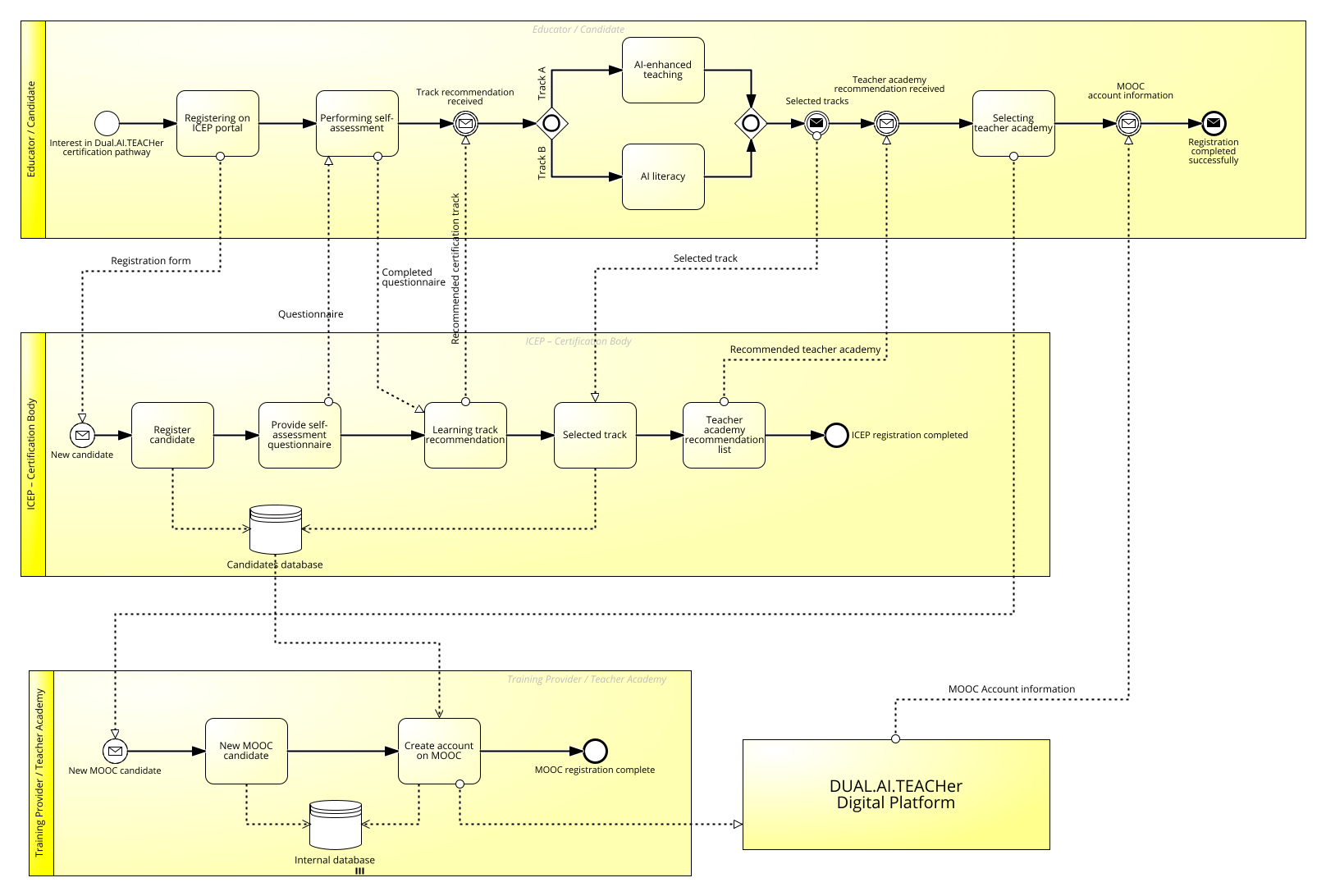](https://playbook.dualaiteacher.eu/uploads/images/gallery/2026-09/registration-self-assessment-and-track-selection.png)**Figure 1: Registration, Self-Assessment and Certification Pathway Selection Process**
### Learning and preparation
After selecting a certification track, candidates enter the learning and preparation phase. They use the provided learning content and may collect badges through the MOOC as part of their preparation for the certification assessment.
The preparation process includes access to learning materials, support activities, self-assessment, practical assignments, and progress tracking. The candidate can continue learning, repeat activities where needed, or proceed towards the certification assessment once sufficiently prepared.
**[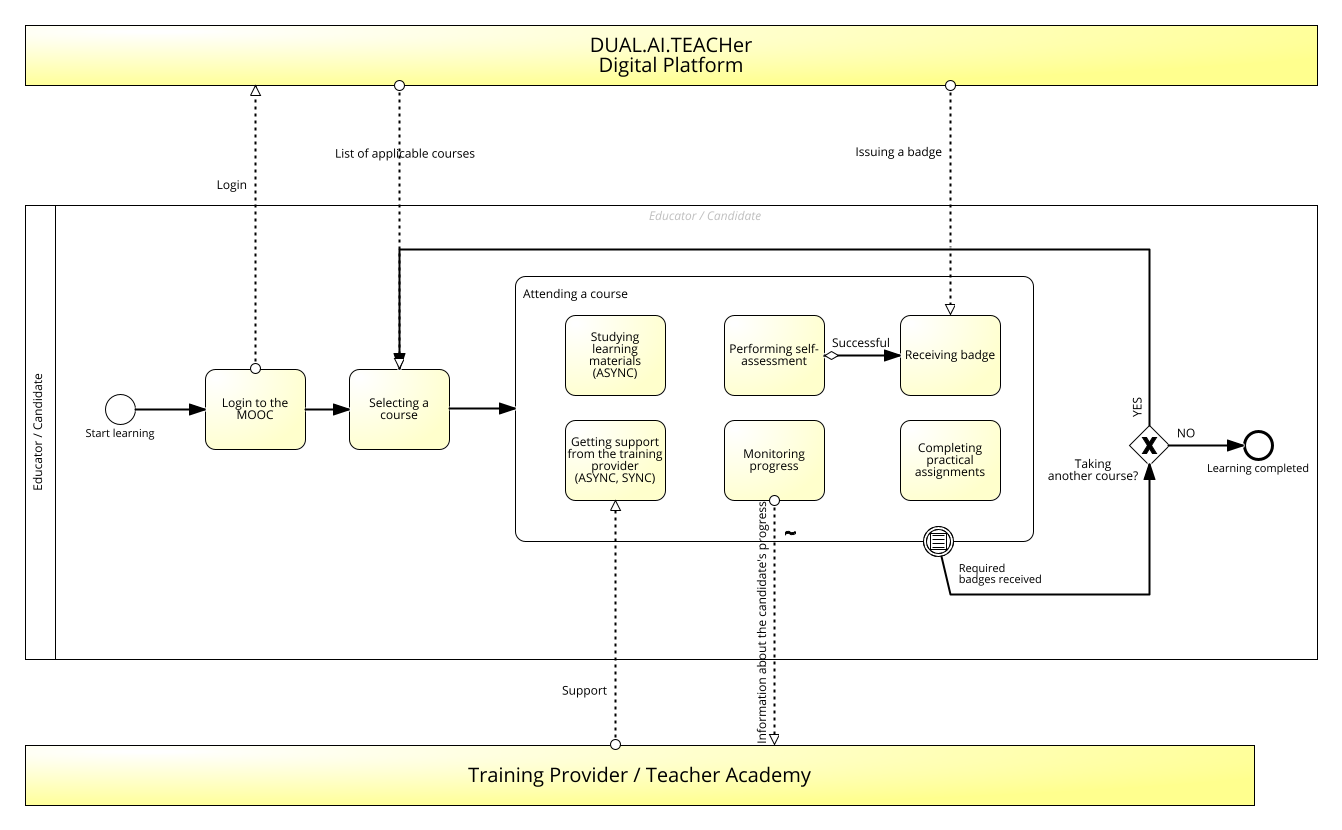](https://playbook.dualaiteacher.eu/uploads/images/gallery/2026-09/learning-activities.png)Figure 2: Learning and Preparation Process**
### Assessment and certification
The certification assessment is delivered through an online examination for each certification track.
The planned assessment format includes:
- **Format:** Online examination
- **Content:** 30 multiple-choice questions
- **Platform:** ICEP certification platform
- **Language:** English and national languages
- **Attempts:** Up to 2 attempts per candidate
- **Monitoring:** Remote proctoring/monitoring
Candidates complete the assessment for the selected track after the preparation phase and readiness self-assessment. Successful completion of the examination leads to the issuance of the corresponding certificate.
The assessment may include the following question types:
- Single Best Answer
- Multiple Choice
- True/False
These selected-response formats are intended to support objective, consistent, and scalable assessment, while enabling efficient automated scoring.
**[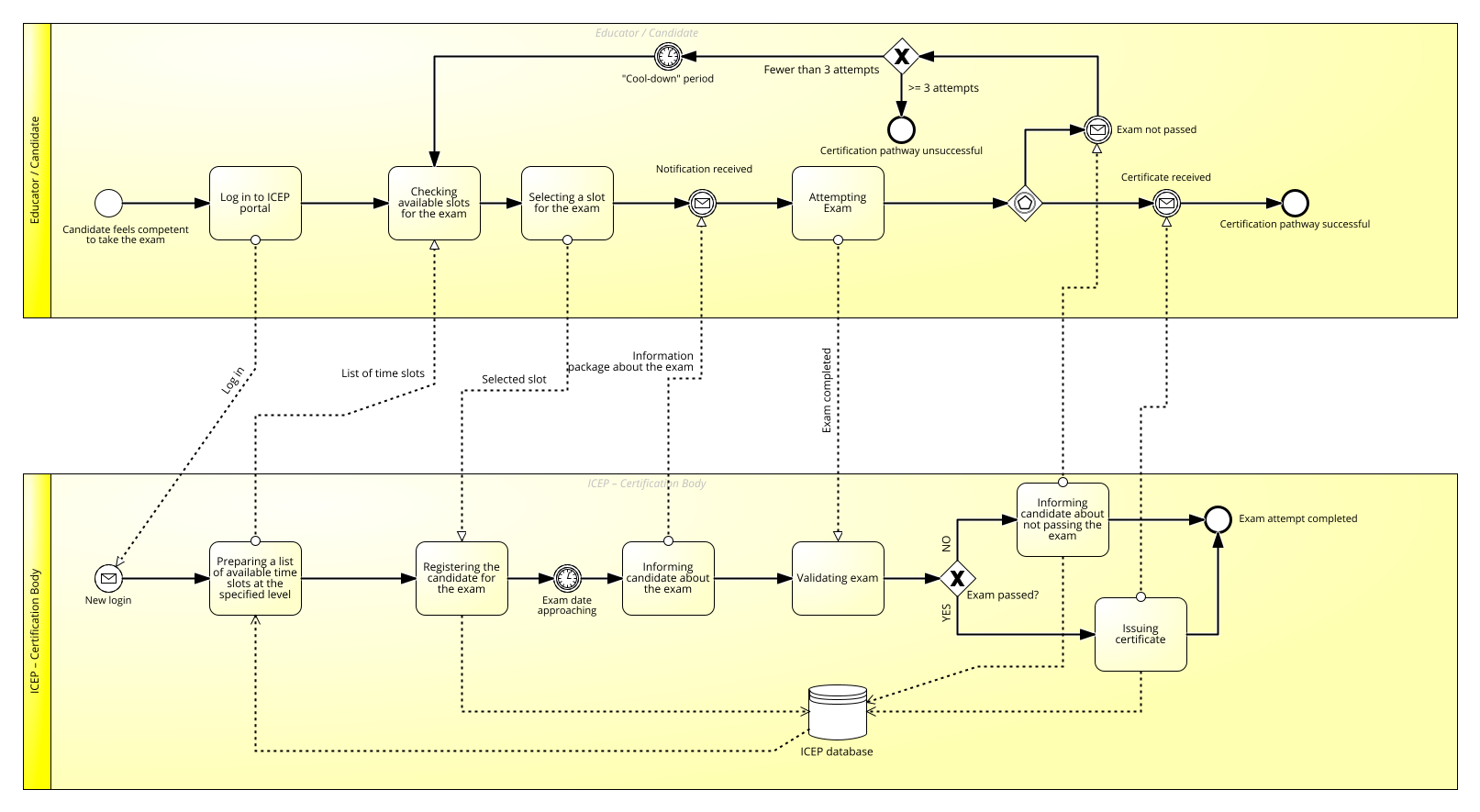](https://playbook.dualaiteacher.eu/uploads/images/gallery/2026-09/issuing-certificate.png)Figure 3: Examination and Certification Process between the Candidate and ICEP**
### Which track is right for me?
The two certification tracks address different professional needs and interests.
**Track A – AI-Enhanced Teaching (WITH AI)** is intended for teachers who want to use AI in teaching and learning in a pedagogically meaningful, safe, and professionally responsible way. In the Certification Pathway Design, this is illustrated through **Maja Novak**, a secondary school teacher who already experiments with generative AI for lesson preparation, differentiated materials, classroom activities, and formative feedback. Her main goal is to move from experimental use of AI towards more informed and reflective professional practice.
**[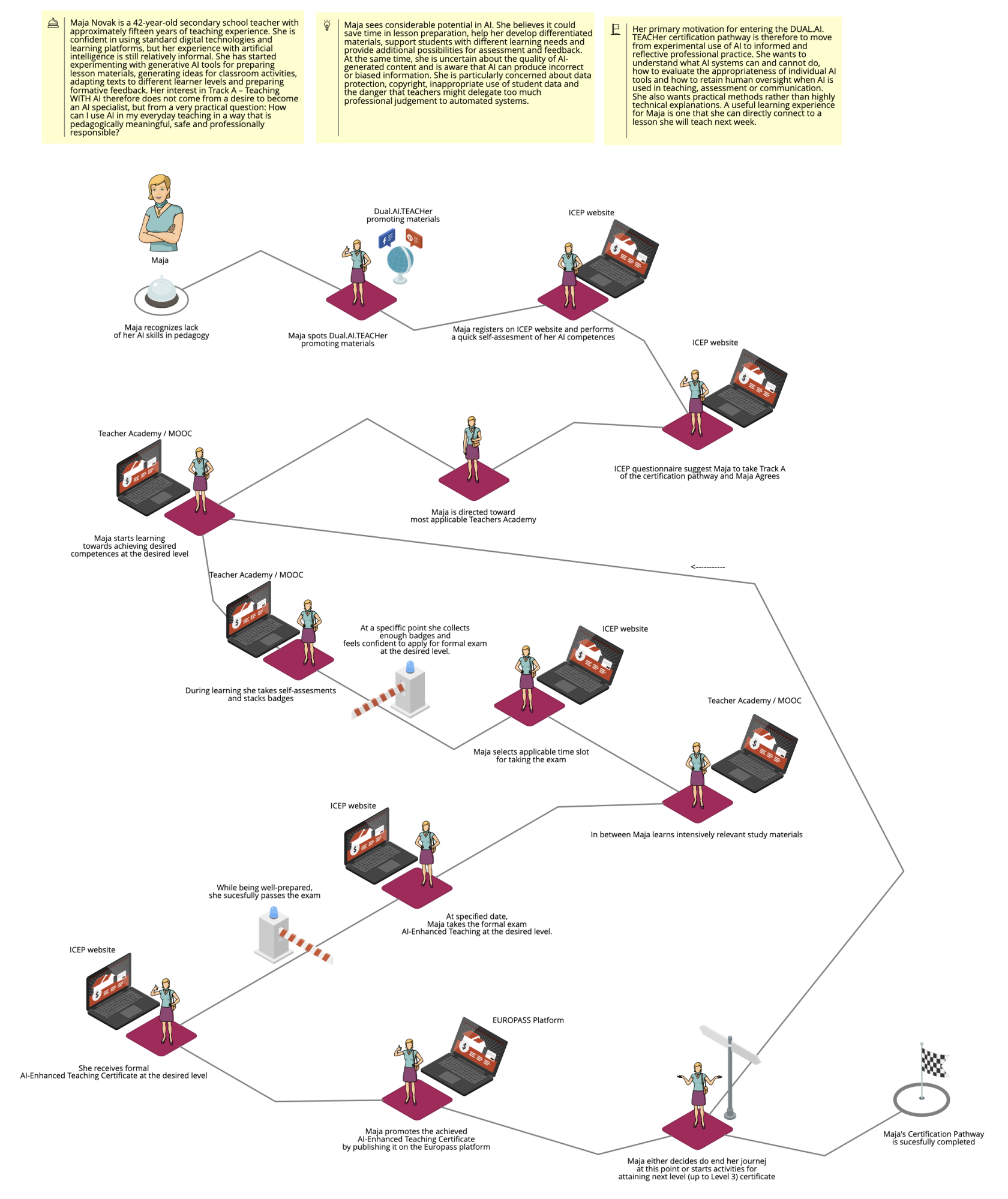](https://playbook.dualaiteacher.eu/uploads/images/gallery/2026-08/dual-ai-teacher-certification-pathway-track-a.png)Figure 4: Candidate Journey – Track A: AI-Enhanced Teaching**
**Track B – AI Literacy (ABOUT AI)** is intended for teachers who want to strengthen their own and their learners’ understanding of AI concepts, limitations, risks, and responsible use. This is illustrated through **Luka Horvat**, an upper-secondary teacher who wants to help students become critical, informed, and responsible users of AI, with particular attention to issues such as misinformation, bias, privacy, transparency, data use, human agency, and the social impact of AI.
**[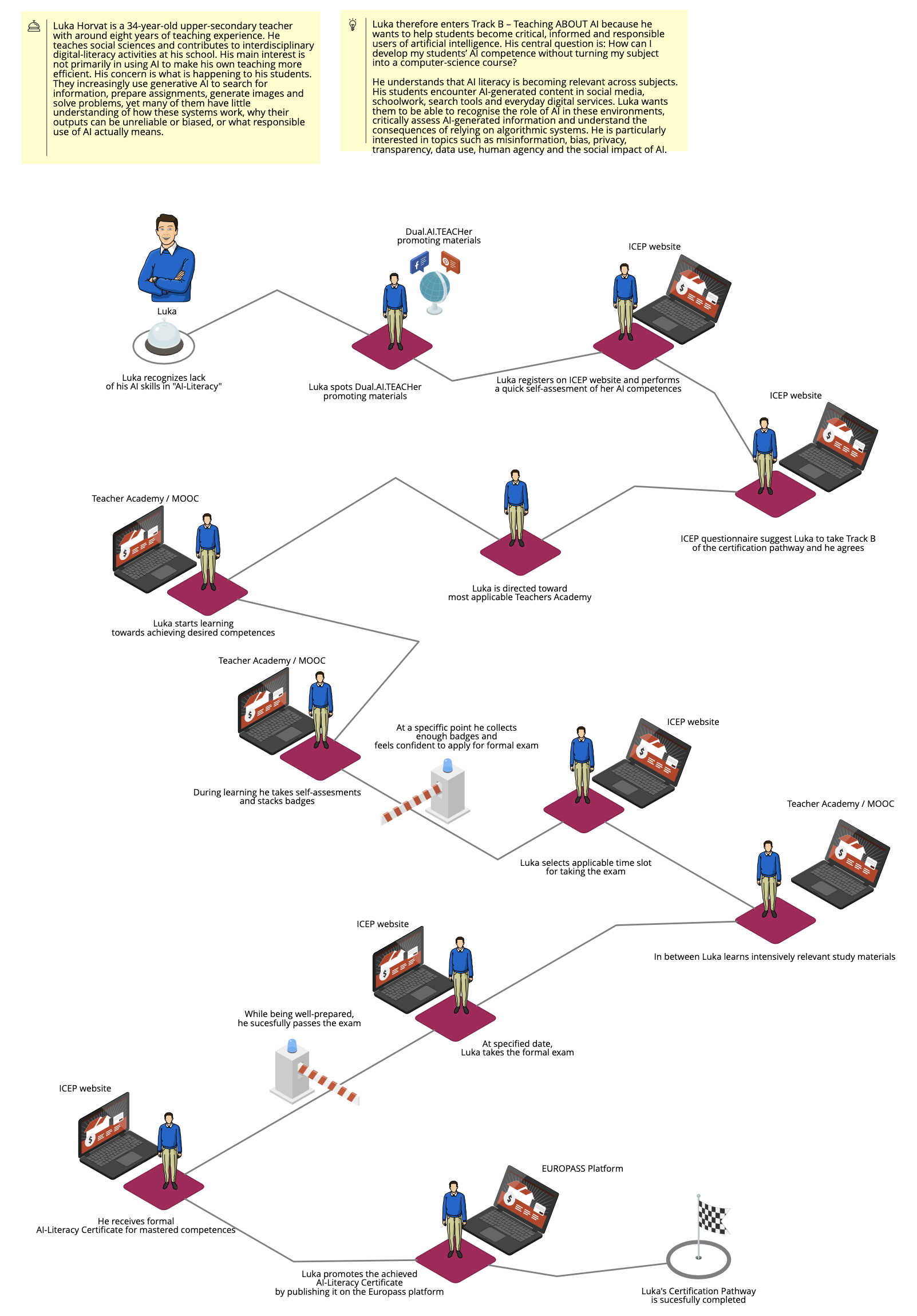](https://playbook.dualaiteacher.eu/uploads/images/gallery/2026-08/dual-ai-teacher-certification-pathway-track-b.png)**
**Figure 5: Candidate Journey – Track B: AI Literacy**
Candidates may pursue either one track or both tracks, depending on their prior knowledge, professional role, and development needs. A preliminary self-assessment supports the selection of the most appropriate pathway.
### Credentialing and Recognition
Upon successful completion of the assessment, candidates receive a **digital certificate** for the completed certification track.
The certification model includes:
- **Issuance:** Digital certificate following successful assessment
- **Validity:** 5 years from the date of issue
- **Certification records:** Maintained by ICEP in a central database
- **Scope:** Separate certification for Track A and Track B; candidates completing both tracks receive both credentials
The certification is intended to support the recognition of teachers’ AI-related competencies and their continuing professional development. It is also intended to support the recognition and portability of these competences across European contexts.
### More Information
Further details on the certification structure, candidate journey, assessment criteria, examination procedure, roles and responsibilities, pilot validation, and sustainability are provided in the full **DUAL.AI.TEACHer Certification Pathway Design** document.
# 4.2 Micro-Credentials (ICEP)
### The Micro-Credentials
**Micro credentials** are short, focused qualifications that certify specific learning outcomes and skills axquired through brief training or courses.
Characteristics:
- **Short-term learning** - Completed in hours, days, or weeks rather than years.
- **Competency-based** - Focused on a single, well-defined skill set or subject (e.g., data analysis or project management).
- **Verifiable proof** - Delivered via secure digital badges or certificates containing metadata about what was learned.
Key benefits:
- **Flexibility** - Allows fast upskilling or retraining without long-term financial commitments.
- **Employability** - Provides employers with transparent, easily verifiable proof of practical competencies.
- **Stackability** - Can often be combined or "stacked" over time to count toward larger qualifications or degrees
1. **Pathway A - AI-Enhanced Pedagogy:** Validates competence in using AI tools for lesson design, adaptive instruction, automated assessment, and workflow optimization.
2. **Pathway B - AI Literacy & Civic Education:** Validates competence in teaching students computational thinking, algorithmic bias, data privacy, and ethical AI citizenship.
Structural Framework & Alignment:
- **Managing Body:** Led by ICEP (Institute of European Certification of Personnel), an accredited SNAS / ISO 17024 certificaton and qualification body.
- **Standards Alignment:** Mapped to DigCompEdu (for digital teaching competence), EntreComp (for innovation), Universal Design for Learning (UDL), ESCO, EQF, and EUROPASS Digital Credentials guidelines.
- **Target Audience:** Reaches 400+ pre-service and in-service educators during the project lifetime.
Technical Architecture & Credentialing Process:
- **Digital Badges:** Module completion on the WP3 MOOC automatically issues open digital badges for individual micro-competences (e.g., *Ethical AI Use*, *Prompt Engineering*, *Adaptive Assessment*). These can be easily shared on professional networks like LinkedIn, providing verifiable proof of skills.
- **Secure Assessment & Validation:** Candidates complete a standardized, remotely monitored digital examination (30 multiple-choice questions) hosted on ICEP’s digital secured platform (`competenceinstitute.com`). Candidates receive up to two exam attempts. The online certification will be offer at the end of the whole course as a assessment tool to verify all knowledge and skills they have learned and improved throughout the whole course consists of all learning modules/chapters/paths, and then verify them through a international certification examination.
- **Portable EU Certification:** Successful completion grants formal digital certificates and micro-credentials valid for **5 years** across the EU. Credentials can be exported directly to EUROPASS profile portfolios and LinkedIn.
# 5. AI Integration Roadmap
# 5.1 How to Use the Roadmap
This chapter presents the DUAL.AI.TEACHer Integration Roadmap: nine stages that take an institution from its first strategic conversation about AI to a permanent structure for it. It is written for people who shape how an institution works, rather than for individual classroom practice.
It is deliberately not a single text to be read from beginning to end. Read the part that matches your role.
| Stage | Start with | Then |
| **Anyone** | [5.2](https://playbook.dualaiteacher.eu/books/playbook-en/page/52-roadmap-summarized-short-version) | It takes two minutes and gives you the whole model |
| **A school leader** or responsible for professional development in a school
| [5.2](https://playbook.dualaiteacher.eu/books/playbook-en/page/52-roadmap-summarized-short-version) | [5.3, written for schools](https://playbook.dualaiteacher.eu/books/playbook-en/page/53-roadmap-for-schools)
|
| **Working in a teacher education institution** (programme direction, teacher educators, quality assurance)
| [5.2](https://playbook.dualaiteacher.eu/books/playbook-en/page/52-roadmap-summarized-short-version) | [5.4, the full version, read in sequence](https://playbook.dualaiteacher.eu/books/playbook-en/page/54-full-roadmap-for-teacher-education-institutions) |
| **A teacher looking for classroom practice**
| [5.2](https://playbook.dualaiteacher.eu/books/playbook-en/page/52-roadmap-summarized-short-version) | You can stop there. Chapters [5.2](https://playbook.dualaiteacher.eu/books/playbook-en/page/52-roadmap-summarized-short-version) and [5.3](https://playbook.dualaiteacher.eu/books/playbook-en/page/53-roadmap-for-schools) are the ones written for you |
### Reading the full version
Section 5.4 describes each of the nine stages in full: what the stage involves, why it is designed that way, and how you can tell that you have completed it. It is the reference version of the roadmap, and it is written to be used twice. Read it once in sequence, to see why the stages are ordered as they are and which of them depend on each other. Then return to individual stages as you work on them, which is how most institutions will use it in practice.
Readers coming from 5.3 do not need 5.4 in order to act, but any stage described there in brief is set out at length in 5.4. The two sections meet at Stage 6, *Embed AI into CPD*: it is where teacher education institutions organise the continuing professional development that schools take up.
# 5.2 Roadmap (Summarized Short Version)
## Our starting point
The DUAL.AI.TEACHer project aims to develop a clear and adaptable roadmap of seven to ten stages that helps teacher education institutions embed AI into both initial teacher education and continuing professional development. The roadmap focuses on institutional change rather than individual initiatives and was developed together with teacher educators.
Two existing models provided particularly relevant foundations.
The first is a six-stage higher education model, summarized as “learning to learn again”. It moves from reframing institutional conversations about AI through trust and governance, staff fluency, curriculum change and the redesign of teaching and assessment, towards institution-wide amplification (Black, 2025). Its main strength is that it treats AI as a driver of institutional transformation rather than simply a tooling question.
The second is a four-phase GenAI implementation roadmap for schools and districts: establish a foundation, develop staff, update what is taught, and assess and progress. Its strength is its operational focus and emphasis on concrete implementation.
Both models do what they set out to do: one addresses universities as a whole, the other schools and districts. Teacher education institutions sit across both settings, and this is where we saw room to extend the existing work. These institutions transform their own teaching while simultaneously preparing future teachers for contexts beyond their direct control. Attending to internal transformation alone would leave AI-related curricula to be delivered by staff with limited practical experience, while attending to future classroom practice alone would modernize the programme without changing the institution that delivers it. The DUAL.AI.TEACHer roadmap builds on both models and connects the two dimensions.
[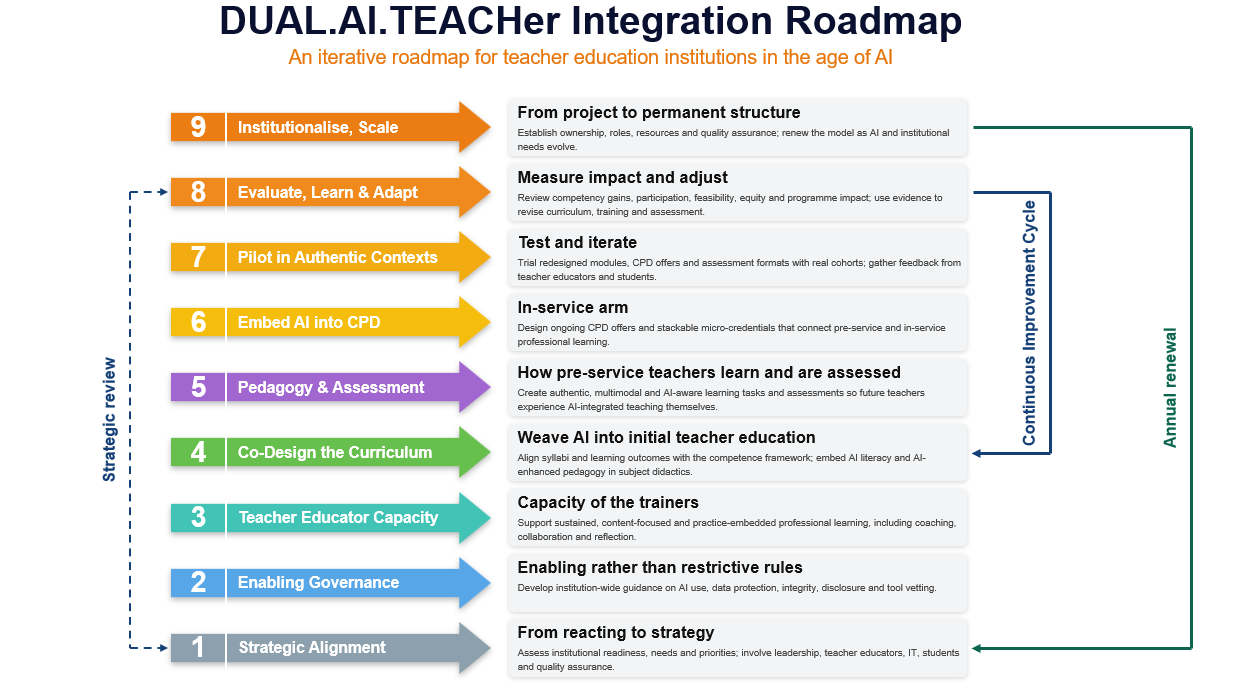](https://playbook.dualaiteacher.eu/uploads/images/gallery/2026-08/grafik.png)
**Figure 1.** DUAL.AI.TEACHer Integration Roadmap: Nine stages for the institutional integration of AI in teacher education.
## Two axes beneath the stages
Rather than combining the two reference models step by step, the roadmap is built around two parallel axes.
The first is **institutional transformation**: structures, governance, curriculum and the formal conditions that enable or constrain AI use. This axis follows the reframe-to-amplify logic of the higher education model and is informed by established research. Diffusion of Innovations identifies trialability and observability as characteristics that facilitate innovation adoption, informing the emphasis in Stage 7 on visible pilot implementation (Neal et al., 2018).
The second is **human capacity**, which serves as the quality axis of the roadmap. Training cannot be reduced to isolated workshops. Research on effective teacher professional development highlights sustained duration, content focus, practice, reflection, feedback and coaching (Lipowsky & Rzejak, 2021). These principles therefore inform the design of training activities throughout the roadmap, from teacher educators in Stage 3 to in-service teachers in Stage 6. A one-off workshop alone does not constitute completion of a stage.
## The Roadmap Cheatsheet
| Stage | Task | Done when |
| Strategic Alignment | Assess where the institution actually stands and agree what it wants to achieve, with leadership involved and a cross-functional team in place. | The starting position and the goal exist in writing. |
| Enabling Governance | Put institution-wide guidance in place on AI use, data protection, integrity, disclosure and tool vetting, framed around what is possible rather than what is banned. | Staff can answer "am I allowed to do this?" without asking anyone. |
| Teacher Educator Capacity | Build the capacity of those who teach, through sustained, content-focused, practice-embedded professional learning with coaching and reflection. | Development is ongoing, not only a single workshop. |
| Co-Design the Curriculum | Move AI into the formal programme by revising syllabi and learning outcomes, anchored in subject didactics rather than in a standalone module. | AI-related outcomes appear in the regular module documentation of several subjects. |
| Pedagogy & Assessment | Redesign learning tasks and assessment to be authentic and AI-aware, and model AI-integrated teaching so students experience it as learners. | Assessment formats have been revised, not just supplemented by a declaration of AI use. |
| Embed AI into CPD | Turn continuing professional development into a structured offer with stackable micro-credentials, securing the in-service arm. | Provision has a published structure and a recognised credential. |
| Pilot in Authentic Contexts | Trial the redesigned modules, CPD and assessments with real cohorts and gather feedback systematically. | Documented feedback exists and has led to identifiable revisions. |
| Evaluate, Learn & Adapt | Review competency gains, participation, feasibility, equity and impact, and use the evidence to revise. | Evidence has changed something, not just filled a report. |
| Institutionalise, Scale
| Convert the initiative into permanent structure: ownership, roles, resources, quality assurance, renewal. | The work continues after the people who started it have moved on. |
**AI for Education.** (n.d.). *AI adoption roadmap for education institutions*.
**Black, A.** (2025, December 3). *Learning to learn again: A roadmap for higher education institutions in the age of AI*. enablinginsights.
**Lipowsky, F., & Rzejak, D.** (2021). *Fortbildungen für Lehrpersonen wirksam gestalten: Ein praxisorientierter und forschungsgestützter Leitfaden*. Bertelsmann Stiftung.
**Neal, J. W., Neal, Z. P., Lawlor, J. A., Mills, K. J., & McAlindon, K.** (2018). What makes research useful for public school educators? *Administration and Policy in Mental Health and Mental Health Services Research, 45*(3), 432–446.
# 5.3 Roadmap for Schools
## Who this section is for
**School leaders, deputy heads and those responsible for professional development in a school.** You do not need to have read the preceding sections in full. If you have read the nine stages in 5.2, this section tells you how they apply to a school; if you have not, you can start here.
**Where schools enter the roadmap.** This roadmap was developed for teacher education institutions, but its change logic is not specific to them, and one stage concerns schools directly. Stage 6, *Embed AI into CPD*, is the in-service arm: it is where teacher education institutions organise the continuing professional development that your staff attend. That is your entry point. What your institution offers as Stage 6 arrives in your school as professional development, and whether it changes anything in your classrooms depends on conditions within that school.
**Why you cannot start there and stop.** Sending staff to a one-off course is the most common approach and at the same time unlikely to change practice on its own. What works is sustained engagement with a content focus, opportunity to practise, and follow-up in the form of coaching or collaboration (Lipowsky & Rzejak, 2021). This has a direct consequence for a school leader. The scarce resource is not the course; it is the protected time afterwards in which teachers try something, discuss it with colleagues and adjust.
[](https://playbook.dualaiteacher.eu/uploads/images/gallery/2026-08/grafik.png)
**Figure 1.** DUAL.AI.TEACHer Integration Roadmap: Nine stages for the institutional integration of AI in teacher education.
## **The three stages to prioritise at school level**
Stage 6 is your connection point, but Stages 1-3 create the conditions that make it work.
***Stage 1, Strategic Alignment.*** Establish where your school actually stands. Some of your staff are already using AI, some are avoiding it, and schools may not have a clear picture of current practice. A short, honest stocktake is worth more than a strategy paper. Name what you want to achieve, and be prepared for the answer that AI is not currently your school's most pressing problem; that is a legitimate result of this stage.
***Stage 2, Enabling Governance.*** This is particulary important at school level and easy to overlook. Staff and students need to know what is permitted, how AI use is to be disclosed, which tools have been checked for data protection, and what counts as academic dishonesty. Where this is unclear, two things happen at once: cautious teachers avoid AI entirely, and confident ones use it without any agreed limits. Clear, enabling guidance helps addressing both. It does not need to be long.
***Stage 3, Staff Capacity.*** In the original roadmap this stage concerns teacher educators; in your school it concerns your teaching staff. The same quality conditions apply. Consider starting with a small group of willing colleagues in one or two subjects rather than a whole-staff rollout, and make their results visible to the rest of the staff. Innovations spread when colleagues can see them working in their own setting (Neal et al., 2018).
## What is different in a school
Three constraints distinguish your situation from that of a teacher education institution, and the roadmap should be read with them in mind.
**You have less curricular autonomy.** Stages 4 and 5 assume an institution that can revise its own course content. Much of your curriculum may be set within national or statutory frameworks and your room for manoeuvre lies in how subjects are taught and how learning is assessed, not in what is prescribed. Read those stages as being about task design and assessment practice.
**Your staff have less discretionary time.** A teacher education institution can assign development work to academic staff as part of their role. In a school, every hour of development competes directly with teaching. This makes Stage 2 disproportionately valuable: guidance costs little time and removes a great deal of friction.
**You are closer to the consequences.** Schools experience the the practical consequences of questions around equity, student data and access particulary directly. Stage 8 asks explicitly about equity for this reason.
**Lipowsky, F., & Rzejak, D.** (2021). *Fortbildungen für Lehrpersonen wirksam gestalten: Ein praxisorientierter und forschungsgestützter Leitfaden*. Bertelsmann Stiftung.
**Neal, J. W., Neal, Z. P., Lawlor, J. A., Mills, K. J., & McAlindon, K.** (2018). What makes research useful for public school educators? *Administration and Policy in Mental Health and Mental Health Services Research, 45*(3), 432–446.
# 5.4 Full Roadmap for Teacher Education Institutions
## Who this section is for
**Deans, programme directors, teacher educators and those responsible for quality assurance in institutions that prepare teachers.** This roadmap was written primarily for you, and this section assumes you have read the nine stages in 5.1. Unlike school readers, teacher education institutions need to consider the roadmap as a whole, because the stages address different parts of institutional change that depend on one another.
[](https://playbook.dualaiteacher.eu/uploads/images/gallery/2026-08/grafik.png)
**Figure 1.** DUAL.AI.TEACHer Integration Roadmap: Nine stages for the institutional integration of AI in teacher education.
1. Strategic Alignment
From reacting to strategy Most institutions do not start from zero. They start from a patchwork of individual initiatives, informal tool use and unresolved concerns. The first stage makes that starting position visible and turns it into a shared strategic direction. Leadership opens the process rather than delegating it, because later stages require decisions about staffing, resources and curriculum that need institutional support. The institution assesses its readiness, needs and priorities, and establishes a cross-functional steering team that includes teacher educators, IT, students and quality assurance. Involving students is not symbolic: they experience the curriculum directly and, in teacher education, are also members of the future profession.
The stage is complete when the institution can state, in writing, where it stands, what it wants to achieve and who is responsible for taking the work forward.
2. Enabling Governance
Guidance comes early because uncertainty can become a major barrier to adoption. Staff who do not know what is permitted may either avoid AI altogether or use it without shared expectations. The institution develops institution-wide guidance covering AI use, data protection, academic integrity, disclosure expectations and a process for reviewing and approving tools. The decisive design choice is the framing: guidance should explain what is possible and under which conditions, rather than consist mainly of prohibitions. Draft guidance is circulated for feedback before adoption, improving both its practical usefulness and its legitimacy.
The stage is complete when staff can readily find a clear answer to the question “Am I allowed to do this?” and know where to turn when a case falls outside the guidance.
3. Teacher Educator Capacity
Teacher educators cannot model practices they have not had the opportunity to explore themselves. This stage builds their capacity through professional learning that is sustained rather than one-off, connected to content and subject didactics rather than focused mainly on tools, and embedded in practice through collaboration, coaching and structured reflection. These are features consistently associated with effective teacher professional development (Lipowsky & Rzejak, 2021). Competences are mapped against the DUAL.AI.TEACHer Competency Framework and the UNESCO AI Competency Framework for Teachers so that development has both a direction and a reference point. AI integration should build on teacher educators' existing professional expertise rather than treat AI as a separate technical competence. A single workshop does not complete this stage. The stage is complete when teacher educators have sustained opportunities to develop, apply and reflect on AI-related practice in their own teaching contexts.
4. Co-Design the Curriculum
Here AI moves from extracurricular activity into the formal programme. Course and module documentation is reviewed, and learning outcomes are aligned with the competency framework so that what is taught, practised and assessed points in the same direction. A central design principle of this roadmap is that AI literacy and AI-enhanced pedagogy should be embedded within subject didactics rather than confined to a standalone module. A dedicated AI course may be useful as a transitional step, but it risks signalling that AI is a separate topic rather than part of everyday subject teaching. Co-design with teacher educators matters because those who will teach the revised programme need to have shaped it.
The stage is complete when AI-related learning outcomes are visible in the regular documentation of multiple subjects or modules and are connected to the wider programme rather than isolated in a single course.
5. Pedagogy & Assessment
Changing the curriculum on paper is not enough if teaching and assessment remain unchanged. This stage redesigns learning tasks and assessment formats so that they are authentic, multimodal and AI-aware, and so that assessment focuses on what future teachers can understand, justify, create and apply rather than on outputs that a generative system can produce on request. Equally important is the modelling effect: pre-service teachers should experience thoughtful AI-integrated teaching as learners before they are expected to use it as professionals. Teacher education has a distinctive opportunity here because students experience teaching practices while simultaneously developing their own professional practice.
The stage is complete when AI-related learning outcomes are reflected in actual teaching and assessment practice, not merely added to module descriptions or disclosure requirements.
6. Embed AI into CPD
Teacher education institutions do not only prepare future teachers; they also support those already working in schools. This stage develops continuing professional development into a structured offer rather than a series of isolated events. The same quality conditions as in Stage 3 apply: sustained engagement, a clear content focus, opportunities to practise, and follow-up through collaboration, feedback or coaching. In the DUAL.AI.TEACHer model, this work can be linked to the certification pathway developed in T2.6, allowing professional learning to build over time. Stage 6 also creates a two-way connection with schools: institutions contribute professional learning, while in-service teachers bring current classroom experience back into teacher education.
The stage is complete when in-service professional learning forms a coherent and sustained offer with clear progression, rather than a calendar of unrelated single events.
7. Pilot in Authentic Contexts
Redesigned modules, CPD offers and assessment formats are trialled with real cohorts under realistic conditions, and feedback from teacher educators, students and other participants is gathered systematically. Piloting reduces the risk of scaling an approach before it has been tested in practice. It also makes implementation visible: colleagues can see how an approach works in a context similar to their own, discuss the results and adapt it before wider adoption. The purpose of the pilot is therefore not to demonstrate that the design was correct, but to discover what needs to change.
The stage is complete when documented feedback from authentic implementation has led to identifiable revisions.
8. Evaluate, Learn & Adapt
Evaluation asks whether the changes achieved what they were intended to achieve. Depending on the intervention, this may include competency development, participation, feasibility, equity, staff and student experience, and wider programme effects. Equity is considered explicitly because AI integration may reduce some inequalities while creating or reinforcing others, for example across subjects, staff groups or students with different levels of access and support. Evidence is then used to revise curriculum, professional development, assessment and implementation.
This stage also establishes a regular review cycle for the guidance developed in Stage 2, which will need to evolve as technologies, practices and regulatory conditions change.
9. Institutionalise and Scale
The final stage moves successful work from project status into the regular structures of the institution. This means clear ownership, defined responsibilities, appropriate resources and integration into existing processes such as programme development and quality assurance. Scaling should follow the institution's own context, capacity and profile rather than a single generic model. Institutionalisation also means creating mechanisms for renewal: AI technologies, educational practices and institutional needs will continue to change, so the model itself cannot remain fixed.
The stage is complete when the work continues after the people who started it have moved on.
| Term | Explanation | Also used in |
| Automation bias | Accepting a machine's suggestion without independently checking it
|
|
| AI Detector | Software claiming to identify machine-written text. What it actually measures is predictability.
| 1.5 |
| AI Pedagogical Competency Framework | Structure that sorts AI-related teaching competencies into dimensions & levels and links them to outcomes & assessments.
|
|
| Bias | Slants inherited from the material a system learned from and not reliably reduced by making the system bigger | 1.4, 1.5 |
| Certification pathway | The route through which competences are validated and formally recognised, here as a dual pathway. |
|
| [Cognitive offloading](https://playbook.dualaiteacher.eu/books/playbook-en/page/12-teaching-about-vs-teaching-with-ai "1.3 Learning About vs Teaching with AI") | Handing mental work to something outside your head. It is useful when knowledge is in place, and damaging when it is still forming. | 1.4 |
| Competence | What a teacher knows, can do & is willing to do, described so that it can be taught and checked. |
|
| Deskilling | The slow erosion of professional exptertise when a tool absorbs the work through which that expertise is maintained. | 1.4 |
| Digital Badge | The shareable digital form of a certificate or micro-credential. |
|
| Dimension | One of the broad areas the framework is divided into, each grouping competences that belong together in practice. |
|
| False positive | A correct, honest piece of work wrongly flagged. The error that damages students | 1.4, 1.5 |
| [Guardrails](https://playbook.dualaiteacher.eu/books/playbook-en/page/12-teaching-about-vs-teaching-with-ai "1.3 Learning About vs Teaching with AI") | Limits built into a system so that it supports thinking instead of replacing it. | 1.4, 1.5 |
| Hallucination | Fluent, confident, false. Not a defect awaiting a patch but a consequence of how the systems generate text | 1.4, 1.5 |
| Integration roadmap | The step-by-step route a teacher or an institution takes from first contact with AI to settled practice. | |
| [Knowledge-action gap](https://playbook.dualaiteacher.eu/books/playbook-en/page/12-teaching-about-vs-teaching-with-ai "1.3 Learning About vs Teaching with AI") | The measured distance between knowing about AI and teaching differently because of it. | 1.4, 1.5 |
| Micro-credential | A smaller certification covering one focused set of competences instead of a whole pathway. |
|
| [Schema](https://playbook.dualaiteacher.eu/books/playbook-en/page/12-teaching-about-vs-teaching-with-ai "1.3 Learning About vs Teaching with AI") | Person's organised knowledge | 1.4 |
| Teaching about AI | Making AI itself the subject of the lesson, so that students understand how it works & where it fails. |
|
| Teaching with AI | Using AI as a tool for your own teaching work, from planning to feedback. |
|
|
|
|
|
|
|
|
|
|
|
|
|
|
|
|
|