5. AI Integration Roadmap
- 5.1 How to Use the Roadmap
- 5.2 Roadmap (Summarized Short Version)
- 5.3 Roadmap for Schools
- 5.4 Full Roadmap for Teacher Education Institutions
5.1 How to Use the Roadmap
This chapter presents the DUAL.AI.TEACHer Integration Roadmap: nine stages that take an institution from its first strategic conversation about AI to a permanent structure for it. It is written for people who shape how an institution works, rather than for individual classroom practice.
It is deliberately not a single text to be read from beginning to end. Read the part that matches your role.
| Stage | Start with | Then |
| Anyone | 5.2 | It takes two minutes and gives you the whole model |
|
A school leader or responsible for professional development in a school |
5.2 | |
|
Working in a teacher education institution (programme direction, teacher educators, quality assurance) |
5.2 | 5.4, the full version, read in sequence |
|
A teacher looking for classroom practice |
5.2 | You can stop there. Chapters 5.2 and 5.3 are the ones written for you |
Reading the full version
Section 5.4 describes each of the nine stages in full: what the stage involves, why it is designed that way, and how you can tell that you have completed it. It is the reference version of the roadmap, and it is written to be used twice. Read it once in sequence, to see why the stages are ordered as they are and which of them depend on each other. Then return to individual stages as you work on them, which is how most institutions will use it in practice.
Readers coming from 5.3 do not need 5.4 in order to act, but any stage described there in brief is set out at length in 5.4. The two sections meet at Stage 6, Embed AI into CPD: it is where teacher education institutions organise the continuing professional development that schools take up.
5.2 Roadmap (Summarized Short Version)
Our starting point
The DUAL.AI.TEACHer project aims to develop a clear and adaptable roadmap of seven to ten stages that helps teacher education institutions embed AI into both initial teacher education and continuing professional development. The roadmap focuses on institutional change rather than individual initiatives and was developed together with teacher educators.
Two existing models provided particularly relevant foundations.
The first is a six-stage higher education model, summarized as “learning to learn again”. It moves from reframing institutional conversations about AI through trust and governance, staff fluency, curriculum change and the redesign of teaching and assessment, towards institution-wide amplification (Black, 2025). Its main strength is that it treats AI as a driver of institutional transformation rather than simply a tooling question.
The second is a four-phase GenAI implementation roadmap for schools and districts: establish a foundation, develop staff, update what is taught, and assess and progress. Its strength is its operational focus and emphasis on concrete implementation.
Both models do what they set out to do: one addresses universities as a whole, the other schools and districts. Teacher education institutions sit across both settings, and this is where we saw room to extend the existing work. These institutions transform their own teaching while simultaneously preparing future teachers for contexts beyond their direct control. Attending to internal transformation alone would leave AI-related curricula to be delivered by staff with limited practical experience, while attending to future classroom practice alone would modernize the programme without changing the institution that delivers it. The DUAL.AI.TEACHer roadmap builds on both models and connects the two dimensions.
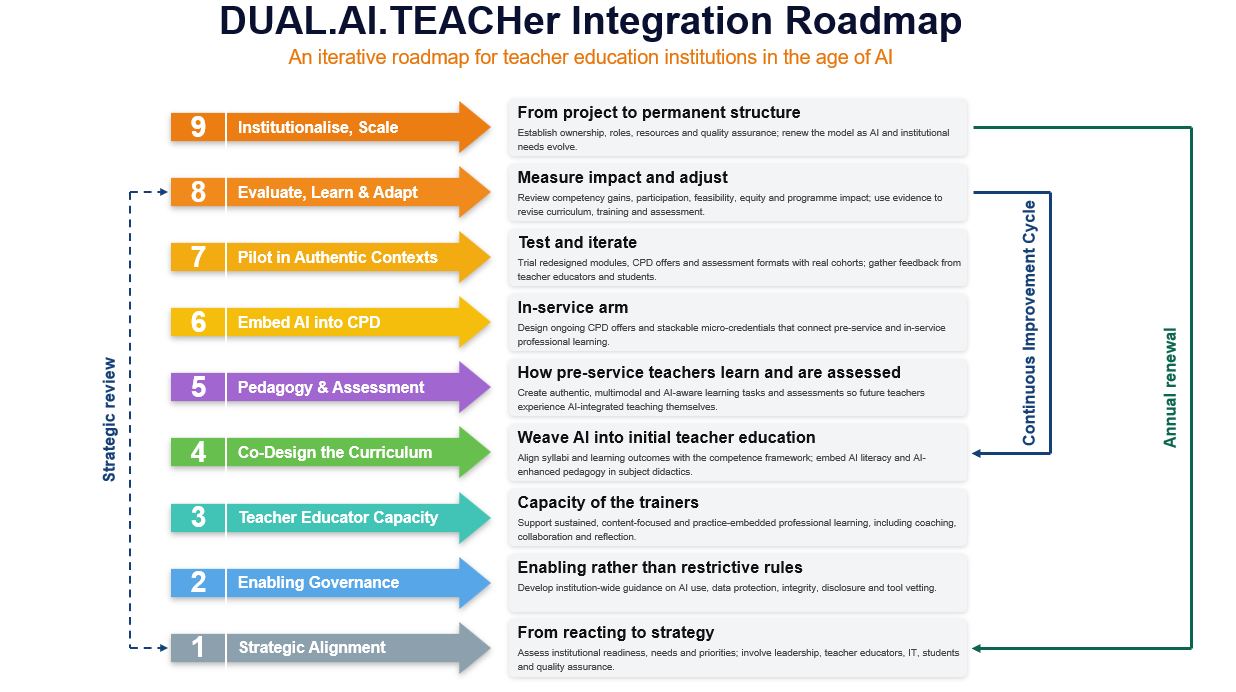
Figure 1. DUAL.AI.TEACHer Integration Roadmap: Nine stages for the institutional integration of AI in teacher education.
Two axes beneath the stages
Rather than combining the two reference models step by step, the roadmap is built around two parallel axes.
The first is institutional transformation: structures, governance, curriculum and the formal conditions that enable or constrain AI use. This axis follows the reframe-to-amplify logic of the higher education model and is informed by established research. Diffusion of Innovations identifies trialability and observability as characteristics that facilitate innovation adoption, informing the emphasis in Stage 7 on visible pilot implementation (Neal et al., 2018).
The second is human capacity, which serves as the quality axis of the roadmap. Training cannot be reduced to isolated workshops. Research on effective teacher professional development highlights sustained duration, content focus, practice, reflection, feedback and coaching (Lipowsky & Rzejak, 2021). These principles therefore inform the design of training activities throughout the roadmap, from teacher educators in Stage 3 to in-service teachers in Stage 6. A one-off workshop alone does not constitute completion of a stage.
The Roadmap Cheatsheet
| Stage | Task | Done when |
| Strategic Alignment | Assess where the institution actually stands and agree what it wants to achieve, with leadership involved and a cross-functional team in place. | The starting position and the goal exist in writing. |
| Enabling Governance | Put institution-wide guidance in place on AI use, data protection, integrity, disclosure and tool vetting, framed around what is possible rather than what is banned. | Staff can answer "am I allowed to do this?" without asking anyone. |
| Teacher Educator Capacity | Build the capacity of those who teach, through sustained, content-focused, practice-embedded professional learning with coaching and reflection. | Development is ongoing, not only a single workshop. |
| Co-Design the Curriculum | Move AI into the formal programme by revising syllabi and learning outcomes, anchored in subject didactics rather than in a standalone module. | AI-related outcomes appear in the regular module documentation of several subjects. |
| Pedagogy & Assessment | Redesign learning tasks and assessment to be authentic and AI-aware, and model AI-integrated teaching so students experience it as learners. | Assessment formats have been revised, not just supplemented by a declaration of AI use. |
| Embed AI into CPD | Turn continuing professional development into a structured offer with stackable micro-credentials, securing the in-service arm. | Provision has a published structure and a recognised credential. |
| Pilot in Authentic Contexts | Trial the redesigned modules, CPD and assessments with real cohorts and gather feedback systematically. | Documented feedback exists and has led to identifiable revisions. |
| Evaluate, Learn & Adapt | Review competency gains, participation, feasibility, equity and impact, and use the evidence to revise. | Evidence has changed something, not just filled a report. |
|
Institutionalise, Scale |
Convert the initiative into permanent structure: ownership, roles, resources, quality assurance, renewal. | The work continues after the people who started it have moved on. |
AI for Education. (n.d.). AI adoption roadmap for education institutions.
Black, A. (2025, December 3). Learning to learn again: A roadmap for higher education institutions in the age of AI. enablinginsights.
Lipowsky, F., & Rzejak, D. (2021). Fortbildungen für Lehrpersonen wirksam gestalten: Ein praxisorientierter und forschungsgestützter Leitfaden. Bertelsmann Stiftung.
Neal, J. W., Neal, Z. P., Lawlor, J. A., Mills, K. J., & McAlindon, K. (2018). What makes research useful for public school educators? Administration and Policy in Mental Health and Mental Health Services Research, 45(3), 432–446.
5.3 Roadmap for Schools
Who this section is for
School leaders, deputy heads and those responsible for professional development in a school. You do not need to have read the preceding sections in full. If you have read the nine stages in 5.2, this section tells you how they apply to a school; if you have not, you can start here.
Where schools enter the roadmap. This roadmap was developed for teacher education institutions, but its change logic is not specific to them, and one stage concerns schools directly. Stage 6, Embed AI into CPD, is the in-service arm: it is where teacher education institutions organise the continuing professional development that your staff attend. That is your entry point. What your institution offers as Stage 6 arrives in your school as professional development, and whether it changes anything in your classrooms depends on conditions within that school.
Why you cannot start there and stop. Sending staff to a one-off course is the most common approach and at the same time unlikely to change practice on its own. What works is sustained engagement with a content focus, opportunity to practise, and follow-up in the form of coaching or collaboration (Lipowsky & Rzejak, 2021). This has a direct consequence for a school leader. The scarce resource is not the course; it is the protected time afterwards in which teachers try something, discuss it with colleagues and adjust.
Figure 1. DUAL.AI.TEACHer Integration Roadmap: Nine stages for the institutional integration of AI in teacher education.
The three stages to prioritise at school level
Stage 6 is your connection point, but Stages 1-3 create the conditions that make it work.
Stage 1, Strategic Alignment. Establish where your school actually stands. Some of your staff are already using AI, some are avoiding it, and schools may not have a clear picture of current practice. A short, honest stocktake is worth more than a strategy paper. Name what you want to achieve, and be prepared for the answer that AI is not currently your school's most pressing problem; that is a legitimate result of this stage.
Stage 2, Enabling Governance. This is particulary important at school level and easy to overlook. Staff and students need to know what is permitted, how AI use is to be disclosed, which tools have been checked for data protection, and what counts as academic dishonesty. Where this is unclear, two things happen at once: cautious teachers avoid AI entirely, and confident ones use it without any agreed limits. Clear, enabling guidance helps addressing both. It does not need to be long.
Stage 3, Staff Capacity. In the original roadmap this stage concerns teacher educators; in your school it concerns your teaching staff. The same quality conditions apply. Consider starting with a small group of willing colleagues in one or two subjects rather than a whole-staff rollout, and make their results visible to the rest of the staff. Innovations spread when colleagues can see them working in their own setting (Neal et al., 2018).
What is different in a school
Three constraints distinguish your situation from that of a teacher education institution, and the roadmap should be read with them in mind.
You have less curricular autonomy. Stages 4 and 5 assume an institution that can revise its own course content. Much of your curriculum may be set within national or statutory frameworks and your room for manoeuvre lies in how subjects are taught and how learning is assessed, not in what is prescribed. Read those stages as being about task design and assessment practice.
Your staff have less discretionary time. A teacher education institution can assign development work to academic staff as part of their role. In a school, every hour of development competes directly with teaching. This makes Stage 2 disproportionately valuable: guidance costs little time and removes a great deal of friction.
You are closer to the consequences. Schools experience the the practical consequences of questions around equity, student data and access particulary directly. Stage 8 asks explicitly about equity for this reason.
Lipowsky, F., & Rzejak, D. (2021). Fortbildungen für Lehrpersonen wirksam gestalten: Ein praxisorientierter und forschungsgestützter Leitfaden. Bertelsmann Stiftung.
Neal, J. W., Neal, Z. P., Lawlor, J. A., Mills, K. J., & McAlindon, K. (2018). What makes research useful for public school educators? Administration and Policy in Mental Health and Mental Health Services Research, 45(3), 432–446.
5.4 Full Roadmap for Teacher Education Institutions
Who this section is for
Deans, programme directors, teacher educators and those responsible for quality assurance in institutions that prepare teachers. This roadmap was written primarily for you, and this section assumes you have read the nine stages in 5.1. Unlike school readers, teacher education institutions need to consider the roadmap as a whole, because the stages address different parts of institutional change that depend on one another.
Figure 1. DUAL.AI.TEACHer Integration Roadmap: Nine stages for the institutional integration of AI in teacher education.
1. Strategic Alignment
From reacting to strategy Most institutions do not start from zero. They start from a patchwork of individual initiatives, informal tool use and unresolved concerns. The first stage makes that starting position visible and turns it into a shared strategic direction. Leadership opens the process rather than delegating it, because later stages require decisions about staffing, resources and curriculum that need institutional support. The institution assesses its readiness, needs and priorities, and establishes a cross-functional steering team that includes teacher educators, IT, students and quality assurance. Involving students is not symbolic: they experience the curriculum directly and, in teacher education, are also members of the future profession.
The stage is complete when the institution can state, in writing, where it stands, what it wants to achieve and who is responsible for taking the work forward.
2. Enabling Governance
Guidance comes early because uncertainty can become a major barrier to adoption. Staff who do not know what is permitted may either avoid AI altogether or use it without shared expectations. The institution develops institution-wide guidance covering AI use, data protection, academic integrity, disclosure expectations and a process for reviewing and approving tools. The decisive design choice is the framing: guidance should explain what is possible and under which conditions, rather than consist mainly of prohibitions. Draft guidance is circulated for feedback before adoption, improving both its practical usefulness and its legitimacy.
The stage is complete when staff can readily find a clear answer to the question “Am I allowed to do this?” and know where to turn when a case falls outside the guidance.
3. Teacher Educator Capacity
Teacher educators cannot model practices they have not had the opportunity to explore themselves. This stage builds their capacity through professional learning that is sustained rather than one-off, connected to content and subject didactics rather than focused mainly on tools, and embedded in practice through collaboration, coaching and structured reflection. These are features consistently associated with effective teacher professional development (Lipowsky & Rzejak, 2021). Competences are mapped against the DUAL.AI.TEACHer Competency Framework and the UNESCO AI Competency Framework for Teachers so that development has both a direction and a reference point. AI integration should build on teacher educators' existing professional expertise rather than treat AI as a separate technical competence. A single workshop does not complete this stage. The stage is complete when teacher educators have sustained opportunities to develop, apply and reflect on AI-related practice in their own teaching contexts.
4. Co-Design the Curriculum
Here AI moves from extracurricular activity into the formal programme. Course and module documentation is reviewed, and learning outcomes are aligned with the competency framework so that what is taught, practised and assessed points in the same direction. A central design principle of this roadmap is that AI literacy and AI-enhanced pedagogy should be embedded within subject didactics rather than confined to a standalone module. A dedicated AI course may be useful as a transitional step, but it risks signalling that AI is a separate topic rather than part of everyday subject teaching. Co-design with teacher educators matters because those who will teach the revised programme need to have shaped it.
The stage is complete when AI-related learning outcomes are visible in the regular documentation of multiple subjects or modules and are connected to the wider programme rather than isolated in a single course.
5. Pedagogy & Assessment
Changing the curriculum on paper is not enough if teaching and assessment remain unchanged. This stage redesigns learning tasks and assessment formats so that they are authentic, multimodal and AI-aware, and so that assessment focuses on what future teachers can understand, justify, create and apply rather than on outputs that a generative system can produce on request. Equally important is the modelling effect: pre-service teachers should experience thoughtful AI-integrated teaching as learners before they are expected to use it as professionals. Teacher education has a distinctive opportunity here because students experience teaching practices while simultaneously developing their own professional practice.
The stage is complete when AI-related learning outcomes are reflected in actual teaching and assessment practice, not merely added to module descriptions or disclosure requirements.
6. Embed AI into CPD
Teacher education institutions do not only prepare future teachers; they also support those already working in schools. This stage develops continuing professional development into a structured offer rather than a series of isolated events. The same quality conditions as in Stage 3 apply: sustained engagement, a clear content focus, opportunities to practise, and follow-up through collaboration, feedback or coaching. In the DUAL.AI.TEACHer model, this work can be linked to the certification pathway developed in T2.6, allowing professional learning to build over time. Stage 6 also creates a two-way connection with schools: institutions contribute professional learning, while in-service teachers bring current classroom experience back into teacher education.
The stage is complete when in-service professional learning forms a coherent and sustained offer with clear progression, rather than a calendar of unrelated single events.
7. Pilot in Authentic Contexts
Redesigned modules, CPD offers and assessment formats are trialled with real cohorts under realistic conditions, and feedback from teacher educators, students and other participants is gathered systematically. Piloting reduces the risk of scaling an approach before it has been tested in practice. It also makes implementation visible: colleagues can see how an approach works in a context similar to their own, discuss the results and adapt it before wider adoption. The purpose of the pilot is therefore not to demonstrate that the design was correct, but to discover what needs to change.
The stage is complete when documented feedback from authentic implementation has led to identifiable revisions.
8. Evaluate, Learn & Adapt
Evaluation asks whether the changes achieved what they were intended to achieve. Depending on the intervention, this may include competency development, participation, feasibility, equity, staff and student experience, and wider programme effects. Equity is considered explicitly because AI integration may reduce some inequalities while creating or reinforcing others, for example across subjects, staff groups or students with different levels of access and support. Evidence is then used to revise curriculum, professional development, assessment and implementation.
This stage also establishes a regular review cycle for the guidance developed in Stage 2, which will need to evolve as technologies, practices and regulatory conditions change.
9. Institutionalise and Scale
The final stage moves successful work from project status into the regular structures of the institution. This means clear ownership, defined responsibilities, appropriate resources and integration into existing processes such as programme development and quality assurance. Scaling should follow the institution's own context, capacity and profile rather than a single generic model. Institutionalisation also means creating mechanisms for renewal: AI technologies, educational practices and institutional needs will continue to change, so the model itself cannot remain fixed.
The stage is complete when the work continues after the people who started it have moved on.
Your specific position
Teacher education institutions carry two mandates at once. You transform your own teaching, and you prepare future teachers for classrooms you do not control, under conditions you cannot fully predict, using technology that may have changed by the time your graduates arrive there. The two mandates are closely connected. Focusing only on internal transformation risks producing AI-related curricula without sufficient connection to future classroom practice. Focusing only on future classroom practice risks modernising the programme without changing the institution that delivers it. The roadmap therefore treats both dimensions together.
Stage 3 enables what follows. Much of the later work depends on the capacity of teacher educators. Their expertise lies in their disciplines and subject didactics, so integrating AI is not simply a matter of adding another tool. Professional development needs to connect AI use to subject-specific teaching, learning and assessment rather than treating it as a generic technical competence. For this reason, Stage 3 deserves particular focus when resources are limited.
Where Stage 4 becomes difficult. The principle that AI literacy should be embedded within subject didactics rather than treated only in a standalone module is easy to state but a lot harder to implement. A standalone module can be assigned to one person, while distributed integration requires many colleagues to reconsider parts of their own teaching. Where a standalone module is useful as a transitional step, it should ideally be connected to a longer-term plan for integration across the programme.
Your distinctive lever in Stage 5. Stage 5 highlights a particular feature of teacher education: your students are learners now and teachers later. How you teach them therefore becomes part of what they learn about teaching. If pre-service teachers experience thoughtful, AI-integrated teaching as learners, they encounter concrete models they can later reflect on and adapt in their own practice. Teaching about AI without modelling its pedagogical use provides a very different experience. This is why Stage 5 goes beyond assessment reform alone.
Stage 6 is your interface with schools. Your continuing professional development provision is the entry point. It extends your institution's reach beyond future teachers to those who are already working in classrooms. At the same time, collaboration with in-service teachers can bring current classroom experience back into teacher education. CPD can therefore function not only as a service provided to schools, but also as a channel for reciprocal learning between schools and teacher education institutions.
What you can do that schools cannot
Teacher education institutions often have greater scope to revise programmes and assessment, access to research capacity, and a mandate to work across multiple schools. This gives Stages 7 and 8 particular value: what is learned through pilots and evaluation can inform not only your own institution but also partner schools and the wider system. Making those experiences visible can also support the uptake of new practices elsewhere.
Where to begin if everything is urgent. Start with Stage 2 and Stage 3. Governance reduces uncertainty, while staff capacity creates the conditions for meaningful work in Stages 4 to 6. Beginning with curriculum revision before staff have the capacity to implement it risks producing changes on paper that are difficult to realise in practice.